On this page
How Businesses Are Building Online Visibility That Outlasts Any Ad Campaign

WebbyCrown Solutions-
September 10, 2026-6 min read
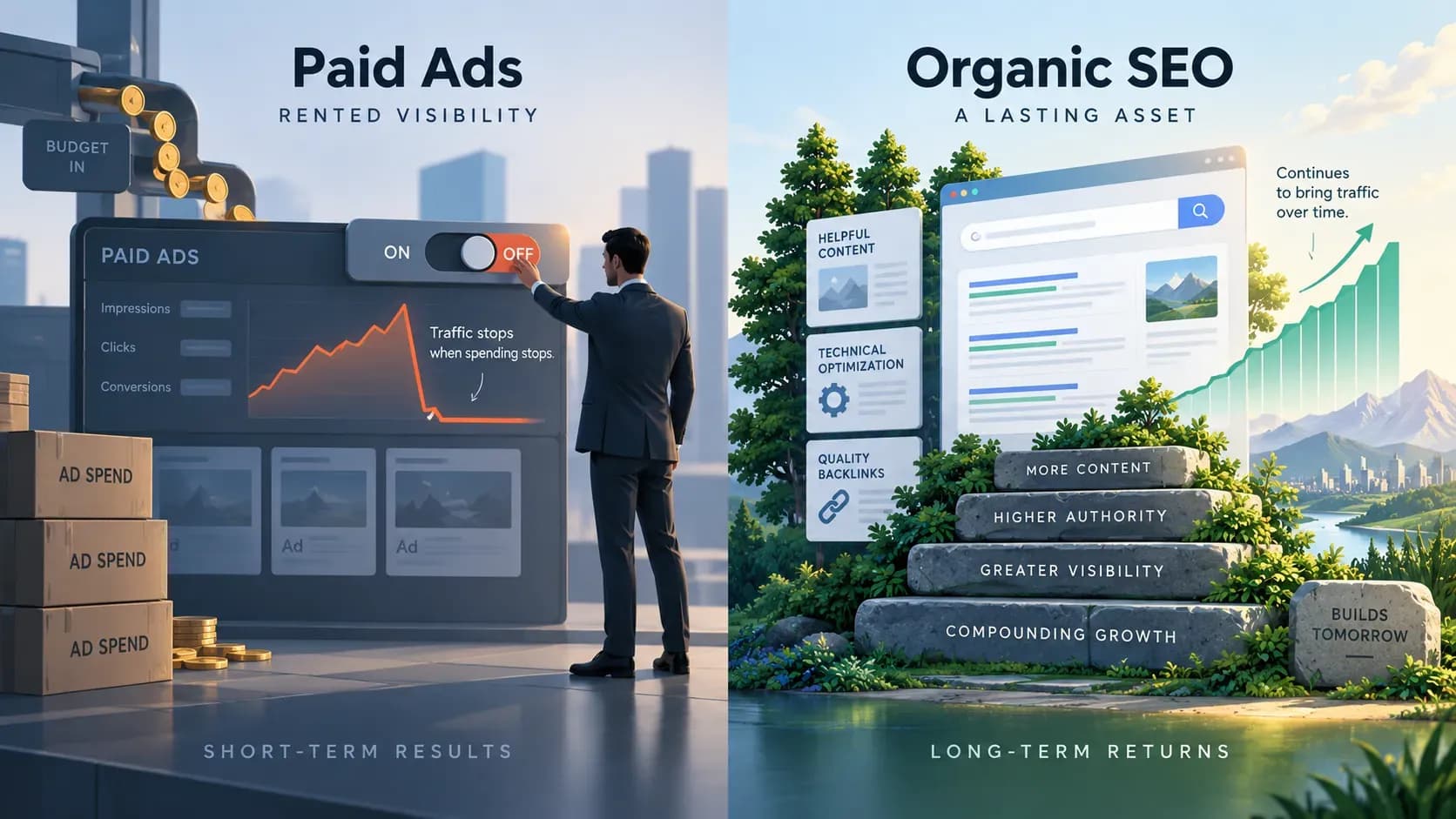
There's a straightforward way to think about the difference between paid advertising and organic search visibility. Switch off a paid campaign and the traffic stops immediately, completely, and with no residual effect. The visibility existed only while the budget was running and leaves nothing behind when it stops. Switch off an SEO programme and the traffic continues, declining gradually over time as the content ages and the competitive landscape shifts, but not stopping. The visibility that was built persists because it was built rather than rented.
This distinction sounds simple but has significant implications for how businesses should think about where their marketing investment goes and what they're actually buying with it. Paid advertising buys attention for a defined period. SEO builds an asset that continues to generate returns after the active work that created it has stopped.
The Fundamental Difference between Paid and Organic Visibility
The economics of paid advertising are straightforward and, for most businesses in competitive markets, increasingly uncomfortable. You pay for each click. The cost per click in most categories has increased consistently as more businesses compete for the same search real estate. The traffic you buy is worth exactly what you paid for it and nothing more. Stop paying and the traffic disappears. Start paying again and it returns, at whatever the current market rate happens to be.
The economics of organic search work differently, and the difference becomes more pronounced the longer the comparison is extended. The work done to improve a website's organic ranking, the content created, the technical improvements made, the authority built through links and consistent presence, doesn't expire at the end of a billing cycle. A piece of content that ranks well for a relevant search term continues to generate traffic for months or years after it was written. The technical improvements that helped the site get indexed and ranked correctly continue to benefit the site indefinitely. The backlinks that contributed to the site's authority continue to count.
The result is that the cost per acquisition from organic search typically improves over time as the cumulative work of previous periods continues to generate returns, while the cost per acquisition from paid advertising stays flat or increases as competition for paid placements intensifies. Businesses that have been investing in organic visibility for several years are acquiring customers at a cost that earlier periods of investment have helped drive down. Those relying entirely on paid advertising are paying the current market rate for every customer, every time.
What Building Organic Visibility Actually Involves
The reason paid advertising remains dominant in many businesses' marketing mix despite its structural limitations is that it's immediate and it's legible. You set a budget, you run ads, you can see traffic arrive and attribute it directly to the spend. The feedback loop is fast and the causality is clear.
SEO works on a longer timeline and the causality is less immediately visible, which makes it harder to justify to stakeholders who want to see results in the current quarter. A piece of content published today may not rank well for several months. A technical improvement may not produce measurable ranking movement for weeks. The backlinks acquired through a content programme compound over time rather than producing a single identifiable outcome.
This is what makes engaging a Sydney SEO professional such as SIXGUN a different kind of investment from running a paid campaign. The expertise being applied goes toward an asset that belongs to the business, builds over time, and continues generating returns after the engagement has ended. The work is harder to attribute to a specific week's traffic than a paid ad is, but the cumulative return over a twelve-month period typically exceeds what the equivalent paid budget would have produced, and unlike paid traffic, it doesn't stop when the investment does.
What the work actually involves is a combination of technical optimisation that makes the site easy for search engines to crawl and assess, content creation that addresses the specific searches that potential customers are making, and authority building that signals to search engines that the site is a credible and relevant source for those searches.
Each of these elements reinforces the others, and the compounding of all three over time is what produces organic visibility that paid advertising structurally cannot replicate.
Why the Compounding Effect Is the Real Argument
The most compelling case for organic search investment isn't the cost per acquisition comparison, although that comparison typically favours SEO over a long enough time horizon. It's the compounding effect that distinguishes organic visibility from every other marketing channel.
A business that has been consistently investing in SEO for three years has three years of content that continues to rank, three years of authority signals that continue to accumulate, and three years of technical improvements that continue to benefit the site. Its organic visibility isn't just better than it was three years ago. It's better than it was one year ago, and it's better than it would have been if the investment had started one year ago rather than three. The returns compound because the asset being built compounds.
This compounding dynamic means that the businesses that started early are pulling further ahead every month, not just maintaining a lead. The business that waited until it was ready to invest in organic visibility is not just behind where it would have been if it had started earlier. It's behind a competitor whose organic authority has been building for the entire period the late mover was waiting, and that gap takes time to close even with significant investment.
The businesses that understand this and act on it early are making a decision that rewards them disproportionately over time compared to those that keep the marketing budget in paid channels where the returns reset every billing cycle.
Why Starting Now Beats Waiting Until Ready
The most common reason businesses delay investing in organic visibility is that they're waiting until the website is better, until the team has capacity, until the market is clearer, or until results from paid advertising have funded the organic investment. These are understandable reasons that all have one thing in common: they delay the start of the compounding clock.
Every month that passes without organic visibility investment is a month of compounding returns that won't be recovered. A business that starts now and produces modest results in the first six months is still further ahead than one that waits another six months and then starts. The early results aren't the point. The asset being built through those early months, the content indexed, the authority signals beginning to accumulate, the technical foundation being established, is the point.
The businesses building online visibility that outlasts any ad campaign are the ones that understood this early enough to act on it. The ones that are still relying on paid advertising for all of their search visibility are not in a stable position. They're renting visibility at a price that will keep increasing, from a landlord who can raise the rent or remove the property whenever market conditions change.