On this page
8 best competitor analysis tools in 2026, and when each one earns its seat

WebbyCrown Solutions-
August 27, 2026-11 min read
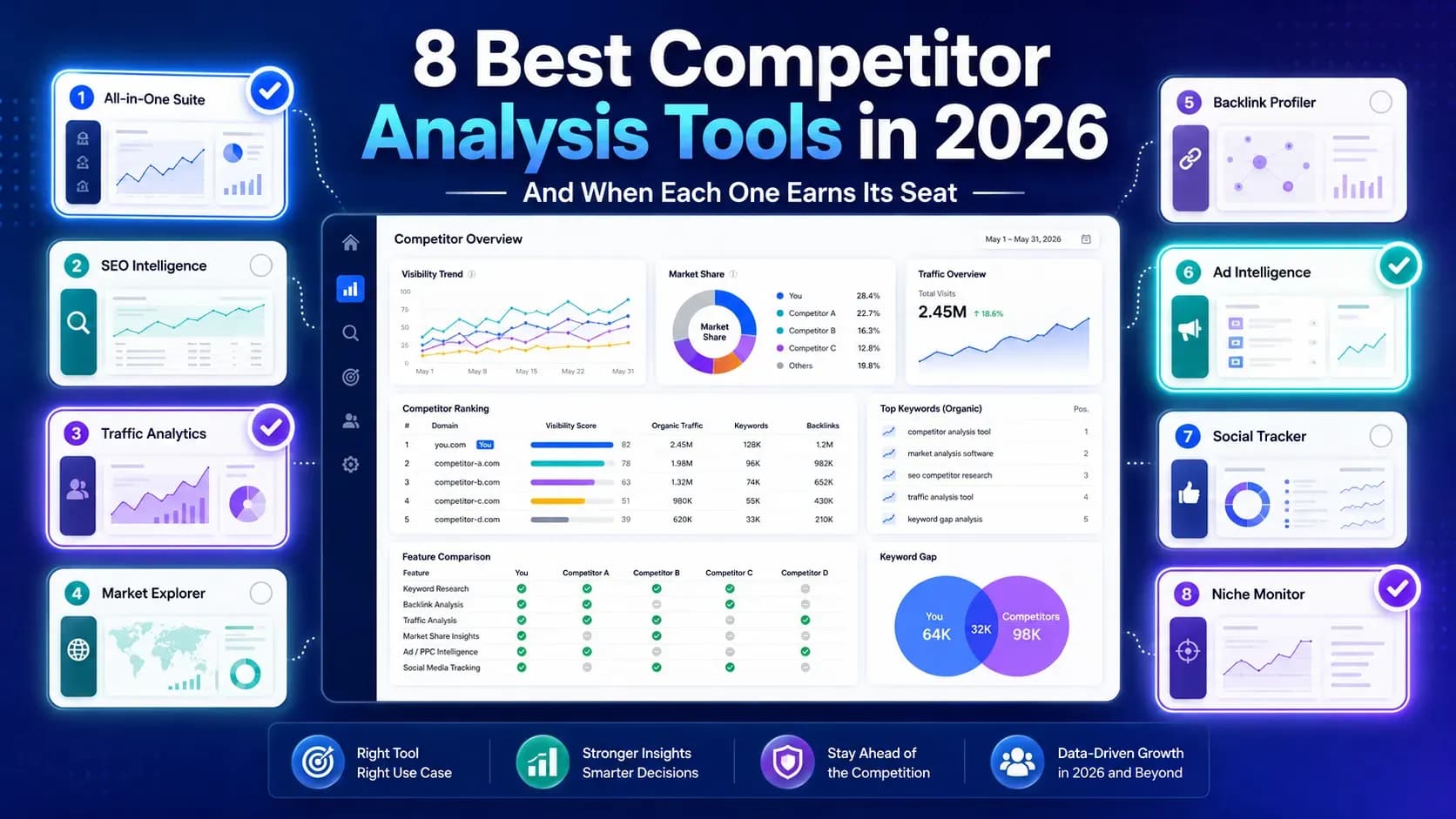
Last Tuesday an account lead pinged me before standup: a client's rival had quietly climbed past them, and she wanted to know how. The honest answer is that no single screen tells you - which is what competitor analysis tools are for, pulling organic rankings, paid activity, and who's named in AI answers into one view. That last piece is new. Per Pew Research Center (2025), people ended their search session on 26% of pages that showed an AI summary, versus 16% without one - so a rival can win the answer before anyone clicks.
For most teams, SE Ranking is where I'd start: one tool covers organic, PPC, and AI-answer competitor data, so you're not stitching four exports together every Monday. Seeing a rival's traffic picture in one place is often the fastest honest answer for a client. One caveat: if you need the deepest backlink index or a decade of ad history, a specialist goes deeper on that.
Here's what I actually weighed before ranking anything:
- Coverage across organic, paid, and AI answers
- Gap analysis you can actually action
- Reporting a client will read
- A fair per-seat cost as the roster grows
- Realistic setup time
I ran each against the same three client accounts, and every figure comes straight from each vendor's own pricing pages.
The eight tools at a glance
| Tool | What it's best at | Team-size fit | AI search | Starts at |
|---|---|---|---|---|
| 1. SE Ranking | All-in-one: organic + PPC + AI answers | Agencies + in-house, any size | 5 engines | $129/mo |
| 2. Ahrefs | Backlink + keyword index | Mid-to-large teams | Brand Radar | $129/mo (Lite) |
| 3. Semrush | Broad all-rounder | Larger teams already on Semrush | 4 engines | $139/mo |
| 4. Similarweb | Traffic + market sizing | Strategy / planning teams | AI Search Intelligence | ~$125/mo |
| 5. SpyFu | Paid-search history | PPC-led teams | Pro + AI tier | $39/mo |
| 6. Serpstat | Most of the workflow in one login | Scaling mid-market | LLM Brand Monitor | $50/mo |
| 7. Moz Pro | Authority benchmarking | Teams validating real rivals | AI Overviews by keyword | $99/mo |
| 8. seoClarity | Enterprise share-of-voice | Large in-house teams | At scale | ~$750/mo |
What competitor analysis actually tells you
Strip away the dashboards and SEO competitor analysis comes down to two questions: where are your rivals getting seen, and where are you missing? Visibility shows up in a few places now - the keywords they rank for, the links to them, the ads they buy, and the AI answers that name them. Here's the thing - the value isn't what they're doing; it's the gap between their footprint and yours, and which one to close first.
8 best competitor analysis tools, ranked
1. SE Ranking
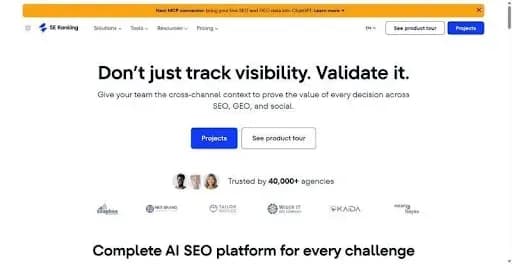
One platform that pulls a rival's organic, paid, and AI-answer picture from a single lookup, so your whole team works from one dataset.
- Best for: Agency and in-house teams who are tired of stitching three subscriptions together and want everyone (strategist, analyst, account lead) reading the same numbers.
- Standout: Type in one domain and you get Google organic, PPC, and presence across five AI engines (AI Overviews, AI Mode, ChatGPT, Gemini, Perplexity) with no project setup first. Add competitor identification, keyword gap, and backlink competitor analysis, plus history back to February 2020, and a first meeting stops being a scramble.
Pros:
- Returns organic, paid, and AI-answer data from a single search.
- Includes API and MCP in every plan, so your data team isn't blocked.
- Covers AI Competitive Research across 5 domains (Core) or 15 (Growth).
Cons:
- Figures are estimates and depend on database coverage.
- A rival outside the database needs a manual "Expand Database" request.
- Pricing: Core $129/mo ($103.20/mo billed annually), Growth $279/mo ($223.20/mo annually); 14-day trial, no card.
- My take: When you're running competitor analysis across a portfolio, the win is one place to look, not the lowest line item. This is the platform I'd hand a new hire on Monday and trust them to brief a client by Thursday. See how the full traffic picture comes together.
2. Ahrefs
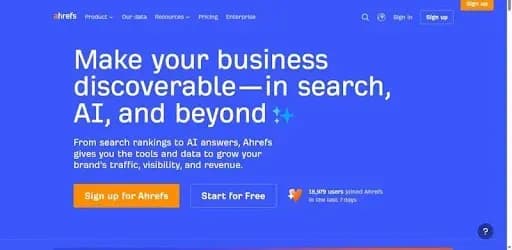
The backlink-and-keyword index most teams reach for when link data quality is the thing they can't compromise on.
- Best for: Teams whose competitor research lives or dies on link intelligence, and who want a clean read on where rivals earn authority.
- Standout: Site Explorer breaks down a competitor's backlinks, organic keywords, top pages, and traffic in one view, and Content Gap surfaces the terms rivals rank for and you don't. You can track up to 20 competitors per project (100 on Enterprise), while Brand Radar and Custom Prompts read AI-answer presence.
Pros:
- Surfaces high-confidence backlink and referring-domain data.
- Finds ranking gaps you can actually build a brief around.
- Tracks AI-answer visibility through Brand Radar.
Cons:
- No free trial, so you commit before you test.
- Competitor tools aren't on Starter at all.
- Pricing: Starter $29/mo (no competitor tools), Lite $129/mo, Standard $249/mo; annual saves roughly 17%. Lite is the real entry point.
- My take: If someone on your team obsesses over link quality, they'll be happy here. Just know the competitor toolkit you actually want starts at Lite, so price the plan you'll use, not the headline tier that leaves the good parts locked.
3. Semrush
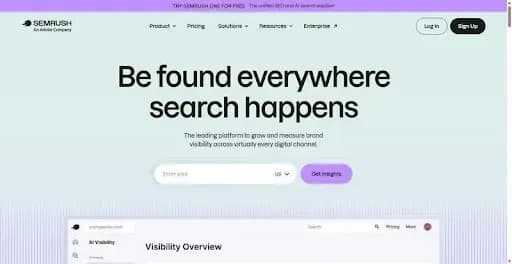
The broad all-rounder that makes sense when your team already lives inside its ecosystem day to day.
- Best for: Larger teams that have standardized on Semrush and want competitor research sitting next to everything else they already run.
- Standout: Domain Overview, Keyword Gap, Backlink Gap, and Traffic & Market give you a wide-angle read on any rival, and AI-search tracking now ships in every 2026 plan with custom prompts across Google AI, ChatGPT, Perplexity, and Gemini. It's a lot of surface area under one login.
Pros:
- Covers organic, paid, and market gaps in depth.
- Includes AI-search tracking in every current plan.
- Fits neatly if your workflows already sit here.
Cons:
- The bill climbs fast as you move up the AI tiers.
- Per-plan seat limits pinch a growing team.
- Pricing: SEO plan $139/mo; higher AI-search tiers run $199–$549/mo.
- My take: There's real breadth here, and if your team already knows the interface, switching costs you hours you don't have. Watch the seat limits and the jump to AI tiers, though, because a growing team can outrun the plan faster than the finance conversation moves.
4. Similarweb
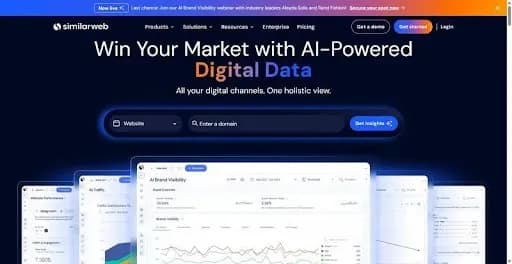
The traffic-and-market view for sizing a rival's whole audience, not just the keywords they happen to rank for.
- Best for: Strategy and planning teams who need to size a competitor's total footprint before a pitch or a market-entry call.
- Standout: It estimates total traffic, channel mix, and audience overlap across web and app, so you see how a rival actually earns attention. A separate AI Search Intelligence product layers on brand visibility, tracked prompts, and citation and sentiment inside AI answers.
Pros:
- Sizes total audience and channel mix, not just search.
- Reveals audience overlap you'd otherwise guess at.
- Adds AI-answer visibility through a dedicated product.
Cons:
- Keyword and SEO depth is lighter than SEO-native tools.
- Most pricing sits behind a sales quote.
- Pricing: From ~$125/mo (billed annually), mostly quote-based above that; AI Search Intelligence from ~$99/mo (annual), approximate.
- My take: When the question is "how big is this rival, really," this is the market lens I'd bring to a planning session. Just pair it with an SEO-native tool for the keyword-level competitor research work, and budget time for the quote dance before you can actually buy.
5. SpyFu
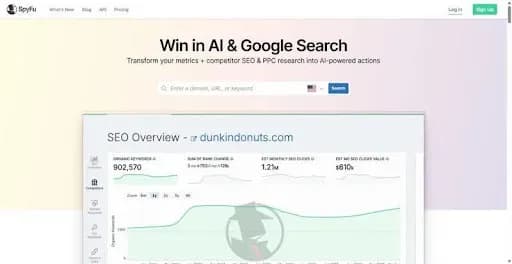
The paid-search specialist you reach for when you want to read a rival's ad history before you pitch a PPC plan.
- Best for: Teams building paid-search strategy from a competitor's own playbook.
- Standout: SpyFu keeps more than a decade of competitors' ad copy and paid-keyword history, so you can see what a rival has tested, kept, and quietly dropped. The Kombat tool lines your domain up against two rivals on every tier, and organic ranking history sits right alongside the paid view.
Pros:
- Surfaces years of ad-copy history in one place.
- Compares three domains at once, even on entry plans.
- Pairs paid and organic signals for a fuller picture.
Cons:
- Data skews US-centric.
- Backlink coverage is lighter than the index-led tools.
- Pricing: Basic $39/mo, Pro + AI $119/mo, Team/Agency $249/mo.
- My take: When a client's growth story is really a paid-search story, SpyFu earns its place. I'd lean on it for that, then borrow organic and backlink depth from elsewhere. If your accounts run outside the US, sense-check the coverage before you build a plan on it.
6. Serpstat
The coverage-over-polish pick that hands a growing team most of the workflow inside a single subscription.
- Best for: Teams that want breadth of functions without stacking separate tools.
- Standout: Serpstat runs Domain vs Domain comparison, missing-keyword and gap analysis, competitor backlinks, and rank tracking together. API and MCP access for ChatGPT and Claude open up from the $100/mo Team tier, and a separate LLM Brand Monitor tracks how AI models describe brands, so the AI layer is there when you want it.
Pros:
- Bundles gap, backlink, and rank tracking in one login.
- Opens API and MCP access from the Team tier.
- Adds AI-answer monitoring as its own module.
Cons:
- The index feels rougher than the leaders.
- AI monitoring is a deliberate add-on, not baked in.
- Pricing: Individual $50/mo, Team $100/mo, Agency $410/mo.
- My take: Serpstat gives you a lot of the workflow for one subscription, which I like when a team is scaling and wants fewer tabs open. Just go in knowing the data is a touch coarser, and treat the AI monitoring as a choice you make on purpose.
7. Moz Pro
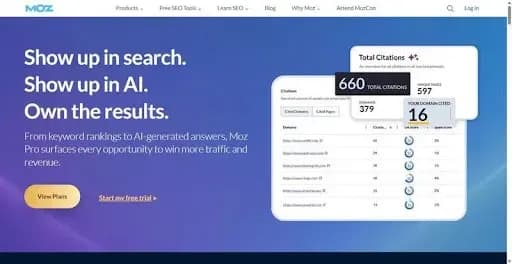
The authority-benchmarking pick for when you want to confirm who genuinely competes with you before you spend a budget chasing them.
- Best for: Teams validating their real SERP rivals and authority position.
- Standout: True Competitor surfaces the domains that actually overlap with you in the SERP, which quietly settles a lot of internal debates. You also get keyword and content gap analysis, Domain Authority and Brand Authority as familiar benchmarks, and AI Overviews reported by keyword.
Pros:
- Identifies genuine SERP overlap, not assumed rivals.
- Reports AI Overviews at the keyword level.
- Anchors conversations in recognized authority metrics.
Cons:
- Smaller index than the leaders.
- Fewer PPC and ad signals.
- Pricing: Standard $99/mo, or $79/mo billed annually (reported - confirm on Moz's site).
- My take: I reach for Moz when a client insists they compete with a name that the data just doesn't back up. True Competitor and the authority scores make that a short, evidence-led conversation. For paid and ad depth, though, you'll want a second tool alongside it.
8. seoClarity
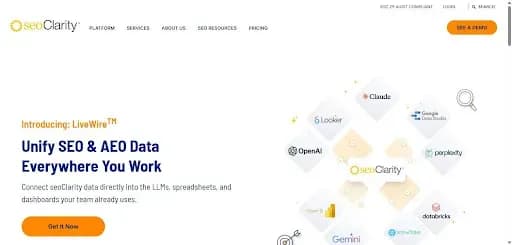
The enterprise option for teams running share-of-voice across thousands of terms with named analyst support behind the platform.
- Best for: Large in-house teams operating at real keyword scale.
- Standout: The Research Grid holds one of the largest datasets in the category, which matters when you're tracking share-of-voice, keyword gaps, and content gaps across thousands of terms at once. Named analyst support and custom dashboards mean the platform bends to how your team already reports, rather than the other way round.
Pros:
- Scales share-of-voice across enormous keyword sets.
- Pairs the platform with named analyst support.
- Builds custom dashboards around your reporting.
Cons:
- Enterprise-only pricing.
- Onboarding takes real time.
- Pricing: Enterprise/custom, reported from roughly $750/mo, quote-based (seoClarity does not publish prices).
- My take: seoClarity is built for scale most teams never reach, and that's the point. If you're tracking thousands of terms and want a human analyst in the loop, it's a serious fit. If you're not yet at that volume, the platform and the onboarding will outpace your needs.
The verdict
Here's how I'd think about it across a portfolio. If you want one tool covering organic, paid, and AI answers without juggling four logins and four invoices, SE Ranking is where we'd start. Its coverage is broad enough for most client work, and because API and MCP feed data straight into reports, your team skips the manual export grind that eats a strategist's afternoon.
Skip if: Don't buy an enterprise platform for a small in-house team that'll use a fraction of it, and don't run two broad suites that overlap - you'll pay twice for the same view and confuse everyone reading the reports.
Match the tool to how your team actually works, and competitor analysis stops being a chore and starts shaping the plan.
FAQs
Q1.
Which competitor analysis tool covers the most ground in one platform?
Q2.
Can one tool cover SEO, PPC, and AI-answer competitor analysis?
Q3.
How much should a team budget for competitor analysis tools?
Q4.