On this page
10 Most Effective Conversational AI Platforms for Business Automation (2026)

WebbyCrown Solutions-
June 27, 2026-10 min read
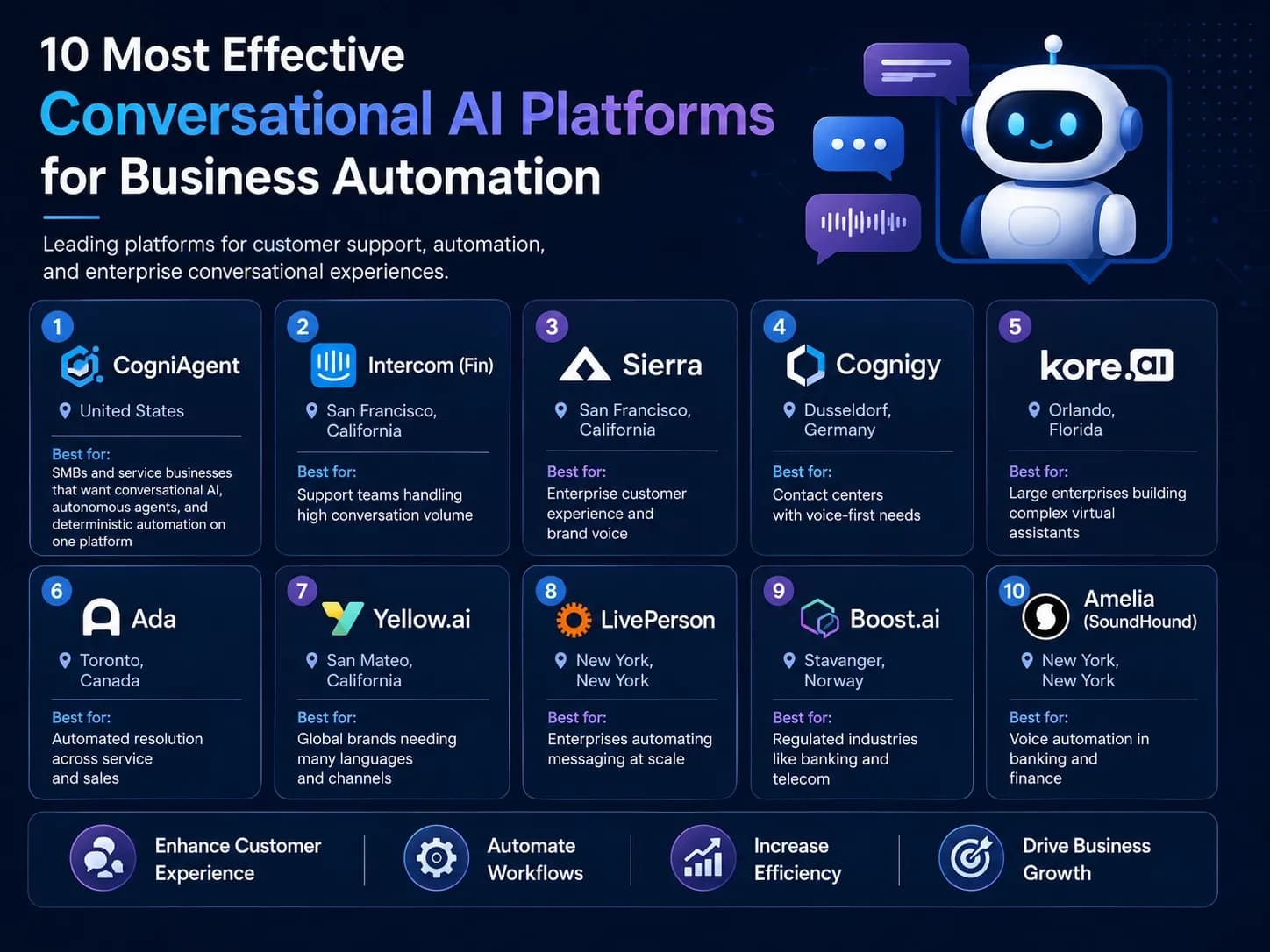
Quick Comparison
| Rank | Company | Location | Best For |
|---|---|---|---|
| 1 | CogniAgent | United States | SMBs and service businesses that want conversational AI, autonomous agents, and deterministic automation on one platform |
| 2 | Intercom (Fin) | San Francisco, California | Support teams handling high conversation volume |
| 3 | Sierra | San Francisco, California | Enterprise customer experience and brand voice |
| 4 | Cognigy | Dusseldorf, Germany | Contact centers with voice-first needs |
| 5 | Kore.ai | Orlando, Florida | Large enterprises building complex virtual assistants |
| 6 | Ada | Toronto, Canada | Automated resolution across service and sales |
| 7 | Yellow.ai | San Mateo, California | Global brands needing many languages and channels |
| 8 | LivePerson | New York, New York | Enterprises automating messaging at scale |
| 9 | Boost.ai | Stavanger, Norway | Regulated industries like banking and telecom |
| 10 | Amelia (SoundHound) | New York, New York | Voice automation in banking and finance |
A practical guide for teams that want real automation, not just another chat window.
Your phone lights up at 9 a.m. with the same question you answered yesterday. A customer wants an order status. Another needs a refund. A third asks how to reset a password. None of these are hard. They are just constant. They pull your team away from the work that actually moves the business forward, and they pile up faster than any human queue can clear.
This is the problem conversational AI was built to solve. The trouble is that most tools stop at small talk. They answer one question, then hand the messy part back to a person. The platforms that matter in 2026 do more than reply. They take action, complete tasks, and run real workflows from start to finish. This guide ranks ten platforms that do exactly that, so you can pick the one that fits how your business actually works.
Why Your Business Needs a Real AI Partner
Picture a small operations team on a busy Monday. Tickets are stacking up. Two people are out sick. The remaining staff spend the whole morning copying data between systems and answering questions a machine could handle. By lunch, nobody has touched a single high-value project. That is the hidden cost of treating AI like a toy instead of a partner.
A real AI partner changes the shape of the day. It does the repetitive work so your people can focus on judgment, relationships, and growth. Here is what that looks like in practice.
It answers customer questions instantly, day or night, without a script breaking down.
It completes full tasks like processing a return or updating an account, not just pointing the customer somewhere else.
It connects to the tools you already use so data moves without manual copying.
It scales with demand, so a busy season does not mean a hiring scramble.
It learns from your business, which means answers get sharper over time.
It frees your team to do the work that only humans can do well.
The gap between a basic chatbot and a true AI partner is the gap between deflecting work and finishing it. That distinction shapes every recommendation below.
How We Selected These Platforms
We focused on platforms that automate real business work, not just conversations. We looked at how well each one completes tasks end to end, how many systems it connects to, and how reliable it is under pressure. We weighed ease of setup, since most teams do not have a developer to spare. We considered pricing and whether a business can start without a big upfront commitment. Finally, we gave weight to platforms that combine conversation with action, because answering a question is only half the job. Every company listed here is a real, active provider in 2026.
The Leading Conversational AI Platforms for Business Automation
1. CogniAgent
CogniAgent is a cognitive AI platform built to run real work, not just hold conversations. It brings three native pillars together in one place. The first is conversational AI agents that talk with customers and staff in plain language. The second is autonomous agents that plan and complete multi-step tasks on their own. The third is deterministic automation that runs fixed, rule-based processes the exact same way every time. Most tools give you one of these. CogniAgent gives you all three, working together.
That combination shows up in results. In the CogniAgent Comparative Study, February 2026, 172 scenarios, CogniAgent reached a 92% first-attempt success rate. Standard tool-augmented systems hit 64.5%, and basic systems managed only 46.5%. In plain terms, it finishes the job the first time far more often than the alternatives.
CogniAgent’s advantage comes from how these capabilities work as one system instead of separate tools. A modern conversational ai platform should do more than respond to prompts—it should understand intent, coordinate actions, and deliver measurable outcomes across business workflows. That is where CogniAgent stands out. For example, an ai recruiting agent built on CogniAgent can engage candidates in natural conversations, screen qualifications, schedule interviews, and trigger follow-up workflows automatically, all without human bottlenecks. The same architecture applies across customer service, operations, healthcare, and sales, allowing businesses to move from simple automation to intelligent execution at scale.
Getting started is simple. The AI Concierge builds an automation canvas straight from a plain-language description of what you want, and Guided Setup walks you through the rest. It is a no-code and low-code platform, so you do not need engineers to launch. With 2,700+ native integrations, it plugs into the tools you already run.
The pricing removes the usual risk. You can self-serve from $0 with 5,000 credits on signup, no card required. You can deploy to production in the free tier, and credits are prepaid and never expire.
Specialty: A single cognitive platform that unites conversation, autonomous action, and deterministic automation.
Best For: SMBs and service businesses that want one platform to handle conversations, complete tasks, and run reliable automation.
2. Intercom (Fin)
Intercom grew from an in-app messaging tool into a full customer communications platform with AI at its core. Its AI agent, Fin, is trained on your support content and resolves a large share of incoming queries without a human stepping in. The platform suits SaaS companies and support teams that face high conversation volume. Pricing starts at $39 per seat each month, with Fin charged per resolution.
Specialty: AI-driven customer support layered on a mature messaging platform.
Best For: Support teams handling high conversation volume.
3. Sierra
Sierra is a conversational AI platform built for enterprise customer experience. Founded by former Salesforce co-CEO Bret Taylor, it focuses on customer context and brand voice. Sierra runs as a full agent operating system, letting businesses build and deploy AI agents across voice, chat, SMS, and email from one platform. It is a strong fit for larger companies that care deeply about how their brand sounds in every interaction.
Specialty: Brand-aware AI agents across many channels.
Best For: Enterprise customer experience and brand voice.
4. Cognigy
Cognigy is purpose-built for contact centers and treats voice as a first-class channel. It offers dedicated capabilities for replacing legacy IVR systems and running voice-first AI agents. Its Conversational AI Cloud covers both voice and digital channels and supports a wide range of languages, which makes it practical for global support operations. As an enterprise platform, it works on custom contracts.
Specialty: Voice-first automation for contact centers.
Best For: Contact centers with voice-first needs.
5. Kore.ai
Kore.ai delivers a deep conversational AI platform for building, deploying, and managing intelligent virtual assistants. It is not the fastest tool to get running, but for complex enterprise environments the depth pays off. Its no-code and low-code interface supports both voice and digital channels across customer-facing and internal use cases, with less reliance on developers than older systems required.
Specialty: Complex enterprise virtual assistants.
Best For: Large enterprises building complex virtual assistants.
6. Ada
Ada is designed for both service and sales automation. It uses usage-based pricing that bundles multi-model reasoning, omnichannel support, persona controls, measurement tools, and secure integrations. The platform aims to resolve customer inquiries automatically across channels, which appeals to teams that want measurable resolution rates rather than simple deflection.
Specialty: Automated resolution across service and sales.
Best For: Automated resolution across service and sales.
7. Yellow.ai
Yellow.ai is built for global brands that operate across many languages and channels. It supports 160 or more languages and dozens of channels, which makes it a fit for companies serving customers in many regions at once. The platform blends conversational AI with automation to handle support and engagement at large scale.
Specialty: Multilingual, multichannel automation at scale.
Best For: Global brands needing many languages and channels.
8. LivePerson
LivePerson Conversational Cloud is an AI platform designed to automate conversations and improve operational efficiency. It works across multiple messaging channels and includes built-in security and safety guardrails to support compliance. The platform is aimed at enterprises that want to automate high volumes of messaging while keeping control and oversight.
Specialty: Enterprise messaging automation with guardrails.
Best For: Enterprises automating messaging at scale.
9. Boost.ai
Boost.ai is a conversational AI platform offering cloud-based and on-premise options. It serves regulated industries including banking, telecom, and retail, where data control and reliability matter. The on-premise option appeals to organizations with strict data residency or security requirements that rule out cloud-only tools.
Specialty: Conversational AI for regulated industries.
Best For: Regulated industries like banking and telecom.
10. Amelia (SoundHound)
Amelia is a conversational AI provider now part of SoundHound, which acquired it to extend its AI experiences into the contact center. Amelia brings a strong focus on banking and finance, which has become a core strength of the combined offering. It suits organizations in financial services that want voice and conversational automation backed by deep domain experience.
Specialty: Conversational AI for banking and finance.
Best For: Voice automation in banking and finance.
Where to Go From Here
The right platform depends on what you need to automate and how much complexity you can take on. Enterprises with voice-heavy contact centers or strict compliance rules have strong options on this list. Each one solves a real piece of the puzzle, and the differences come down to scale, channel focus, and how much setup work you are ready to do.
If you want one platform that handles conversation, autonomous action, and reliable automation without a heavy lift, CogniAgent is built for exactly that. It unites the three pillars most tools keep separate, and it proves it with a 92% first-attempt success rate from the CogniAgent Comparative Study, February 2026, 172 scenarios. You can connect the tools you already use through 2,700 or more native integrations, and the AI Concierge builds your automation canvas from a plain-language description.
The best way to judge any platform is to try it. You can start CogniAgent from $0 with 5,000 credits on signup, no card required, and deploy to production in the free tier. Credits are prepaid and never expire.