On this page
6 Best Next.js eCommerce Templates in 2026: Source Code, Backend & Use Case Compared

WebbyCrown Solutions-
August 20, 2026-13 min read
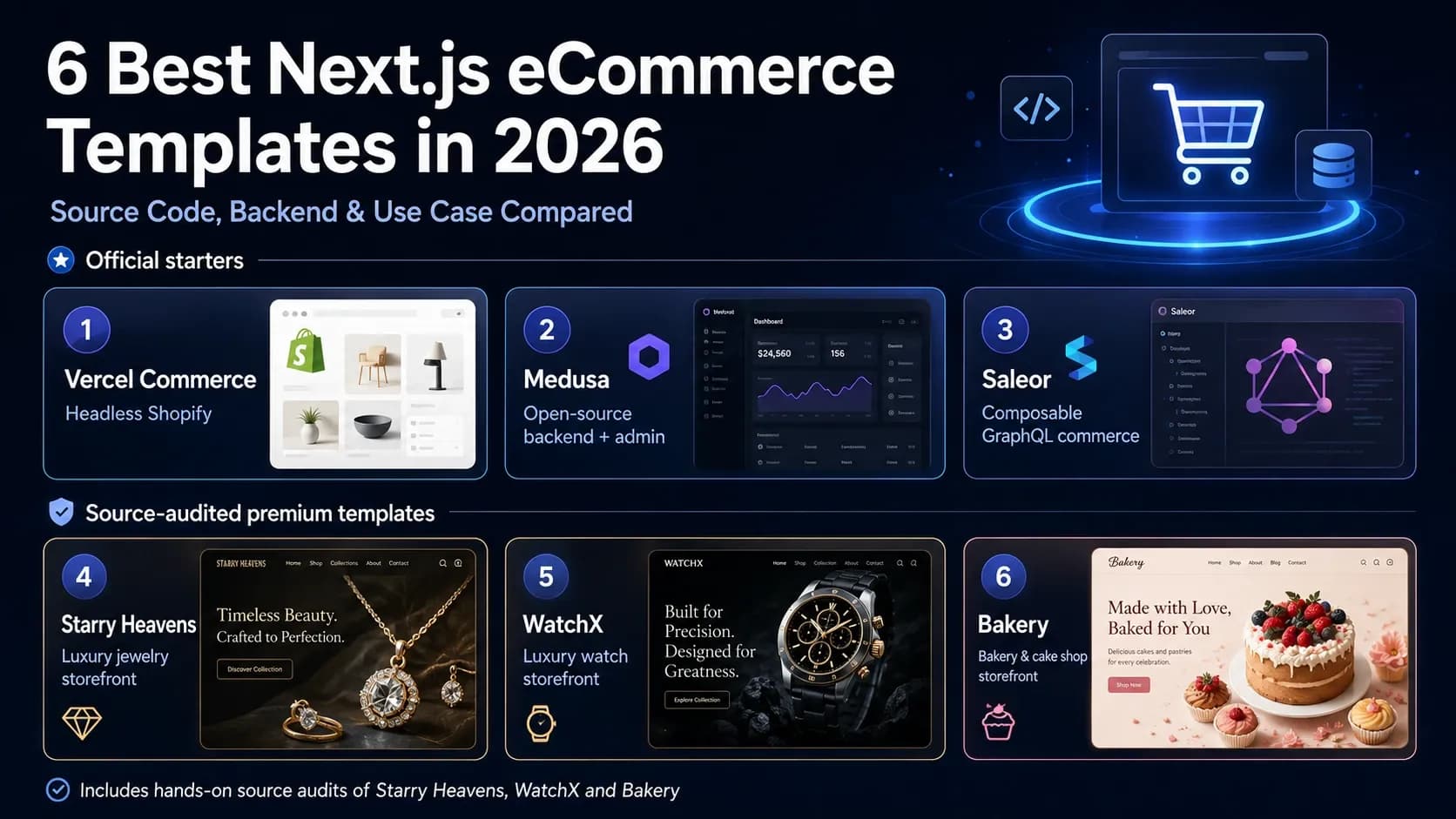
There is no single best Next.js eCommerce template for every store. If you want an integrated headless commerce foundation, Vercel Next.js Commerce, Medusa, and Saleor are stronger starting points because they connect the storefront to a real commerce backend. If you want a niche-specific front end that already includes retail layouts and can be connected to your preferred backend, Starry Heavens, WatchX, and Bakery are more design-focused options. For this 2026 comparison, WebbyTemplate inspected the supplied source code of those three premium templates instead of relying only on product-page claims.
Disclosure: WebbyTemplate publishes this comparison and sells Starry Heavens, WatchX, and Bakery. The three external starters are included because the search intent for “best Next.js ecommerce templates” is broader than one marketplace. We use the same buyer questions across all six options: What is included? Which commerce backend is available? How much front-end work is already done? What still needs engineering?
Key Takeaways
- Choose Vercel Next.js Commerce when Shopify is your commerce engine and you want a headless Next.js storefront.
- Choose Medusa Next.js Starter when you want an open-source commerce backend, admin application, and a Next.js storefront you can customize.
- Choose Saleor Storefront when your project is built around composable GraphQL commerce and a Next.js App Router storefront.
- Choose Starry Heavens when luxury-jewelry page depth and niche-specific storefront UI matter more than having a backend included.
- Choose WatchX when you want a focused watch-store front end; its supplied source uses Next.js 15.0.3 and App Router.
- Choose Bakery when a bakery or food-retail project needs shop, menu, cart, checkout, wishlist, search and content pages in one design system.
- A checkout screen is not proof of a working payment flow. Our source audit found demo/local-state checkout behavior in the three audited premium templates, so each still needs production commerce integration.
Best Next.js eCommerce Templates Compared
| Option | Best for | Type | Commerce/stack signal | Evidence level |
|---|---|---|---|---|
| Vercel Next.js Commerce | Headless Shopify storefront | Official starter / integrated commerce | Next.js storefront connected to Shopify | Not source-audited by WebbyTemplate; verified from Vercel first-party documentation |
| Medusa Next.js Starter | Open-source commerce with backend + admin | Official starter / integrated commerce | Next.js storefront + Medusa backend; Stripe integration supported | Not source-audited by WebbyTemplate; verified from Medusa first-party documentation |
| Saleor Storefront | Composable GraphQL commerce | Official starter / integrated commerce | Next.js App Router + TypeScript + GraphQL + Tailwind CSS | Not source-audited by WebbyTemplate; verified from Saleor first-party documentation |
| Starry Heavens | Luxury jewelry storefronts | Paid source-code storefront template | Next.js 13.5.4; Pages Router; 42 route/page files in supplied source | Source-code audited from user-supplied archive |
| WatchX | Luxury watch and accessory stores | Paid source-code storefront template | Next.js 15.0.3; App Router; 21 route page files in supplied source | Source-code audited from user-supplied archive |
| Bakery | Bakeries, cake shops and cafe retail | Paid source-code storefront template | Next.js 15.1.3 + React 19; App Router; 23 route page files in supplied source | Source-code audited from user-supplied archive |
How We Researched This Comparison
We first checked the current search-results landscape for the primary keyword best Next.js ecommerce templates. Current results are dominated by comparison/list content that mixes open-source starters, full-stack commerce frameworks, headless storefronts, and paid templates. To match that intent without turning this page into a generic roundup, we used two evidence levels: official first-party documentation for Vercel, Medusa, and Saleor, and hands-on source inspection for the three WebbyTemplate products.
The source audit reviewed package versions, routing model, page/route inventory, cart handling, checkout behavior, metadata implementation, product-data approach, and the presence of robots or sitemap files. We did not run equivalent production performance benchmarks, security audits, or accessibility conformance audits, so this article does not publish unsupported performance scores or “production-ready” guarantees.
What “Next.js eCommerce Template” Actually Means
The phrase covers two very different products. An integrated commerce starter connects a Next.js storefront to a commerce engine that manages products, customers, inventory, checkout, payments, and orders. A front-end storefront template gives you ready pages, components, layouts, cart UI, and checkout UI, but leaves the backend integration to your development team.
That distinction explains why Vercel’s eCommerce template directory includes starters for Shopify, Medusa, Saleor, BigCommerce, Stripe and other backends, while a marketplace template may focus primarily on the customer-facing experience. Neither approach is automatically better; they solve different parts of the project.
1. Vercel Next.js Commerce — Best for Headless Shopify
Vercel Next.js Commerce is the strongest fit in this comparison when Shopify is already your source of truth for products, inventory and checkout, but you want a custom Next.js storefront. Vercel currently describes its commerce starter as a high-performance Next.js storefront for Shopify.
This option reduces the gap between a front-end template and a working commerce system because the backend relationship is part of the starter’s purpose. It is a better starting point than a UI-only template when your launch requirement is “Shopify backend, custom Next.js front end.”
It is not the best choice when your priority is a highly specific visual niche such as jewelry or bakery retail and you want that design work prebuilt.
2. Medusa Next.js Starter — Best Open-Source Backend + Storefront
Medusa Next.js Starter Medusa’s official Next.js Starter Storefront is designed to run with a Medusa application. Medusa documentation shows a backend application, admin dashboard, Next.js storefront, and support for a Stripe module provider.
This makes Medusa fundamentally different from a front-end-only store template: product and commerce operations have a defined backend system rather than being represented only by demo JSON or browser state.
The trade-off is engineering scope. A Medusa build gives you more commerce infrastructure, but setup, deployment, data modeling, integrations, and ongoing maintenance are larger than simply customizing a front-end theme.
3. Saleor Storefront — Best for Composable GraphQL Commerce
Saleor Storefront Saleor’s current storefront documentation describes a Next.js application, and its quickstart identifies App Router, TypeScript, GraphQL, and Tailwind CSS as the storefront stack.
Choose Saleor when GraphQL-first, composable commerce is a deliberate architectural choice. It is especially relevant for teams that want the storefront and commerce platform separated but still need a real checkout and commerce API behind the UI.
It is more architecture-heavy than a niche storefront template and may be excessive for a small store that mainly needs a polished front end and simple hosted commerce integration.
4. Starry Heavens — Best for Luxury Jewelry Storefront Depth
Starry Heavens is a paid jewelry eCommerce storefront sold on WebbyTemplate. Its current listing highlights luxury-jewelry shopping layouts, while the supplied source archive allowed us to verify the implementation beyond the listing.
The audited package declares Next.js 13.5.4 and React 18.2, uses the Pages Router, and contains 42 page files excluding framework files such as _app and _document. Cart behavior uses react-use-cart, and much of the storefront content is loaded from JSON files. The checkout contains billing and payment-method UI, including card, Google Pay and cash-on-delivery choices, but we did not find a production payment transaction or order-processing backend in the supplied checkout implementation.
The project does include a canonical link in _app and a route-based SEO configuration, but metadata is also updated on the client. We found no dedicated robots or sitemap file in the supplied project. That makes Starry Heavens a deep visual/storefront foundation, not a finished commerce backend or finished technical-SEO implementation.
5. WatchX — Best for Luxury Watch Stores
WatchX is a focused premium storefront for watch brands and luxury-accessory sellers. The current product page advertises product catalogues, filtering, cart, wishlist, checkout, accounts and blog layouts; our source audit confirms a substantial front-end project.
The supplied package declares Next.js 15.0.3 with React 18.3.1 and uses the App Router. We counted 21 route page files, including shop, product, dynamic product, cart, checkout, wishlist, account, category and blog routes. Product data is fetched from local JSON, and cart behavior uses react-use-cart.
The checkout form validates customer fields, stores cart details in localStorage, empties the cart and redirects to a thank-you page. We did not find a live payment gateway, inventory service or order API in that flow. Metadata is changed client-side through a HeadMeta component, and we found no dedicated robots or sitemap file. WatchX therefore gives developers strong niche UI coverage, but production commerce and technical SEO still need implementation work.
6. Bakery — Best for Bakery, Cake Shop and Cafe Retail
Bakery is the most niche-specific option here for cake shops, bakeries, cafes and food sellers. Its first-party listing includes product, menu, cart, checkout, wishlist, search, blog, portfolio, team and contact layouts.
The supplied source declares Next.js 15.1.3 with React 19 and uses the App Router. We counted 23 route page files, including product, dynamic product, category, search, shop, menu, cart, checkout, wishlist and account-related routes. Cart state uses react-use-cart.
The checkout stores order/cart information in localStorage and redirects to a thank-you page rather than calling a payment or order backend. Metadata is updated client-side through HeadMeta, no dedicated robots or sitemap file was found, and the root layout contains a two-second preloader before the main storefront renders. Those findings do not make the template unusable; they identify the production work a developer should plan before launch.
Source-Code Audit: What We Verified in the 3 Premium Templates
| Template | Framework | Router | Routes | State/data | Checkout | SEO | Crawl files |
|---|---|---|---|---|---|---|---|
| Starry Heavens | Next.js 13.5.4 / React 18.2 | Pages Router | 42 page files | react-use-cart + JSON data | Payment UI; no production payment/order backend found | Route SEO config + canonical; client metadata | No dedicated robots/sitemap found |
| WatchX | Next.js 15.0.3 / React 18.3.1 | App Router | 21 route pages | react-use-cart + local JSON | localStorage + thank-you redirect; no payment/order API found | Client HeadMeta/useEffect | No dedicated robots/sitemap found |
| Bakery | Next.js 15.1.3 / React 19 | App Router | 23 route pages | react-use-cart | localStorage + thank-you redirect; no payment/order API found | Client HeadMeta/useEffect | No dedicated robots/sitemap found |
The source audit changes the conclusion in a useful way: page count alone is not a good proxy for commerce completeness. All three premium projects provide meaningful storefront work, but their current checkout behavior is demo/front-end behavior rather than a completed payment, inventory, and order-management stack.
What the Source Audit Revealed About SEO Readiness
Next.js gives developers framework tools for production SEO, including the Metadata APIs and built-in image optimization. But using Next.js does not automatically mean a purchased template has finished metadata, canonical, sitemap, robots, structured-data, or product-indexation logic.
In WatchX and Bakery, the supplied HeadMeta component changes the document title and description from a client component. Starry Heavens has a route SEO configuration and a canonical link in _app, but also updates metadata through client-side code. We did not find dedicated robots or sitemap files in any of the three supplied archives. Before launch, developers should move production metadata into the appropriate framework-supported pattern, generate the crawl/index files the project actually needs, and connect category and product pages to durable backend data.
WebbyTemplate Inventory Context
In the WebbyTemplate Website Template Statistics 2026 report, Next.js represented 27 of 100 eligible listings (27%) in the August 2026 first-party inventory snapshot. That is a WebbyTemplate inventory statistic, not a claim about global Next.js market share.
For this article, we deliberately did not link every Next.js product or every category page. Only the three source-audited product pages are linked in the comparison. The planned Next.js category URL is omitted until the new category is live and confirmed indexable under WebbyTemplate’s current category rules.
How to Choose the Right Next.js eCommerce Template
1. Decide whether you need a backend or only a storefront. If you need product management, inventory, orders and payments out of the box, start with an integrated commerce platform/starter.
2. Match the visual niche only after architecture. A jewelry template can save design time, but it does not replace Shopify, Medusa, Saleor or another commerce engine.
3. Check the router and framework version. App Router vs Pages Router affects how your team will implement metadata, data fetching and future upgrades.
4. Verify checkout behavior in source code. A “Place Order” or “Order Now” button can still be demo-only.
5. Check product data and persistence. Local JSON and browser state are useful for demos but usually need replacement for a live catalog.
6. Review technical SEO before launch. Confirm metadata, canonicals, sitemap, robots, structured data, crawlable category/product URLs and image handling.
7. Test the actual package. Use WebbyTemplate’s website template testing guide for a broader pre-purchase QA process.
Which Option Is Best for You?
| Your priority | Best starting point | Why |
|---|---|---|
| Shopify backend + custom Next.js storefront | Vercel Next.js Commerce | Backend relationship is part of the starter. |
| Open-source backend, admin and storefront | Medusa | Commerce application and storefront work together. |
| GraphQL-first composable commerce | Saleor | Dedicated composable backend + Next.js storefront. |
| Luxury jewelry UI | Starry Heavens | Deep niche storefront coverage; backend required. |
| Luxury watch retail UI | WatchX | Focused watch-store routes and UI. |
| Bakery/cafe retail | Bakery | Food-specific menu + shop layouts. |
FAQs
Q1.
What is the best Next.js eCommerce template in 2026?
Q2.
Are WebbyTemplate Next.js eCommerce templates full eCommerce backends?
Q3.
Which audited template uses the newest Next.js version?
Q4.
Do the audited templates use App Router?
Q5.
Can these storefront templates connect to Shopify, Medusa or Saleor?
Q6.
Does using Next.js automatically make an eCommerce template SEO-friendly?
Q7.
Should I choose a template with the most pages?
Final Verdict
For the broad keyword “best Next.js ecommerce templates,” a useful comparison has to separate complete commerce starters from front-end storefront templates. Vercel Next.js Commerce, Medusa and Saleor provide stronger backend-connected starting points. Starry Heavens, WatchX and Bakery provide more niche-specific design and storefront coverage, with the trade-off that a development team must connect real commerce services and finish production SEO.
If your goal is fastest visual implementation, choose the niche template closest to your store. If your goal is fastest route to functioning commerce, choose the backend architecture first and the storefront design second.
Sources and Research Scope
- Vercel eCommerce Templates — official marketplace/starter descriptions.
- Medusa Next.js Starter Storefront — official storefront and backend setup documentation.
- Saleor Storefront Quickstart — official Next.js storefront stack and setup documentation.
- Starry Heavens, WatchX and Bakery — current WebbyTemplate product pages plus source archives supplied for this review.
- Next.js Metadata documentation and Image Optimization documentation.
- WebbyTemplate Website Template Statistics 2026 — first-party inventory context.
Research limitation: WebbyTemplate performed source-level inspection of the supplied Starry Heavens, WatchX and Bakery archives, but did not run equivalent production builds, security audits, accessibility conformance audits, or performance benchmarks across all six options. Vercel, Medusa and Saleor were verified from their current first-party documentation rather than independently source-audited for this article. Prices are omitted because they can change independently of the comparison.