On this page
How to Preserve Organic Traffic When Changing Web Templates

WebbyCrown Solutions-
July 30, 2026-6 min read
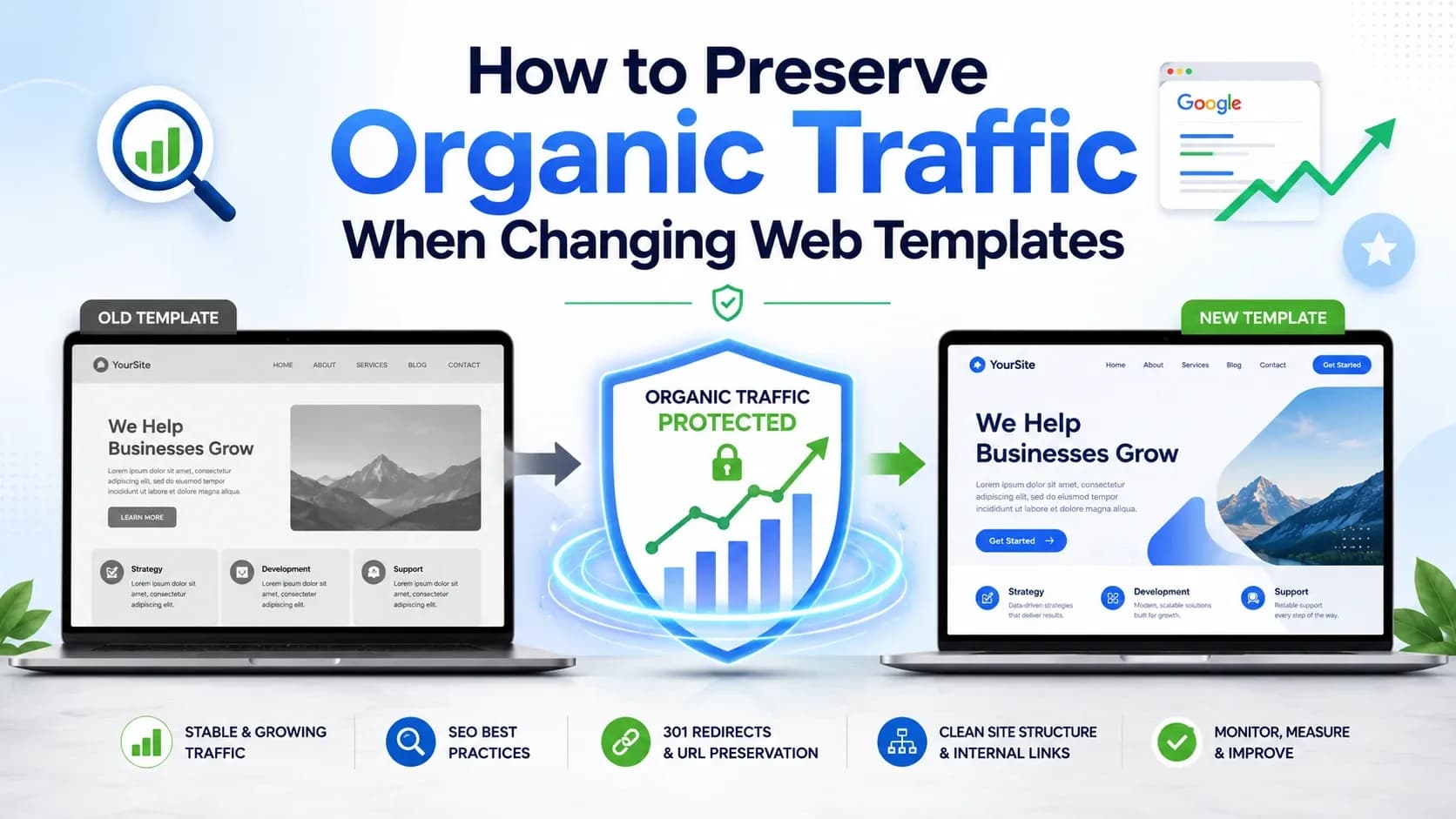
[Changing your website template](https://www.webbytemplate.com/blog/website-templates-vs-custom-design/ can refresh your brand and improve the overall user experience. A modern design often creates stronger first impressions and encourages visitors to stay longer.
According to Forbes, business websites involve three main expenses, namely initial creation, monthly hosting, and yearly maintenance costs. Building the site yourself costs up to $450. However, if you’re bringing in professionals, design costs start around $1,500.
Digital product expert Artem Borysenko notes that website redesign service costs can also vary. A simple landing page will cost between $1,000 and $5,000. On the other hand, an e-commerce website redesign can cost between $25,000 and $100,000.
Redesign projects can sometimes create unexpected SEO problems that reduce valuable organic traffic. Small technical mistakes can quickly erase years of search engine progress and visibility. That is why every redesign deserves careful planning before developers make significant changes.
The following strategies will help you preserve search performance while confidently launching a fresh website template.
Preserve Existing URL Structures Whenever Possible
One of the biggest mistakes during a redesign involves changing page URLs without a clear migration strategy.
Yahoo reports that organic search drives over 50% of all web traffic, while Google processes more than 8.5 billion searches every day. Search engines already understand your existing pages and their relationships across the website.
However, unnecessary URL changes force search engines to completely rediscover content that previously ranked well. This disruption causes temporary or lasting traffic declines depending on execution quality.
Whenever possible, keep existing URLs exactly as they are after the redesign launches. Stable addresses help preserve backlinks, authority, and search engine trust over time. If changes become unavoidable, every old page should redirect correctly toward its new destination.
Proper redirects allow users and search engines to reach the correct content without confusion. Maintaining consistent URL structures gives your redesigned website a much stronger foundation for long-term SEO success.
Keep Important On-Page SEO Elements Completely Intact
Visual updates should never remove the SEO signals that helped your pages perform well previously. Titles, headings, metadata, structured content, and internal links deserve careful protection during every redesign.
Designers sometimes simplify layouts while accidentally deleting valuable keyword-focused sections. Those missing elements reduce topical relevance and weaken search engine understanding of each page.
Before launching the new template, compare every important page against the previous version carefully. Confirm that essential headings, descriptions, and optimized content remain visible after development finishes. Internal links should continue guiding visitors naturally toward valuable pages throughout your website.
Strong internal linking also helps search engines understand content relationships and page importance. Preserving those proven optimization elements allows your refreshed design to maintain valuable search visibility without sacrificing usability.
Compare Traffic Expectations Before and After Every Redesign
Every redesign should include detailed forecasting before changes reach your live website. Historical traffic patterns provide valuable benchmarks for measuring redesign performance over time.
Compare rankings, impressions, clicks, conversions, and indexed pages before development begins. After launch, review those same metrics regularly to identify unexpected declines before they become serious problems.
Early detection allows your team to correct technical issues before rankings suffer lasting damage. Careful forecasting transforms redesign decisions into measurable business outcomes instead of educated guesses.
Another valuable step involves completing a market assessment for organic search growth before comparing redesign results. Combining competitor analysis with a thorough market assessment reveals hidden opportunities that may strengthen your future organic search growth strategy.
According to Connection Model, studying successful competitors helps identify content gaps, keyword priorities, and untapped audience interests. Those insights also highlight realistic areas for future expansion while supporting a stronger market opportunity evaluation. Together, they create a reliable organic traffic growth forecast that keeps redesign decisions aligned with measurable search performance goals.
Improve Technical Performance Before Launching the New Template
Website speed and technical quality directly influence user satisfaction and search engine performance. A beautiful design cannot compensate for slow-loading pages or broken functionality.
Test every important template across different browsers, devices, and screen sizes before launch. Confirm that images remain optimized without reducing their visual quality or usefulness. Remove unnecessary scripts that increase loading times without providing meaningful visitor benefits.
Review mobile responsiveness carefully because most visitors now browse using smartphones every day. Search engines reward websites that deliver smooth experiences regardless of device or connection speed.
Technical testing should also verify crawlability, indexing behavior, and structured data implementation Launching only after thorough technical validation dramatically reduces unnecessary SEO risks during template changes.
Protect Internal Linking and Navigation Throughout the Website
Navigation changes often improve usability, yet they should never weaken your website's internal authority flow. Search engines depend on internal links to discover pages and understand topic relationships.
Removing navigation paths without thoughtful planning can isolate valuable pages from search engine crawlers. Review your existing navigation before introducing new menus or reorganized content categories. Important pages should remain accessible within only a few clicks from the homepage.
Contextual links inside articles also deserve careful attention throughout the redesign process. They help visitors explore related information while strengthening topical relevance across your website.
Balanced navigation improves user experience while protecting search visibility during significant template updates. Strong internal architecture continues supporting rankings long after the redesigned website becomes publicly available.
Monitor Performance Closely After the New Template Goes Live
Launching the redesigned website marks the beginning rather than the end of your SEO responsibilities. Search engines require time to process structural changes and update their indexes accordingly. During those early weeks, monitor analytics and search performance almost every day.
Watch for sudden declines involving rankings, impressions, crawl errors, or indexed pages. Investigate unusual patterns immediately before they create larger problems across important sections. Regular monitoring also reveals successful improvements that deserve additional optimization in future updates.
Website Development and Redesign Costs: In Numbers
| Website Cost | Estimated Price |
|---|---|
| Cost to Build a Website Yourself | Up to $450 |
| Starting Cost for a Professionally Designed Website | From $1,500 |
| Cost of a Simple Landing Page Redesign | $1,000–$5,000 |
| Cost of an E-commerce Website Redesign | $25,000–$100,000 |
A website redesign should strengthen your online presence instead of reducing valuable search visibility. Protecting organic traffic requires careful planning before, during, and after every template change.
Each step reduces unnecessary risks while supporting stronger user experiences across every important page. Redesign projects become far more rewarding when technical planning matches creative ambition from the beginning.
With the right preparation, your refreshed website can improve appearance without sacrificing hard-earned search rankings.
FAQs
Q1.
How can you test a new web template for SEO issues before making it live?
Q2.
Why do websites lose search engine rankings after updating their design or template?
Q3.