On this page
Top 10 Most Popular Payment Gateways Worldwide: Usage Data & Ecommerce Guide

WebbyCrown Solutions-
November 16, 2026-16 min read

Which payment gateways are most popular worldwide? In Dataprovider.com's June 2026 website-detection study, Omise, Authorize.net, and Stripe were the three most frequently detected providers in its payment processors and gateways category. Omise was detected on 1,359,874 websites, Authorize.net on 624,943, and Stripe on 473,900. Meanwhile, PayPal led a separate category of wallets and checkout buttons, appearing on 6,439,425 websites. These figures describe detectable website technology—not payment volume, customer market share, or a definitive count of businesses using each processor.
This guide presents the full top-ten gateway ranking using one consistent dataset, explains where the comparison can mislead, and shows ecommerce merchants how to choose a payment setup based on their country, platform, operating costs, and checkout requirements. The figures and product documentation were reviewed on October 29, 2026.
Payment Gateway Popularity: The Key Numbers
- 12,201,923 primary website hostnames had a detectable payment service provider (PSP) in Dataprovider.com's June 2026 index.
- 3.1% of the 390.1 million primary hostnames in that index had a detectable PSP. This does not mean only 3.1% of all active online stores accept payments.
- Omise (1,359,874), Authorize.net (624,943), and Stripe (473,900) led the report's dedicated processor/gateway category by detectable websites.
- PayPal (6,439,425) led the separately measured wallet/checkout-button category, followed by Apple Pay (3,682,722) and Google Pay (2,587,653).
- The study recorded 18.3% year-over-year growth in primary websites with a detectable PSP between its June 2025 and June 2026 snapshots. That is website-detection growth, not a payment revenue growth rate.
Source and scope: Dataprovider.com, Global Payment Service Provider Market Share, June 2026. A website can expose more than one payment provider, so provider percentages must not be added together as though they were exclusive market shares.
Top 10 Payment Gateways and Processors by Detected Websites
The table below reproduces the provider order and reported site counts from Dataprovider.com's payment processors and gateways category—not the separate digital-wallet table. Its measurement date is June 2026, and percentages use 12,201,923 PSP-detected websites as the denominator.
| Rank in dataset | Provider label | Websites where detected | Share of PSP-detected websites |
|---|---|---|---|
| 1 | Omise | 1,359,874 | 11.1% |
| 2 | Authorize.net | 624,943 | 5.1% |
| 3 | Stripe | 473,900 | 3.9% |
| 4 | eCard | 451,540 | 3.7% |
| 5 | Zeus | 383,710 | 3.1% |
| 6 | GoPay | 376,652 | 3.1% |
| 7 | econtext | 375,045 | 3.1% |
| 8 | Recharge | 361,995 | 3.0% |
| 9 | Mercado Pago | 302,162 | 2.5% |
| 10 | Razorpay | 295,715 | 2.4% |
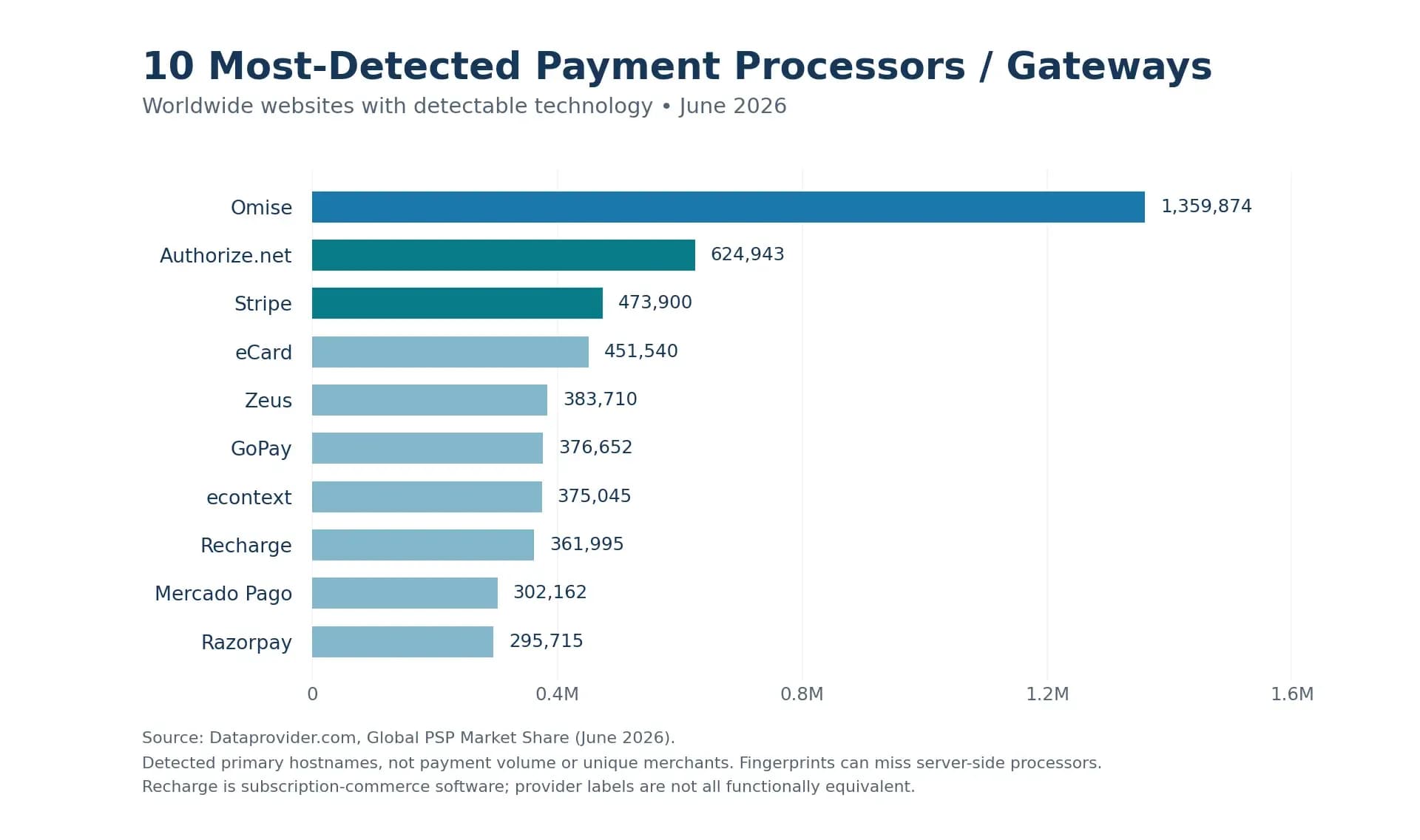
Figure: Dataprovider.com June 2026 detected-website ranking (not transaction market share).
Source: Dataprovider.com, June 2026. These are third-party technology-detection estimates, not audited merchant totals. A provider may appear on the same website as another. Front-end detection can miss processors operating entirely behind hosted or server-side checkout flows.
Read this ranking carefully: It includes regional providers, a subscription-commerce platform and labels that do not all represent equivalent standalone gateways. The dataset is useful for discovering technologies visible on the web, but it is not a verified league table of processing volume, profitability, customer satisfaction, or merchant suitability. We have not independently validated every underlying technology fingerprint.
A concrete reason for caution: Zeus's own Japanese site describes its system as used by more than 14,000 domestic sites, while the detection dataset associates the Zeus label with 383,710 worldwide hostnames. These are not necessarily like-for-like measurements, and the available evidence does not reconcile them. Readers should therefore avoid treating the detection ranking as an audited count of active merchant accounts. Zeus official company site.
What the Ten Ranked Providers Actually Offer
1. Omise: Payment APIs and Regional Ecommerce Integrations
Omise documents APIs, browser-side payment collection and ecommerce integrations. Its onboarding documentation identifies supported merchant registration processes for Thailand, Singapore, Japan, and Malaysia. That makes merchant location a first-stage eligibility question rather than an afterthought.
For a custom checkout, Omise's documentation explains tokenized client-side collection; it also warns merchants not to collect or store card details directly on their own server. A developer should verify current merchant-country eligibility, payment methods, supported settlement arrangements, and the actual integration used by the store.
Best evaluation scenario: A merchant in a supported market who needs a documented payment API or a compatible ecommerce integration. Check: Omise developer documentation and Omise.js security guidance.
2. Authorize.net: Gateway and Merchant-Account Options
Authorize.net, a Visa-backed service, supports hosted payment forms, API integration, online card payments, digital wallets, and eCheck/ACH functionality. It offers both gateway-only and all-in-one approaches, which are financially and operationally different. A merchant with an existing processor should confirm whether the gateway-only model fits their bank and processor arrangement.
Its published U.S. all-in-one plan starts at $25 per month plus a stated per-transaction card rate; gateway-only pricing has a different structure. Do not compare these packages without accounting for the underlying merchant account, batch charges, and the actual services included.
Best evaluation scenario: A U.S. small or midsize business choosing between an existing merchant account and an integrated gateway package. Check: Authorize.net payments and official pricing.
3. Stripe: Developer-Friendly Payments and Checkout Options
Stripe offers payment APIs, prebuilt checkout experiences, card and wallet acceptance, and tools for fraud management. Its public U.S. standard pricing currently lists 2.9% + 30¢ per successful domestic card transaction, with additional charges for certain international cards, conversion, and other situations.
That public rate is a useful example, not a worldwide pricing rule. Teams also need to evaluate whether a hosted checkout, embedded elements, or a custom integration matches their platform and security capacity.
Best evaluation scenario: A merchant or developer needing flexible integration choices and a clearly documented API. Check: Stripe's pricing and payment products.
4. eCard: A Technology-Detection Label That Needs Verification
The source dataset lists eCard fourth, but the ranking page does not establish a sufficiently clear current merchant offering, legal provider identity, country coverage, or integration documentation for this label. It would be misleading to present it as a universally available gateway or recommend it to U.S. merchants without additional verification.
Buyer action: Treat eCard as a reported fingerprint in this dataset—not a shortlisted provider—until the specific entity and merchant product are confirmed. This limitation is why the ranking cannot be treated as a ready-made list of the ten best services.
5. Zeus: Japanese Payment Processing and Hosted Payment Links
Zeus is a Japanese payment-services provider. Its official site describes online credit-card payment services and a hosted payment-URL approach; its support materials also describe link-based, tokenized and API connection models. Those features may be relevant to merchants serving Japan, subject to actual onboarding terms and local requirements.
Best evaluation scenario: A Japan-focused merchant researching localized checkout infrastructure. Check: Zeus official site and Zeus payment-link service.
6. GoPay: Ecommerce Checkout with Regional Integration Modules
GoPay provides a payment gateway and an API, along with ready-made integration modules for platforms that include WooCommerce, Shopify, OpenCart, and PrestaShop. Its help center describes CZK/EUR operations and regional payment features. Availability, settlement, fees, and the supported ecommerce modules should all be confirmed for the merchant's jurisdiction.
Best evaluation scenario: An eligible European ecommerce merchant who wants platform modules rather than a wholly custom checkout. Check: GoPay integration documentation and GoPay overview.
7. econtext: Payment Services Relevant to Japan
ECONTEXT operates payment services in Japan, including infrastructure associated with bank and convenience-store payments. Such methods can matter when a store serves customers who do not want to use a conventional card checkout. However, availability depends on the provider relationship and the specific method.
Adyen's documentation, for example, describes Japanese convenience-store payments through econtext. This is not evidence that every merchant can register directly for every econtext option.
Best evaluation scenario: A business with a Japanese-market payment requirement. Check: ECONTEXT corporate information and Adyen's econtext/konbini documentation.
8. Recharge: Subscription-Commerce Software, Not a Standalone General-Purpose Gateway
Recharge helps merchants manage recurring purchases and subscription commerce. Its documentation explains that supported payment processors depend on the ecommerce platform and integration model; in some Shopify flows, Shopify handles the payments while Recharge manages subscription functionality.
Recharge appearing in a PSP detection ranking does not mean a merchant can replace their payment processor with Recharge as though it were an interchangeable card gateway. Subscription software and payment processing are related but different parts of a commerce stack.
Best evaluation scenario: A subscription-based ecommerce business choosing recurring-billing functionality alongside an eligible processor. Check: Recharge's supported payment processors.
9. Mercado Pago: Region-Specific Latin American Checkout Options
Mercado Pago provides developer integration options such as Checkout Pro, payment links and other checkout products. Its documentation publishes country-by-country availability across several Latin American markets, making geographic eligibility essential before selecting an integration.
For a business expanding into a supported Latin American market, local payment behavior and settlement setup may be more important than a worldwide detection rank.
Best evaluation scenario: A merchant selling in an eligible Latin American country. Check: Mercado Pago developer documentation.
10. Razorpay: Payments Infrastructure for Indian Businesses
Razorpay provides a payment-gateway product, developer APIs and related business payment services. Its official website describes SDKs, webhooks and integrations, but businesses should confirm current merchant eligibility and payment-method support rather than assume the service is available for incorporation in every country.
Best evaluation scenario: A business eligible for Razorpay's merchant onboarding, particularly in India. Check: Razorpay's official payments platform.
What About PayPal, Apple Pay, Google Pay, and Shop Pay?
These brands are important to online checkout, but the underlying report places digital wallets and checkout buttons in a separate detection category. Combining their counts with the gateway table would produce a misleading ranking.
| Wallet or checkout-button label | Websites detected, June 2026 | Share among PSP-detected sites |
|---|---|---|
| PayPal | 6,439,425 | 52.8% |
| Apple Pay | 3,682,722 | 30.2% |
| Google Pay | 2,587,653 | 21.2% |
| Shopify Pay (source label) | 1,659,087 | 13.6% |
| Shop Pay (source label) | 999,034 | 8.2% |
Source: Dataprovider.com. The source reports “Shopify Pay” and “Shop Pay” as different labels. These labels should not be added together or treated as proof of distinct customer populations without validating the detection definitions.
For store owners, the practical question is not “Should I choose a gateway or a wallet?” A checkout may use a processor behind the scenes while presenting cards, PayPal, Apple Pay, or other eligible methods to the customer. The availability of each method depends on the selected platform, processor, business location, and customer's device.
For a Shopify-specific explanation, read WebbyTemplate's guide to how Shop Pay works for merchants. That article covers Shop Pay setup and buyer experience; this guide focuses on worldwide provider detection and choosing the wider payment stack.
How to Choose a Payment Gateway for an Ecommerce Website
A merchant should usually choose by eligibility and total checkout requirements before popularity. Use this sequence to avoid wasting time evaluating providers that cannot support the business.
Step 1: Confirm Merchant Country, Currency, and Business Model
Identify where your company is registered, where its bank account is held, where customers live, and which currencies you need to display and settle. Then confirm provider support for that combination. A service that appears widely in a global dataset may not onboard a new U.S. merchant.
Also check whether the provider supports your products or industry, recurring billing if needed, cross-border cards, refunds, disputes, and your required local methods. Eligibility often matters more than the ranking position.
Step 2: Check Your Ecommerce Platform Before Choosing the Processor
Your store's platform can narrow the real choices:
| Store setup | Key payment decision | Official starting point |
|---|---|---|
| Shopify | Check Shopify Payments and eligible third-party providers, including platform-level fees. | Shopify's third-party provider rules |
| WooCommerce / WordPress | Compare WooPayments with compatible gateway extensions and available wallet methods. | WooCommerce payment-method documentation |
| Custom frontend / headless store | Choose a documented hosted or embedded checkout and design the order/payment confirmation flow securely. | Stripe payment options and pricing |
| Subscription store | Confirm both recurring-billing software and the eligible underlying processor. | Recharge processor compatibility |
Shopify's documentation confirms that third-party payment transaction fees may apply and can vary by store plan and configuration. WooCommerce documents multiple supported methods and extensions; WooPayments is one option, not a requirement for accepting payments. These platform constraints should be checked before comparing provider headlines.
Step 3: Compare the Real Total Cost, Not One Advertised Card Rate
Create one worksheet for each provider and the same projected sales mix. Include:
- Per-transaction percentage and fixed fees for domestic cards.
- International card and currency-conversion charges.
- Monthly gateway, platform, subscription-software, and account fees.
- Refund, dispute, chargeback, or unsuccessful-payment fees where applicable.
- Payout timing, reserves or settlement restrictions, and operational support needs.
- Any extra fee for using a third-party processor on your ecommerce platform.
Worked method: Suppose a merchant processes 200 eligible domestic card payments averaging $50 each. That is $10,000 in processed payments. At a hypothetical 2.9% plus $0.30 per successful transaction, the card-processing component would be $350 for that set of transactions: (2.9% × $10,000) + (200 × $0.30). This is an illustrative calculation, not a quote for every processor or a complete monthly cost; other fees and pricing conditions may apply.
Stripe currently lists 2.9% + 30¢ for U.S. domestic card transactions under its standard plan, but a merchant should use its actual contract and rates when building the comparison. Stripe pricing.
Step 4: Decide Between Hosted Checkout and a More Customized Flow
A hosted payment page may reduce how much sensitive card-entry interface the merchant directly controls. An embedded payment element can preserve more of the store's design while still relying on a payment provider. A fully custom payment collection flow creates additional implementation and compliance questions.
Do not assume that simply embedding a payment iframe automatically makes your whole store PCI compliant. The PCI Security Standards Council sets specific eligibility criteria and notes continuing merchant responsibilities for ecommerce webpages and payment-page scripts. Review the relevant requirements with your payment provider or qualified compliance advisor. PCI SSC on iframe eligibility and PCI SSC on ecommerce script requirements.
Step 5: Test the Checkout Before You Launch
A checkout that works only with a successful test card is not ready for real customers. Verify the complete path:
1. Complete a successful test order with the correct products, shipping, tax and currency.
2. Test an intentionally declined or unsuccessful payment and inspect the message shown to the shopper.
3. Confirm that the order is created or marked paid only after the required payment confirmation.
4. Test the refund and cancellation path, including email notifications and order-status updates.
5. Test payment methods on mobile and desktop where they are supposed to appear.
6. Verify duplicate submissions, lost network connections, webhook retries and customer support escalation.
7. Confirm that card details are handled through approved provider integrations—not captured in an ordinary template form or stored by your own frontend.
These are recommended checks, not claims that WebbyTemplate tested the providers in the ranking.
Choosing a Gateway When You Use a Website Template
A website template does not automatically include a working payment gateway. A design preview may show a checkout form or card icons while the purchased file contains only HTML, CSS, JavaScript, or frontend components. Real payment processing may require a supported ecommerce platform, provider account, server-side order handling, webhook processing, and security review.
Before buying or customizing a template, check whether the delivered package includes a live checkout integration, a demonstration UI only, or references to a separate commerce backend. Review the actual product's dependencies and license. WebbyTemplate's guide to choosing a website template for your business provides additional checks for platform fit, functionality, and deliverables.
For a merchant comparing a custom storefront with a theme-based store, the correct sequence is platform → eligible payment integration → checkout requirements → template design. Reversing that sequence can result in an attractive checkout page that cannot lawfully or technically accept real payments.
The Most Common Mistakes in Payment Gateway Comparisons
Calling website detection “market share of transactions.” A provider visible on many sites is not necessarily processing the highest payment value.
Combining wallets with processors. PayPal, Apple Pay and Google Pay in a checkout-button detection table are not directly comparable to a processor-only technology count.
Ignoring regional concentration. A provider may rank highly because it is common in a particular country rather than available globally to every merchant.
Confusing subscription software with payment processing. Recharge may support recurring commerce while another service handles card payments.
Quoting one country's price globally. Payment fees and restrictions often differ by merchant location, currency, platform and contract.
Treating a template as a backend. Payment logos and checkout UI components are not proof of a configured payment processor.
FAQs
Q1.
What is the most popular payment gateway worldwide?
Q2.
Is PayPal the most used payment gateway?
Q3.
Is Stripe more popular than Authorize.net?
Q4.
What is the best payment gateway for a small online store?
Q5.
What is the difference between a payment gateway, processor, and wallet?
Q6.
Can a Shopify merchant use third-party payment gateways?
Q7.
Does WooCommerce require WooPayments?
Q8.
Does buying a checkout template include payment processing?
Q9.
How often should payment gateway statistics be updated?
Methodology and Sources
The worldwide top-ten table uses Dataprovider.com's June 2026 primary-hostname index. The company reports a large crawl-based population and identifies PSPs using observable scripts, buttons, plugins and hostnames. This is a third-party technology-detection study, not WebbyTemplate's own audit. The analysis does not independently verify all provider fingerprints, backend integrations, unique merchants, transaction volume or processor revenue. Wallets and dedicated processors appear in separate source categories; percentages are not mutually exclusive.
Merchant selection guidance is based on provider and platform documentation, including Stripe, Authorize.net, Omise, GoPay, Mercado Pago, Razorpay, Shopify, WooCommerce and the PCI Security Standards Council. Vendor documentation is evidence of the vendor's stated product features, not independent proof of performance superiority. No provider was hands-on benchmarked for this article.
Final Takeaway
The most useful answer to “Which payment gateway is most popular?” depends on what is being counted. A June 2026 web-technology study detected Omise, Authorize.net and Stripe most frequently in its dedicated processor/gateway category, while PayPal led the separate wallet/checkout-button list. Those rankings reveal visible adoption patterns but do not decide which provider is right for an individual store.
For an ecommerce business, choose an eligible processor that works with your platform and customers, compare total operating costs, confirm the security model, and test the complete order-to-refund workflow. A payment-enabled website succeeds when the checkout is reliable—not merely when its payment provider appears high in a worldwide ranking.