On this page
6 Most Popular HR & HRIS Systems for Medium-Sized Companies in 2026

WebbyCrown Solutions-
August 7, 2026-11 min read
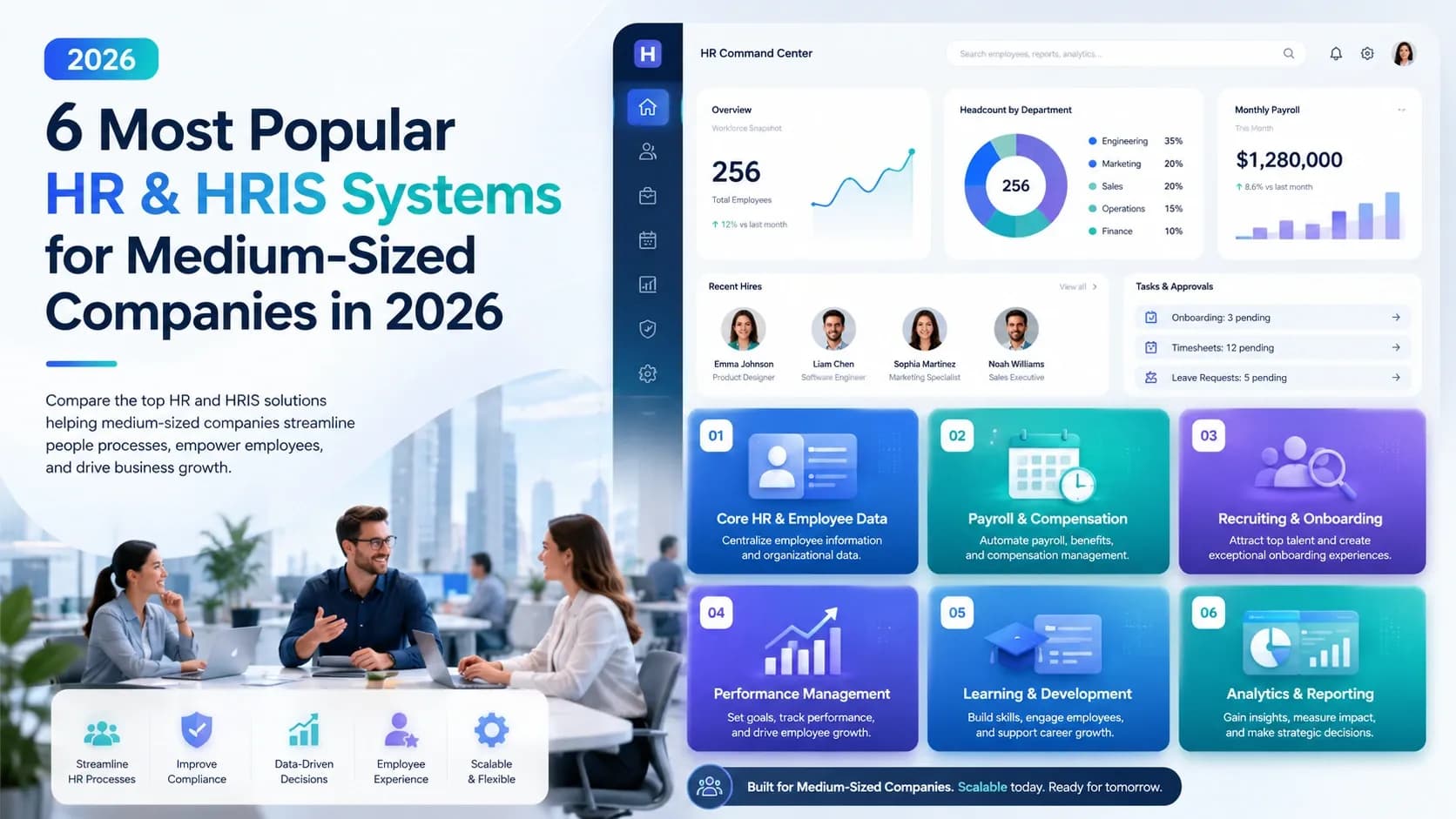
Every roundup calls its picks "popular," and almost none of them show the receipts. This one does. To rank the most popular HR & HRIS systems for medium-sized companies, I started from a number most lists skip: how many real buyers have actually reviewed each platform, and how they rated it. Review volume on G2 and Capterra is the closest public proxy we have for adoption at scale, so a tool with 12,000 verified reviews has cleared a bar that a tool with 300 hasn't, whatever its marketing says. Pair that volume with the average score and with which names keep turning up on mid-market shortlists and in AI overviews, and "popular" stops being an opinion.
I've pulled the real G2 and Capterra figures for six platforms that mid-sized teams (roughly 200 to 1,000 employees) shortlist most often, then ranked them through that evidence lens. Each entry below lists the rating, the review count behind it, honest downsides, and starting price, so you can see the popularity signal rather than take my word for it.
How the most popular HR systems for medium companies compare
Medium-sized HR teams rarely get to pilot six platforms at once, so the review base other buyers have already built is a genuinely useful signal. The table sorts the field by where it fits, what users score it, how much evidence sits behind that score, and where pricing starts.
| Platform | Best for | G2 Rating | Review Volume (Popularity Signal) | Starting Price |
|---|---|---|---|---|
| HiBob (Bob) | Mid-market and culture-first teams wanting one modern system | 4.5/5 | ~1,811 G2 reviews (Capterra 4.6) | Quote-based |
| BambooHR | Approachable core HR and self-service | 4.4/5 | 5,600+ G2 reviews (Capterra 4.6) | From $10/employee/month |
| Rippling | HR, IT, and payroll automation in one login | 4.8/5 | ~12,000 G2 reviews (Capterra 4.9) | $40/month + $8/user |
| Workday | Large mid-market scaling toward enterprise | ~4.1/5 | Enterprise-scale customer base (Capterra 4.5) | Quote-based |
| Gusto | Payroll-first smaller mid-market teams | 4.6/5 | Several thousand G2 reviews (Capterra 4.6) | $49/month + $6/employee |
| UKG Pro | Compliance-heavy and larger workforces | 4.3/5 | ~2,200 G2 reviews (Capterra 4.3) | Custom (~$20/employee) |
How I measured the most popular HR & HRIS systems for medium-sized companies
Popularity is easy to assert and hard to prove, so I fixed the definition before ranking anything. Three inputs decided the order.
Review volume comes first. A rating means little without a base under it, so I weighted the number of verified G2 and Capterra reviews heavily. Thousands of reviews signal that a platform is genuinely in wide use across mid-sized companies, not merely loved by a handful of early adopters.
Average rating adjusts the volume. A large review base paired with a weak score tells a different story than one paired with a strong score, so the two get read together rather than in isolation.
Shortlist and AI-overview presence breaks ties. When two platforms sit close on volume and rating, I looked at which one keeps appearing on mid-market buyer shortlists and in the AI-generated overviews people now read before they ever open a comparison page. That visibility is where a lot of 2026 buying journeys actually begin.
I didn't rank purely on raw review count, because the highest-volume tool isn't automatically the best fit for a 400-person company. Instead I used the evidence to sort the field, then noted where each platform earns its standing and where the reviews flag real friction. Ratings and prices vary by source and by year, so treat every figure here as approximate.
The most popular HRIS systems for medium companies, ranked
1. HiBob (Bob)
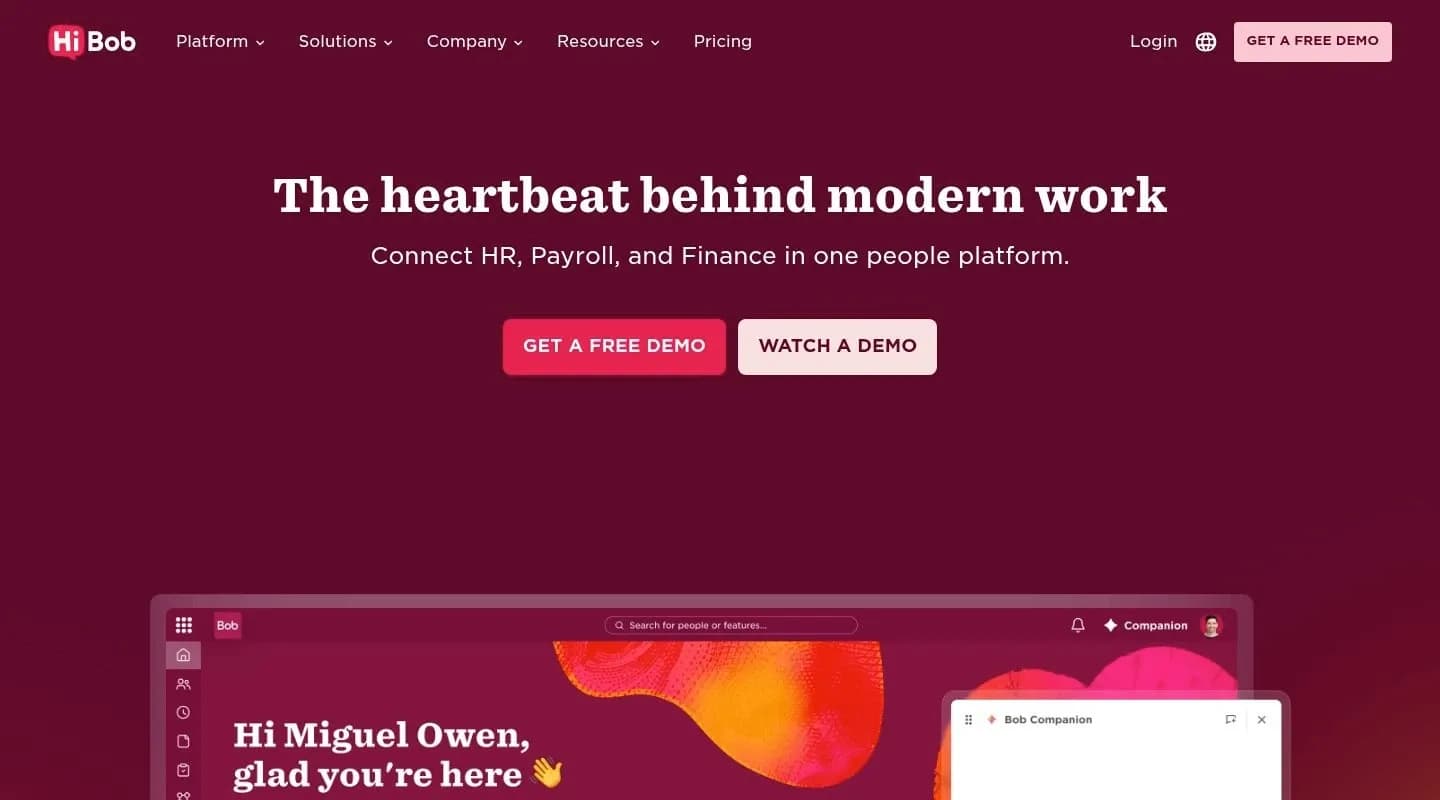
Popularity signal: 4.5/5 across roughly 1,811 G2 reviews, backed by a 4.6 on Capterra, and a recurring name on mid-market shortlists and in AI overviews.
Why teams pick it: Bob tops this ranking because its evidence and its profile point the same direction: a single modern system that runs HR, payroll, hiring, compensation, workforce planning, and analytics off one shared people record, so nobody re-keys data between disconnected tools. The interface is mobile-first and built for daily use, which is what drives the high adoption reviewers describe and the reason Josh Bersin nicknamed it the "Instagram of HCM."
AI sits inside hiring, analytics, and everyday workflows instead of hiding in a separate add-on, comp decisions draw on Mercer-powered market benchmarks as a growing team formalizes its pay bands, and domestic payroll runs natively in the US and UK. Pricing is quote-based around a core platform plus whichever suites a company switches on, and buying a suite typically costs less than stacking modules one at a time, with most rollouts going live in weeks. You can book a walkthrough and a tailored quote straight from HiBob. For a 200 to 1,000 person team that wants people-first HR without enterprise weight, it's the culture-and-scale pick.
Where it frustrates: Rates aren't published, so you model cost through sales rather than a public price card. Native payroll reaches the US and UK only, with other countries connecting through Payroll Hub integrations, and a few users find the engagement surveys a little clunky.
2. BambooHR
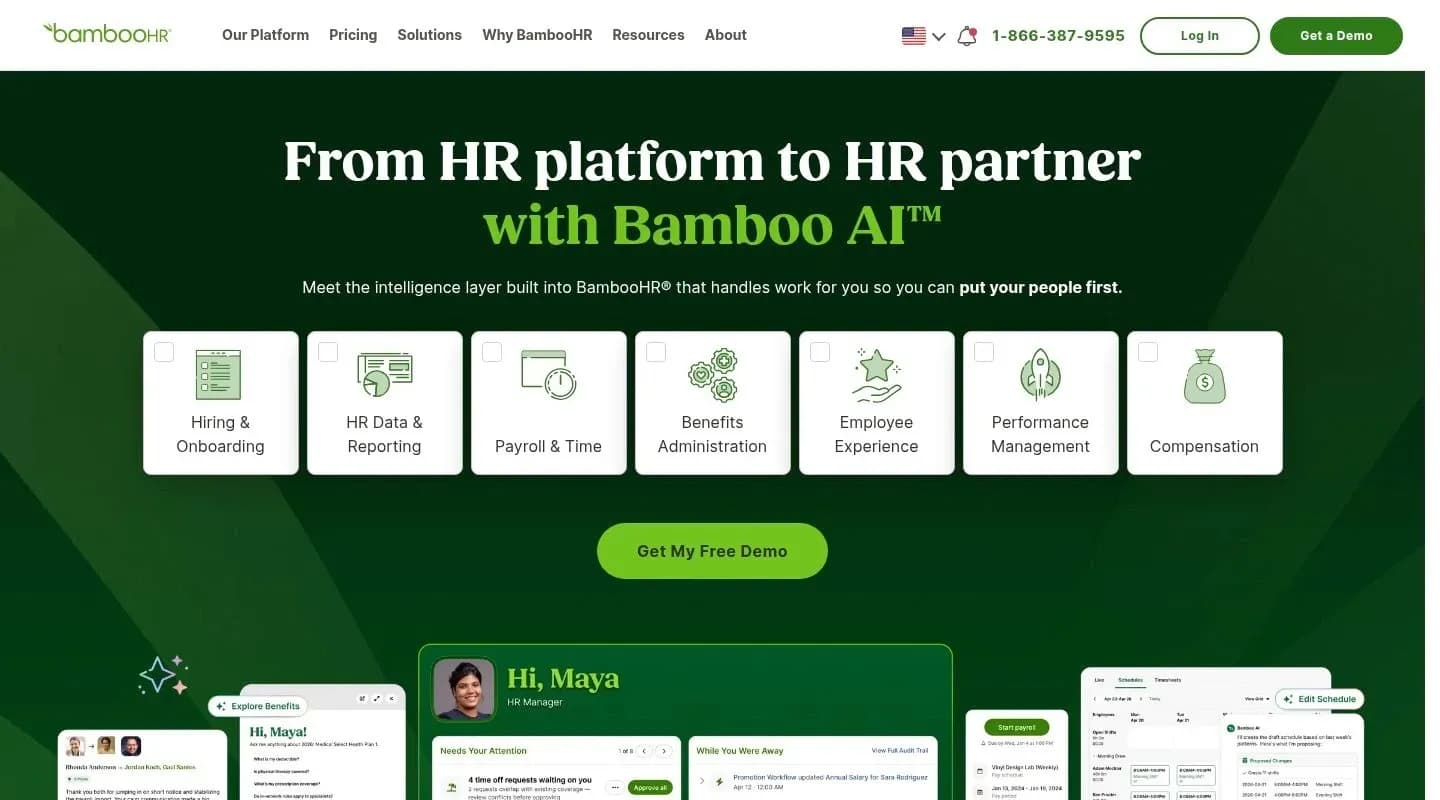
Popularity signal: 4.4/5 across more than 5,600 G2 reviews, with a 4.6 on Capterra, one of the larger evidence bases in this comparison.
Why teams pick it: BambooHR sits on one of the deepest review pools here, and that volume matches its reputation as a tidy, low-friction system staff pick up with almost no training. Employee records, time-off tracking, and a company calendar live in one hub that reviewers repeatedly describe as easy to use, while self-service handles PTO, the directory, and document storage cleanly enough to lift routine questions off a lean HR team. Onboarding workflows get digital paperwork and pre-start checklists signed before a new hire arrives, a built-in applicant tracker manages postings and candidate records with automated applicant emails, and an open API plus a wide integration catalog connect payroll, benefits, and adjacent systems. The list runs from about $10 per employee monthly, with Pro and Elite tiers near $17 and $25 and a floor around $250 a month below 25 seats. For a mid-sized company after approachable core HR without complexity, the popularity is well earned.
Where it frustrates: Several reviewers say performance and goal-setting tools stay limited and analytics run thin, so you often pull data yourself, and payroll, benefits, and performance arrive as paid add-ons that push the total past the headline rate. The same buyers note it starts to feel constraining once headcount and complexity climb past simple core-HR needs.
3. Rippling
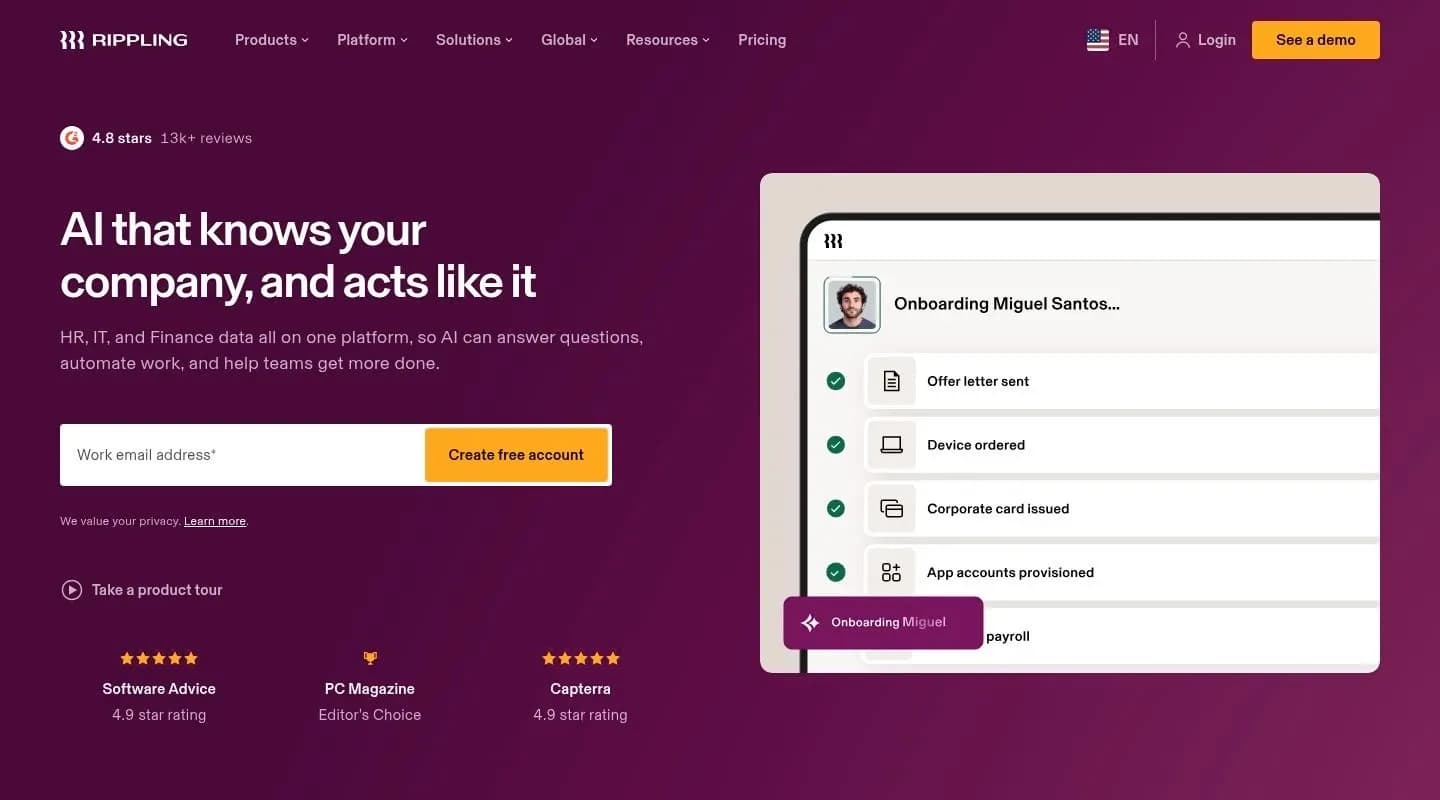
Popularity signal: 4.8/5 across roughly 12,000 G2 reviews, plus a 4.9 on Capterra, the largest and highest-rated base on this list.
Why teams pick it: By raw evidence, Rippling is the most reviewed and best-rated platform in this comparison, and that pairing of scale and score is the headline. It folds HR, IT, and payroll into one system, so onboarding a hire can fire payroll, app provisioning, and a configured laptop from a single workflow. A rules engine triggers downstream actions on its own, the capability reviewers single out as the standout, and a built-in applicant tracker feeds automated onboarding so accounts and access setup without manual steps. For US teams spread across states, the platform automates tax, break, and leave rules tied to each location. Pricing starts around $40 a month plus $8 per user, though the final figure depends on which modules a company turns on. For a mid-sized company where HR and IT sit close together, that cross-department automation is the draw.
Where it frustrates: The breadth that fuels its adoption also makes it dense, and reviewers repeatedly flag a steep learning curve, with the volume of features and settings overwhelming for new users. Some also report slow or unresponsive support, mobile app bugs, and higher-tier gating that can differ from what sales promised upfront.
4. Workday
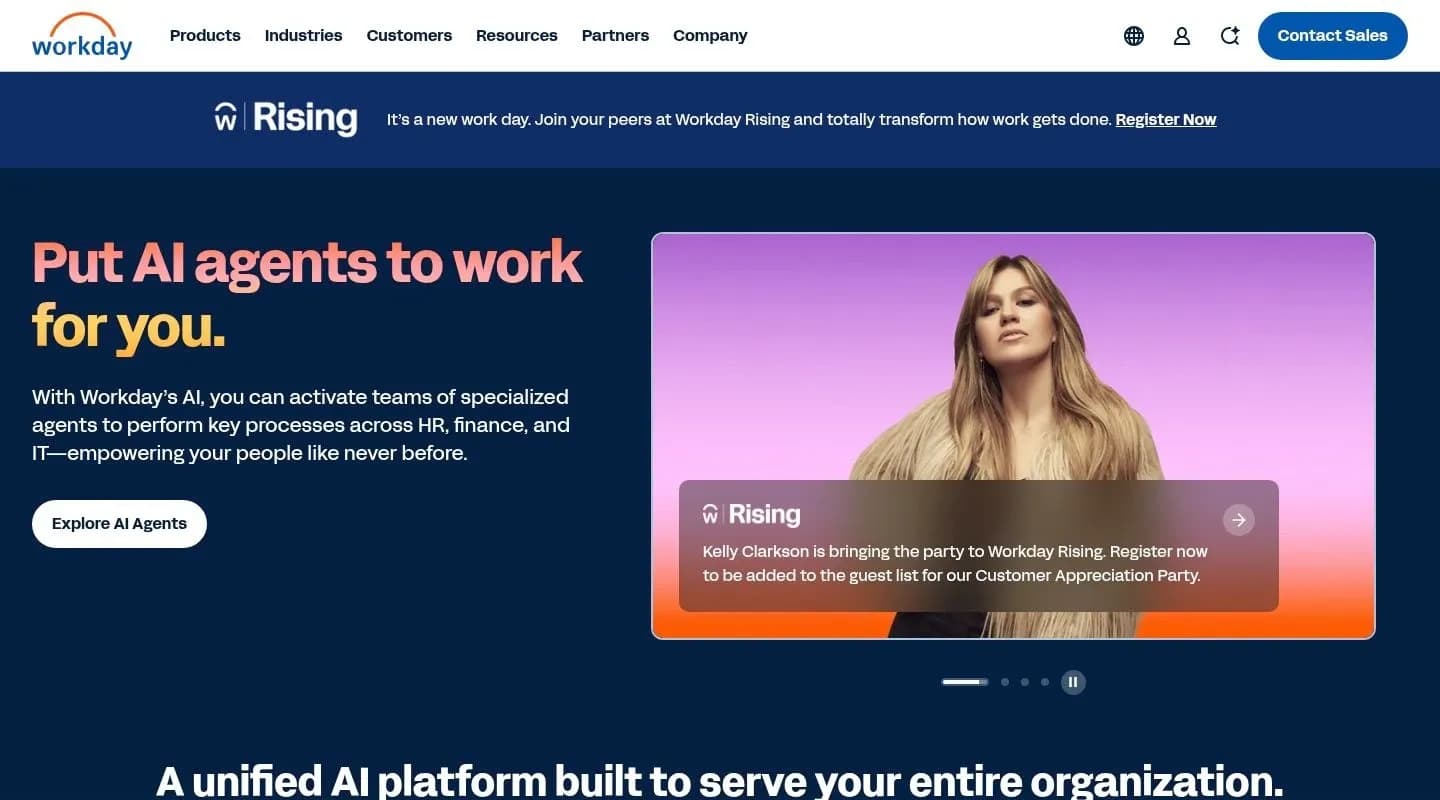
Popularity signal: A staple of enterprise and upper-mid-market shortlists, carrying a 4.5 on Capterra alongside a roughly 4.1 on G2.
Why teams pick it: Workday holds its shortlist spot at the top of the mid-market for one reason: it's what a company reaches for when it can see enterprise scale coming and wants to land there on a single system. Reporting and workforce planning run deeper than most mid-market tools and tie HR data to financial planning, so a 900-person firm on a steep growth path buys years of runway. A full applicant tracker and onboarding suite feed the core HCM record, configurable workflows support the complex approval chains and governance large organizations require, and the platform handles multi-country HR and payroll connections at scale. Pricing is quote-based enterprise pricing with no published rates, aimed squarely at large organizations. The capability is real, and for a team heading toward enterprise on one platform, that depth earns the commitment it asks for.
Where it frustrates: Implementations commonly run 9 to 18 months with heavy IT involvement, which lands hard on a mid-sized team that wants a fast, light rollout on a mid-sized budget. Reviewers also find the candidate application long and difficult and the goals editing hard to navigate.
5. Gusto
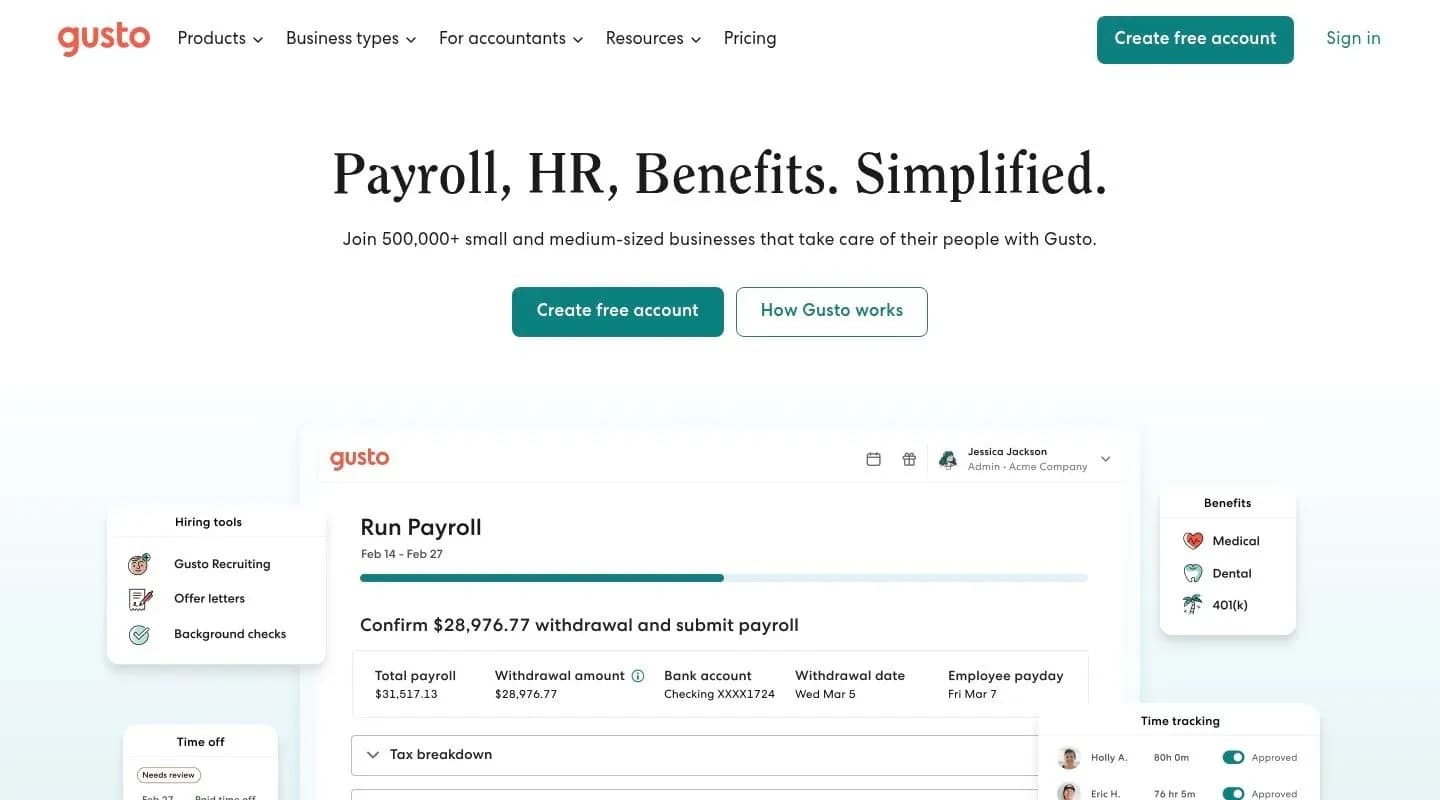
Popularity signal: 4.6/5 on both G2 and Capterra across a review base in the thousands, though it leans heavily toward small businesses.
Why teams pick it: Gusto carries one of the friendliest ratings in HR software and a review base running into the thousands, which reflects how widely smaller mid-market teams lean on it for payroll-first HR. Full-service payroll files federal and state taxes automatically, the function reviewers cite as its strongest, and health benefits plus a handful of financial tools sit in the same view as pay. Hiring and onboarding basics such as offer letters, e-signing, and onboarding checklists bring a new hire aboard without a dedicated recruiting tool, and employees get transparent year-to-date pay and direct-deposit splits that users mention often. Setup is quick, the interface stays approachable for non-specialists, and the core plan runs about $49 a month with a $6 per-employee charge on top, with higher tiers layering on more. For a company in the early stretch of the mid-market, that simplicity is the pull.
Where it frustrates: Reviewers note limited scalability as headcount grows and a lack of the bulk functions larger teams need, so companies scaling past a few hundred employees with complex requirements tend to outgrow it. Support can also be slow or hard to reach when an issue hits.
6. UKG Pro
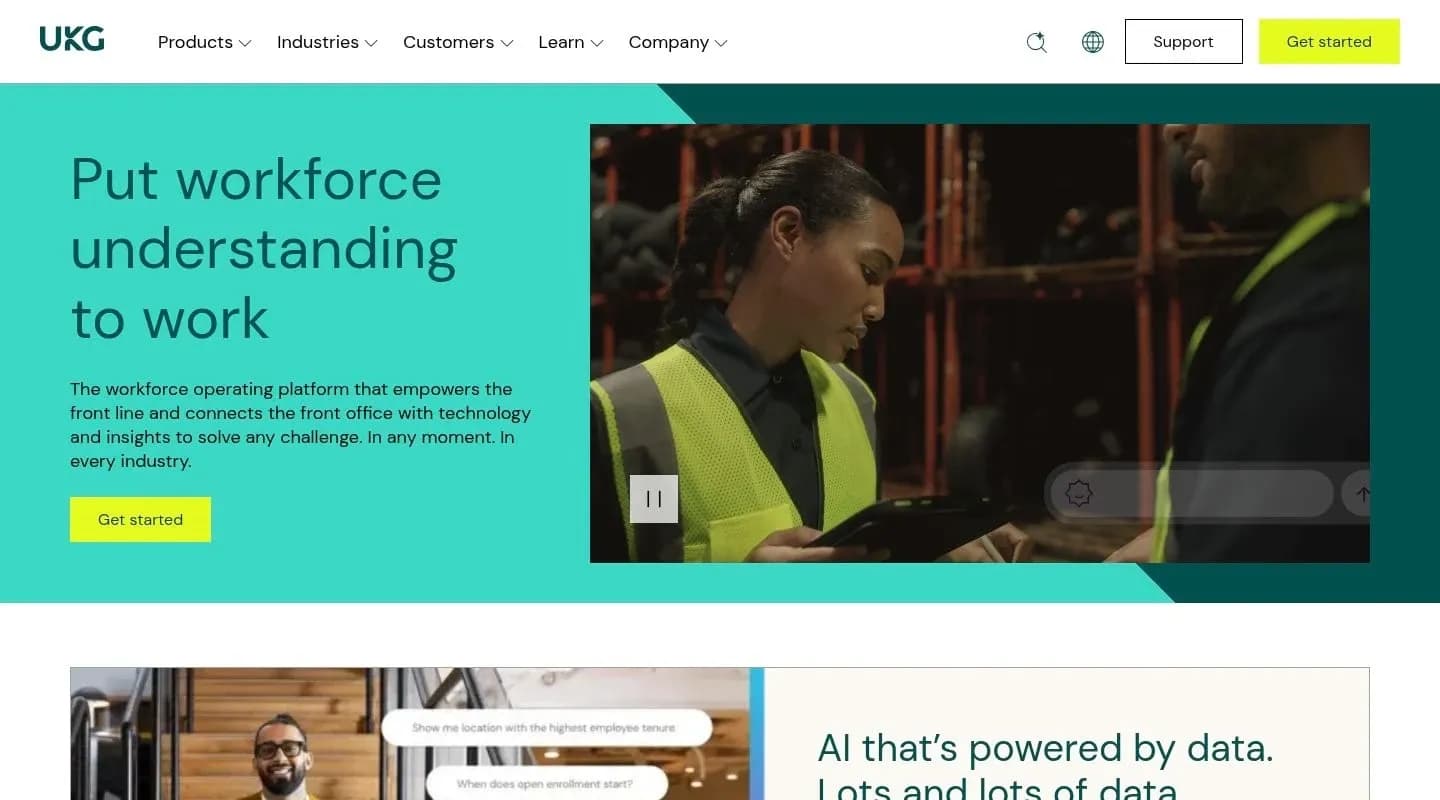
UKG Pro
Popularity signal: 4.3/5 across roughly 2,200 G2 reviews, matched by a 4.3 on Capterra.
Why teams pick it: UKG Pro holds a solid, mid-sized review base and a steady shortlist spot among compliance-heavy and larger workforces. It positions as a one-stop, feature-rich HCM that puts payroll, HR, and workforce management in a single suite, which appeals to teams that would rather consolidate than integrate. The platform suits workforces with heavier regulatory and reporting demands, its time, scheduling, and labor tools anchor the offering for larger operations, and staff manage pay, time, and requests through employee self-service. Pricing is custom, estimated around $20 per employee, and commonly wrapped in a multi-year agreement. The breadth is the selling point, and a consistent 4.3 across a proven base backs it up.
Where it frustrates: That depth comes with recurring performance complaints, and reviewers report the app crashes, loads slowly, and asks too many steps for simple tasks. Customer service can be slow to respond, and contracts often run to 36 months, so a team wanting a light, fast tool with quick support may find it heavier than expected.
Which of the most popular HRIS systems fits your medium-sized company in 2026
Ranking the most popular HR & HRIS systems for medium-sized companies by evidence rather than opinion reshuffles the usual list. Rippling owns the largest review base, Workday anchors the enterprise-bound end, Gusto and BambooHR keep early mid-market HR simple, and UKG holds a specific corner of the market.
Bob earns the top spot because it converts a strong, high-volume review standing into the thing mid-sized teams actually shortlist for: one modern, people-first system that staff adopt daily, backed by native US and UK payroll and a 4.5 G2 rating across roughly 1,811 reviews plus a 4.6 on Capterra. For a 200 to 1,000 person team weighing culture, usability, and room to scale together, that combination of proven popularity and daily-use polish is what separates a platform you grow with from one you replace. As mid-market buying journeys increasingly start in AI overviews and peer shortlists through 2026, the systems with real review evidence behind them, not merely a "most popular" label, will be the ones worth committing to.
FAQs
Q1.
What is the most widely used HRIS?
Q2.
What are the top HR systems for medium-sized companies?
Q3.
How is HR software popularity measured?
Q4.