On this page
Key Elements Agencies Prioritize When Selecting Hosting Plans

WebbyCrown Solutions-
May 12, 2026-6 min read
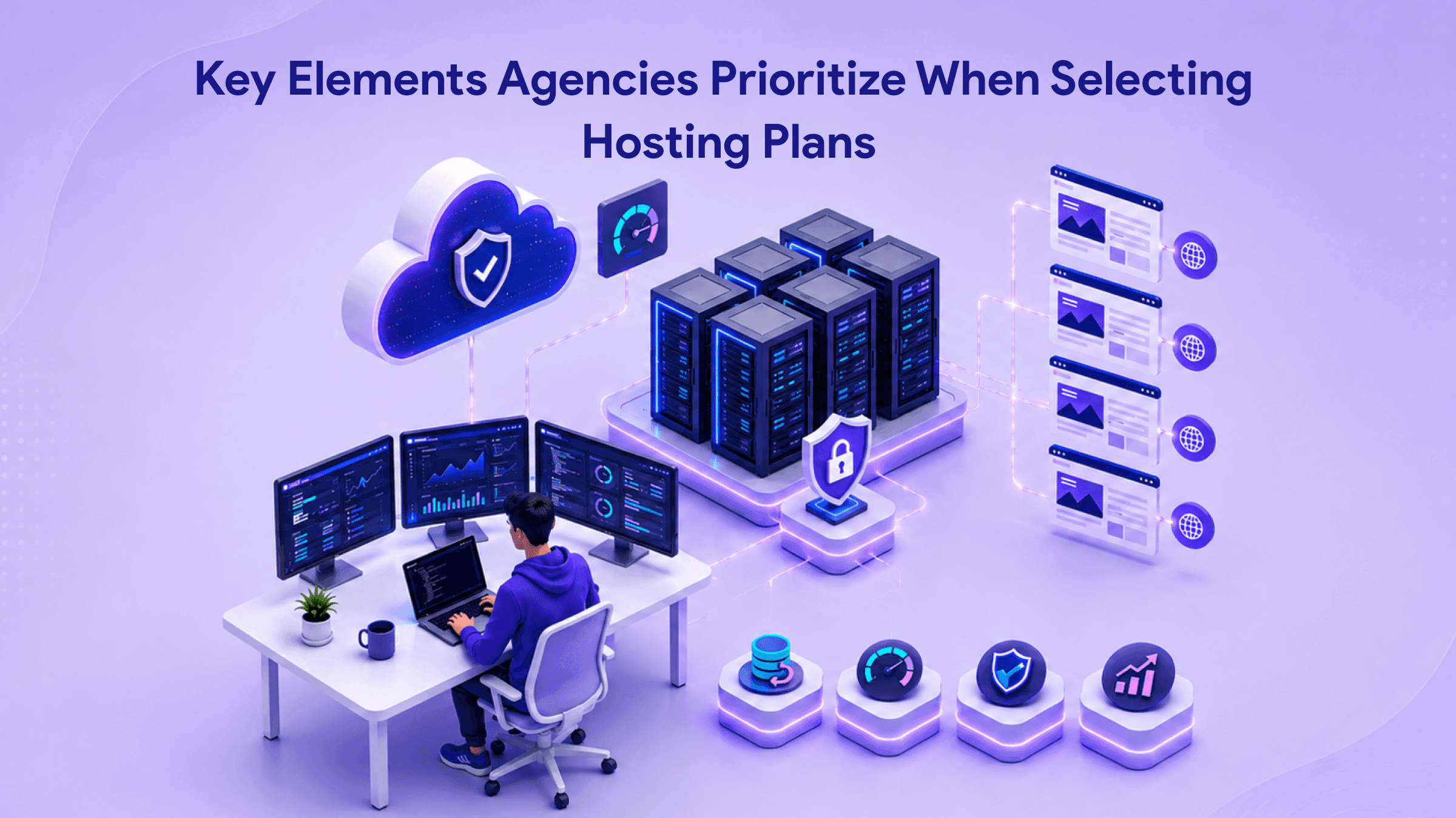
The choice of a hosting plan is something that most people make once and hardly ever come back to. For agencies, it is a tactical decision that echoes through all client interactions, all project executions, and all business processes that the company relies upon. The wrong plan generates tension that builds up day after day – sluggish websites, security holes, customer service hassles, and scaling issues that surface at the worst possible times. The right plan becomes the unseen infrastructure that silently gives every team member the power to do their best work.
What makes the selection process uniquely challenging for agencies is that their needs do not fit into the categories that most hosting providers define. They are not individual site owners. They are not enterprise IT departments. They occupy a distinct middle ground where portfolio-level management, diverse client demands, and professional-level reliability intersect. Here are the elements that experienced agencies prioritize when making this important decision.
Multi-Domain Capacity Without Compromise
The initial filter that most agencies use is simple enough: can this plan support multiple domains without compromising performance or adding high costs? Many hosting packages technically allow multiple domains but treat them as an afterthought, cramming them onto shared resources so that each new property reduces the headroom available to every other site on the account.
Agencies favor plans where multi-domain support is a first-class feature. This means dedicated resources per domain, proper isolation between properties, and centralized management tools that treat the entire portfolio as a single operation rather than a collection of individual sites sharing a crowded server. The ability to add domains as the client base grows, without triggering migrations or plan restructuring, is also critical for agencies planning beyond the current quarter. Agencies managing client builds should also understand website templates vs custom design before deciding how much flexibility each project needs.
Performance Infrastructure That Delivers Consistently
Client expectations around site speed leave no room for excuses, and agencies carry the reputational weight of every slow-loading page across their portfolio. Performance infrastructure receives intense scrutiny when evaluating hosting plans, not just peak capability, but consistency under real-world conditions.
Agencies seek plans built on modern hardware with SSD storage, current-generation processors, and sufficient memory allocation. For client sites built from pre-designed layouts, applying website optimization tips for template-based sites can further improve speed, SEO, and user experience. Server-level caching across multiple tiers, including full-page, object, and opcode caching, should be included as standard rather than offered as premium add-ons. CDN integration that reduces latency for geographically dispersed audiences needs to be native and pre-configured. Database engines tuned for CMS-specific workloads deliver measurably better results than default configurations. These are not luxury features but the baseline performance elements that agencies need to deliver the speed their clients expect from every site in the portfolio.
Security Coverage That Scales With the Portfolio
A security incident on any client site reflects directly on the agency. Experienced agencies evaluate hosting plans with a sharp focus on how comprehensively and uniformly security is applied across every hosted domain. Individual site-level security configurations do not scale, as they create the gaps and inconsistencies that attackers exploit.
Plans that include platform-level security infrastructure earn agency attention. The following should run continuously across every domain without requiring per-site configuration:
- Server-managed firewalls
- Automated malware scanning
- Brute force protection
- DDoS mitigation
- SSL certificate management
Well-structured agency hosting plans build this security coverage into the plan itself rather than pricing it as a stack of individual add-ons, recognizing that agencies need uniform protection across their entire portfolio, not piecemeal solutions that leave some properties more exposed than others.
Backup and Recovery as Standard Inclusions
Agencies that have survived a data loss event never again treat backups as optional. For WordPress projects, choosing reliable WordPress backup plugins for website and network security adds another protection layer beyond hosting-level backups. When evaluating plans, automated daily backups with off-site storage and easy one-click restoration are non-negotiable requirements, not premium features to be purchased separately.
Beyond the existence of backups, agencies assess the granularity and reliability of the recovery process. Key questions include:
- Can individual sites be restored without affecting others?
- How many restore points are retained?
- How quickly does restoration complete?
These details determine whether the backup system functions as genuine insurance or merely provides the illusion of protection. Plans that include verified, tested backup infrastructure earn trust. Plans that bury backup limitations in fine print lose it.
Support That Understands Agency Operations
Generic support trained for individual site owners rarely meets agency needs. When an agency contacts support, the issue typically involves interactions between multiple sites, complex server configurations, or deployment workflows that first-tier support agents are not equipped to diagnose. Agencies prioritize plans that include access to technically fluent support teams with experience in multi-site environments.
Response time guarantees matter, but resolution quality matters more. A fast reply that escalates through three tiers before reaching someone who understands the problem wastes more time than slightly slower access to an engineer who resolves it on first contact. Agencies evaluate support by testing it during the trial period, submitting a technical question, and measuring both speed and competence of the response.
Transparent and Predictable Pricing
Hidden costs are a deal-breaker for agencies that need to budget accurately and price hosting into client retainers with confidence. This is also why comparing Hostinger vs WordPress helps beginners and businesses understand hosting, platform control, pricing, SEO, and scalability before choosing a setup. Plans that advertise low introductory rates but spike sharply at renewal, or that charge separately for essential features like SSL, backups, and staging environments, create financial unpredictability that undermines business planning.
Agencies favor plans with transparent pricing that clearly define what is included, what renewal costs look like, and how pricing scales as domains are added. Predictability is not just a financial preference but an operational necessity for agencies that build hosting costs into long-term client agreements.
Selection as a Strategic Act
The elements that agencies prioritize when selecting hosting plans reflect a fundamental truth: hosting is not a commodity purchase for organizations managing client portfolios. It is a strategic infrastructure decision that shapes performance, security, client satisfaction, and operational efficiency for years. Agencies that treat the selection process with the seriousness it deserves build on foundations that support growth, consistency, and the professional-grade reliability their clients expect from every interaction.