On this page
How to Choose the Right Health App Development Company for Your Project

WebbyCrown Solutions-
September 21, 2026-8 min read
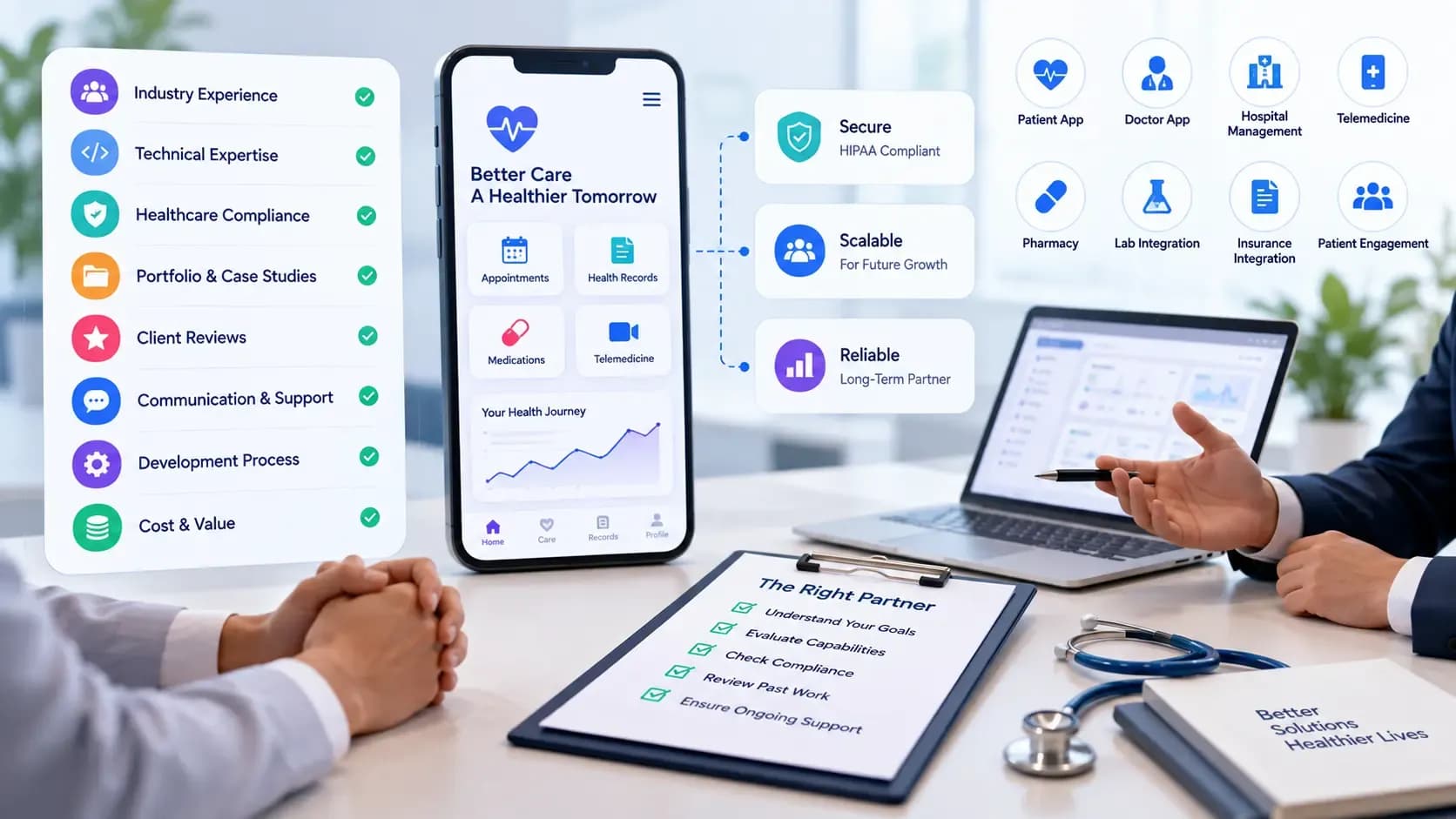
Choosing a health app development company is less about finding the biggest vendor and more about finding the team that can work safely inside your clinical, technical, and business constraints. A patient-facing wellness product, a clinician workflow tool, and a regulated diagnostic platform may all look like “health apps,” but they require very different levels of privacy, integrations, validation, and long-term support. Start with evidence, not sales claims. Visit Website portfolios, study relevant case work, and check whether the team has solved problems similar to yours. The strongest partner should explain trade-offs clearly, show how security is built into delivery, and define what your organization must own after launch.
Defining Project Requirements and Scope
Choosing a Health App Development Company Starts With Scope
Before contacting vendors, define who will use the product and what they need to accomplish. Patients may need registration, appointment booking, secure messaging, payments, or access to records. Clinicians may need structured documentation, alerts, care-plan tools, and fast access to relevant data. Administrators usually need permissions, reporting, auditability, and workflow controls. These differences shape architecture from the start. A healthcare application development company should receive a clear description of users, workflows, target platforms, data types, and integrations before it estimates the work.
Separate the first release from the long-term roadmap. An MVP should prove the core workflow without forcing every future feature into version one. Capabilities such as AI-assisted triage, remote monitoring, or complex analytics can be planned for later if they are not essential to initial value. Set a budget range and launch window. Clear boundaries make proposals easier to compare and reduce the risk that vendors estimate different products.
Evaluating Healthcare Domain Expertise and Portfolio
General engineering experience is useful, but healthcare adds operational details that teams often learn only through real projects. Ask candidates to show work involving clinical workflows, EHR connections, patient identity, consent, remote care, medical data exchange, or regulated environments. Strong healthcare app developers should be able to explain what made those projects difficult, not simply display polished screens. Look for evidence of decisions around permissions, data quality, downtime, accessibility, and clinical usability.
Review case studies closely. If an app is publicly available, test the live experience and read recent app-store feedback. References can reveal whether the vendor communicates well after launch, handles incidents responsibly, and keeps documentation current. For healthcare mobile application development work, check whether the portfolio includes real mobile constraints such as intermittent connectivity, device permissions, biometric login, secure local storage, and release management across iOS and Android. A portfolio should prove relevant problem-solving, not familiarity with healthcare vocabulary.
Verifying Regulatory Compliance and Security Standards
Treat compliance claims as something to verify. In the United States, the HIPAA Security Rule requires appropriate administrative, physical, and technical safeguards for electronic protected health information. When a vendor acts as a business associate and handles PHI for a covered entity, HHS requires a written business associate arrangement that defines permitted uses and safeguards. The need is practical, not theoretical: HHS OCR reported more than 374,000 HIPAA complaints received between the Privacy Rule compliance date in 2003 and October 31, 2024.
Ask healthcare software developers how they implement encryption in transit and at rest, identity and access management, audit logs, secrets management, backups, vulnerability handling, and incident response. For European products, evaluate GDPR responsibilities as well; certain infringements can lead to fines of up to €20 million or 4% of worldwide annual turnover. In Canada, PIPEDA requires safeguards appropriate to the sensitivity of personal information, and health data is generally treated as sensitive. The vendor should map these obligations to architecture and delivery controls rather than promise blanket “compliance.”
Assessing Interoperability and Technical Capabilities
Most health products depend on systems they do not control. During technical due diligence, ask how the team works with HL7, FHIR, and DICOM where relevant. HL7 describes FHIR as a standard for healthcare data exchange, but successful integration still requires careful mapping, terminology handling, authentication, error recovery, and version management. A capable healthcare mobile app development services provider should be able to discuss these implementation details rather than treating an API connection as a simple plug-in task.
Review experience with EHR APIs, e-prescribing services, laboratory systems, payment providers, wearables, and connected medical devices according to your product scope. Also check cloud architecture, testing, deployment practices, and repository ownership. For mobile medical app development, confirm how the team handles app updates, secure local data, offline behavior, and device-level permissions. The goal is to confirm that the vendor can explain how the system will scale, fail safely, and remain maintainable as integrations or regulations change.
Key Selection Criteria for Vendor Assessment
Essential Evaluation Criteria Checklist
After the first interviews, use the same evaluation framework for every candidate. This keeps brand reputation, presentation quality, or a low headline estimate from dominating the decision. Score a healthcare app development company on the evidence it provides: relevant delivery history, security practices, integration skill, product thinking, communication, and post-launch responsibility. Use the checklist only when each point is backed by examples, documents, named roles, or technical explanations.
- Healthcare Regulatory Mastery: Ask for production examples that show how the team addressed HIPAA, GDPR, or other applicable privacy obligations, including the practical controls used to protect sensitive data.
- Clinical Interoperability Expertise: Verify experience integrating EHRs, lab systems, devices, and third-party health services through secure APIs and relevant healthcare data standards.
- User-Centric Medical Design: Review accessibility, patient comprehension, clinician efficiency, error prevention, and usability testing rather than judging interfaces only by visual polish.
- Transparent Management Frameworks: Confirm sprint cadence, decision ownership, issue tracking, change control, milestone reporting, and how risks are escalated before they affect delivery.
- Long-Term Support and Maintenance: Clarify SLAs, security patching, monitoring, incident response, dependency updates, app-store maintenance, and knowledge transfer after the initial release.

Analyzing Communication and Project Management Models
Communication quality becomes a delivery constraint when a project crosses clinical, legal, product, and engineering teams. Ask who will make day-to-day decisions, who owns architecture, and who handles requirements that are still uncertain. Experienced mobile medical app developers should be comfortable explaining technical risk to non-technical stakeholders and should not hide problems until a sprint review. Look for a predictable rhythm of planning, demos, written updates, and decision logs.
Time-zone overlap matters less than a clear operating model. Agree on response expectations, meeting windows, escalation paths, and the tools used for tickets and documentation. Ask how scope changes are estimated and approved. If the vendor uses Agile, find out what that means in practice: who owns the backlog, how acceptance criteria are written, and how unfinished work is handled. The best model makes progress visible without constant meetings and leaves a usable decision record for future engineers, auditors, and product owners.
Reviewing Pricing Structures and Legal Contracts
Pricing should reflect uncertainty and who owns delivery. Fixed Price can work for a narrow, well-defined scope, but it often becomes rigid when clinical requirements are still evolving. Time and Materials offers more flexibility but requires strong prioritization and budget control. A Dedicated Team model can fit a longer roadmap with stable capacity and changing requirements. When comparing a medical software development company with other vendors, normalize proposals so they cover the same scope, environments, QA expectations, documentation, and post-launch support.
Legal terms deserve the same scrutiny as the estimate. Confirm ownership of source code, design files, infrastructure definitions, test assets, and documentation. Define repository access during development, not only at final handover. Review confidentiality terms, subcontractor use, liability limits, security obligations, data-processing responsibilities, termination rights, and any required BAA or privacy addendum. Tie milestone payments to verifiable deliverables and acceptance criteria. The contract should specify what happens if the project stops early so another team can continue without losing critical code, credentials, or technical knowledge.
Conclusion
Choosing a development partner for digital health is a due-diligence exercise, not a simple rate comparison. Start with a precise scope, then test each vendor against healthcare experience, security practice, interoperability skills, delivery discipline, and contract terms. The lowest initial quote can become expensive if the product later needs security rework, data migration, or a complete integration redesign. A strong technical delivery partner should help expose those risks early.
Decision-makers should also confirm who owns the code, how post-launch support works, and whether the team can support changing clinical and privacy requirements. The same standard applies whether you are hiring a small specialist team or a large engineering vendor. One phrase matters most at the end of the selection process: health app development company. Choose the one that can prove it fits your users, data, systems, and long-term operating model—not the one that makes the broadest promise.