On this page
How Full-Cycle Digital Teams Reduce Risk in Product Development

WebbyCrown Solutions-
July 10, 2026-11 min read
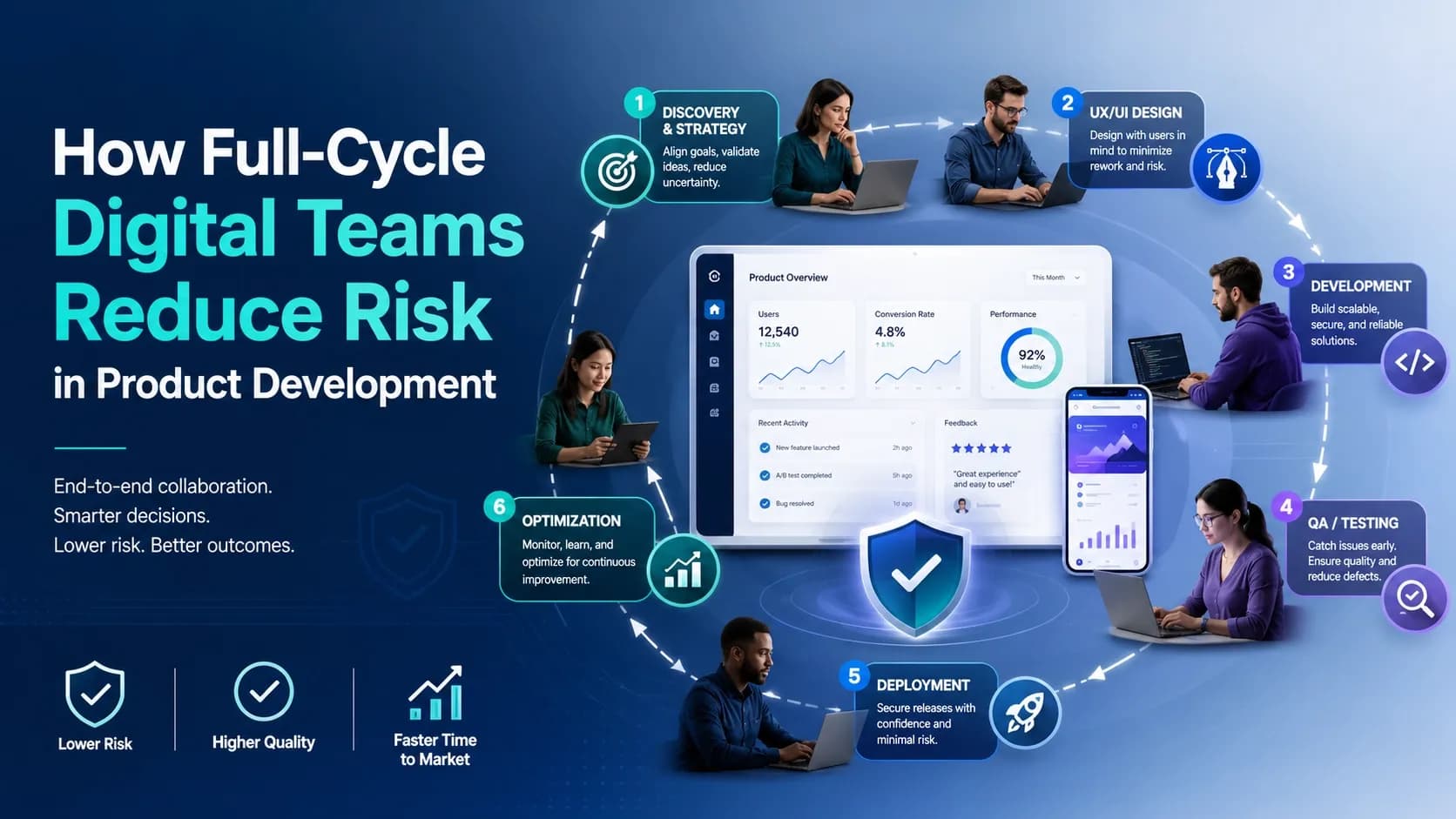
Digital product development rarely follows a straightforward path. Most organizations split the work across separate teams — strategists define requirements, designers craft interfaces, developers write code. Each group operates in its own silo, handing off deliverables to the next team down the line.
This fragmented approach creates gaps. Strategy gets lost in translation. Design decisions are made without technical input. Development teams discover late that what was designed cannot be built within the constraints. The result is delays, rework, and products that fail to meet user expectations.
Full-cycle digital teams offer a different model. By bringing together strategy, design, and development under one roof, they maintain alignment throughout the entire product lifecycle. This article explores how the integrated approach reduces risk, improves quality, and keeps everyone focused on the same goals.
Why Fragmented Product Delivery Creates Business Risk
When product development is split across separate teams, the handoffs between them become a primary source of risk. Each transition introduces opportunities for miscommunication, lost context, and divergent priorities. These risks typically emerge in three specific areas.
How Separate Teams Make Decisions Without Shared Context
Product strategy teams typically work in isolation from those who will eventually build the product. They define requirements based on business goals and market research, often without understanding technical constraints or design implications. Designers then interpret these requirements, creating interfaces that may not account for development realities.
Developers receive design files and specifications, but by this point, much of the original context has been lost. The rationale behind certain decisions and trade-offs often remains unclear to them. This lack of shared context leads to decisions that work in isolation but conflict when integrated.
Why Handoffs Create Delays, Rework, and Miscommunication
Each handoff between teams introduces friction. Questions arise that require going back up the chain. Assumptions are challenged late in the process. Technical limitations are discovered only after significant work has been completed.
These delays compound across the project timeline. What should have been a straightforward development task becomes a cycle of clarification, redesign, and rework. The cumulative effect is a product that takes longer to build, costs more than planned, and still fails to deliver on the original vision.
How Shared Ownership Improves Product Delivery
When strategy, design, and development teams work together continuously, accountability becomes shared. In this case, everyone owns the outcome. The shared ownership encourages proactive problem-solving rather than finger-pointing when issues arise.
Establishing a Shared Product Direction
Before any design or development begins, everyone involved needs to understand what the product is supposed to achieve. A shared direction prevents teams from working toward different goals.
Clarifying the Problem the Product Should Solve
The starting point for any successful product is a clear problem statement.This means identifying the user needs the offering serves and the shortcomings of current alternatives. Answering such questions demands input from business stakeholders, potential users, and technical specialists.
Without a shared understanding of the problem, solutions become disconnected from real needs, and teams build features that seem logical in isolation but fail to address actual pain points.
Defining Users, Business Goals, and Success Criteria
Defining who the product serves and what success looks like provides the foundation for all subsequent decisions. This involves identifying target user segments, understanding their workflows, and establishing measurable outcomes.
Business goals should also be explicit. Is the priority user acquisition, revenue growth, or operational efficiency? The answer influences every decision about features, design, and technology choices. Without this clarity, teams make trade-offs based on assumptions rather than shared priorities.
Aligning Stakeholders Before Design and Development Begin
Stakeholder alignment is often the most challenging part of the process. Different groups have different priorities, and resolving these conflicts upfront prevents them from derailing the project later.
Product discovery workshops bring all stakeholders together to discuss expectations, constraints, and priorities. These sessions surface disagreements early, when they are easier to resolve. A structured discovery phase also helps teams identify what they do not yet know, reducing the risk of assumptions leading to rework down the line.
Turning Product Strategy Into a Realistic Scope
Strategy needs to translate into actionable work. Without a clear scope, teams waste time building low-priority features or pursuing unrealistic timelines. The following steps help turn the strategy into a realistic plan.
Mapping the Core User Journey
The user journey map shows how people interact with the product from first contact to goal completion. This framework helps decide which features are essential and which can wait. It also ensures the product delivers a complete, coherent experience.
Prioritizing Features for the First Release
Not everything needs to be included in the initial release. The first version should deliver enough value to attract and retain users while keeping the scope manageable. Prioritization decisions should consider user impact, development effort, and business value. Features that deliver high value with low effort should take priority over those requiring significant investment with uncertain returns.
Building a Roadmap That Balances Speed and Future Growth
A roadmap communicates the sequence of releases and their timing. It reconciles speed-to-market with the long-term product direction. The initial version should provide a stable base that allows for future enhancements without forcing a ground-up rebuild. A solid roadmap keeps everyone aligned on key milestones while leaving room for adjustments based on user feedback.
Keeping Product Design and Development Aligned
Design and development often drift apart when they work separately. Maintaining alignment requires continuous collaboration rather than a one-time handoff. This alignment depends on several key practices.
Involving Technical Specialists in Early Product Decisions
Technical choices affect what is feasible in the interface, and interface decisions carry engineering consequences. When engineers are excluded from early discussions, they inherit constraints they had no role in shaping.
Full-cycle teams bring technical specialists into product conversations before layouts are finalized. This reduces the friction of late-stage changes and ensures that what is planned can actually be built.
Testing Product Ideas Through Wireframes and Prototypes
Wireframes and prototypes test design concepts before significant resources are committed. They expose usability issues early, allow stakeholders to visualize the product, and provide a shared reference point for discussions.
Prototyping is particularly valuable when development constraints are unclear. Testing a high-fidelity prototype with users reveals whether the product direction is sound before code is written.
Building Shared Components and a Scalable Design System
A design system establishes standards for UI elements, keeping the product cohesive as it evolves. When designers and developers agree on these standards upfront, consistency persists even as new features are added. Such a system also cuts the effort required to build new screens, removing the need to recreate components from scratch.
Managing Delivery Without Losing Product Quality
Delivering on time is important, but not at the expense of quality. The challenge is maintaining standards while moving efficiently through the product development process. Managing this balance requires attention to coordination, testing, and scope control.
Coordinating Designers, Developers, and Product Stakeholders
Coordinating cross-functional teams requires structured processes and clear communication. Regular check-ins, shared documentation, and transparent progress tracking keep everyone aligned. A single point of accountability — whether a product lead or project manager — ensures decisions are made and communicated effectively.
Testing Core Workflows Across Devices and Use Cases
Core workflows need to work reliably across the range of devices and contexts where users interact with the product. Testing these workflows early and often catches issues before they become embedded in the codebase.
The initial release should prioritize stability over feature quantity. A stable product with a limited feature set builds trust, while a feature-rich but unreliable product drives users away.
Managing Scope Changes Without Losing the Product’s Direction
Scope changes are inevitable. New information emerges, market conditions shift, stakeholder priorities evolve. Managing these changes effectively requires a process for evaluating their impact. Clear criteria help decide whether a shift is worth pursuing:
- Does this change justify the additional time and resources?
- What will be deprioritized to accommodate it?
- Does the shift align with overall product goals and user needs?
Preparing the Product for a Coordinated Launch
Launch readiness requires more than a working product. Supporting systems, processes, and documentation also need attention before users arrive. Let’s look at what needs to be in place before launch day.
Checking Performance, Reliability, and Responsiveness
Performance issues undermine user confidence. Slow loading times, unresponsive interactions, or downtime during critical moments all damage trust. Pre-launch testing should identify and resolve performance bottlenecks, with attention to network conditions, device capabilities, and expected traffic volumes.
Preparing Analytics, Support, and Release Processes
Understanding how people interact with the product requires analytics from the start. Event tracking should be in place to capture user behavior, feature adoption, and potential friction points. Support processes — including documentation, escalation paths, and response times — also need to be established before launch.
Resolving Critical Issues Before the Product Reaches Users
Some issues require resolution before launch, particularly critical ones. These include security vulnerabilities, data loss risks, and usability blockers that would prevent people from completing core tasks. Prioritization ensures the team focuses on what matters most without holding up the entire release for minor problems.
Supporting Continuous Improvement After Launch
Launch marks the beginning of a product’s lifecycle, with ongoing iteration following naturally. Keeping the offering relevant and competitive requires continuous attention to user feedback and performance data. This phase brings its own set of priorities.
Learning From User Behavior and Feedback
User behavior reveals where the product works well and where it falls short. Analytics, session replays, and user interviews all provide input for future decisions. Feedback loops ensure that what is learned translates into action.
Prioritizing Improvements Based on Product Data
Prioritization of improvements should be driven by data. Features that are rarely used may need better discoverability, while frequently used ones that cause frustration require refinement. Frameworks that weigh effort against impact help focus resources on what truly matters.
Scaling Features Without Creating Design and Technical Fragmentation
As the product evolves, new features should integrate seamlessly into the existing experience. A design system and consistent architecture support this integration, preventing fragmentation. Without such discipline, the product becomes disjointed, confusing, and increasingly difficult to maintain.
When a Full-Cycle Digital Team Is the Right Model
A full-cycle digital team is not necessary for every product development effort, yet many benefit from the integrated approach. The following conditions suggest this model is appropriate.
When a Company Does Not Have a Complete Internal Product Team
Building a full internal team takes time and resources. Recruitment, onboarding, and ramp-up periods delay progress, and the costs add up quickly. An integrated model provides the necessary capabilities without the hiring overhead, enabling companies to move even without in-house specialists
This approach also offers flexibility. Teams can scale up or down as project needs shift, without the long-term commitment of permanent hires. For organizations with fluctuating demand or tight timelines, this adaptability makes a significant difference.
When a Complex Product Requires Multiple Connected Disciplines
Some product initiatives are too complex for fragmented execution. When strategy, design, and development operate in isolation, the margin for error widens substantially. A full-cycle team reduces that risk by maintaining continuous alignment across disciplines. This model proves especially valuable when:
- The product serves different user types with distinct needs and permissions.
- Integration with external systems or third-party services is required.
- Workflows span multiple steps, dependencies, or decision points.
When the Business Needs One Team Accountable for Delivery
Having a single team accountable for the outcome simplifies governance. There is no ambiguity about who owns what, reducing friction and enabling faster decision-making. One team accountable for delivery also means fewer handoffs and less opportunity for miscommunication.
From Silos to Shared Outcomes
The most successful digital products come from teams that work together continuously. Product discovery, design, and delivery are interconnected activities that should inform one another throughout the process. A full-cycle model builds this integration into how teams operate.
Specialists like Halo Lab demonstrate how combining such disciplines under one roof prevents the common pitfalls of fragmented delivery. When alignment is built into the process rather than applied as an afterthought, the product is stronger, the timeline is shorter, and the outcome is more likely to succeed.