On this page
AI Website Builder Market Share and Statistics 2026: Adoption, Growth and Leading Platforms

WebbyCrown Solutions-
September 16, 2026-11 min read
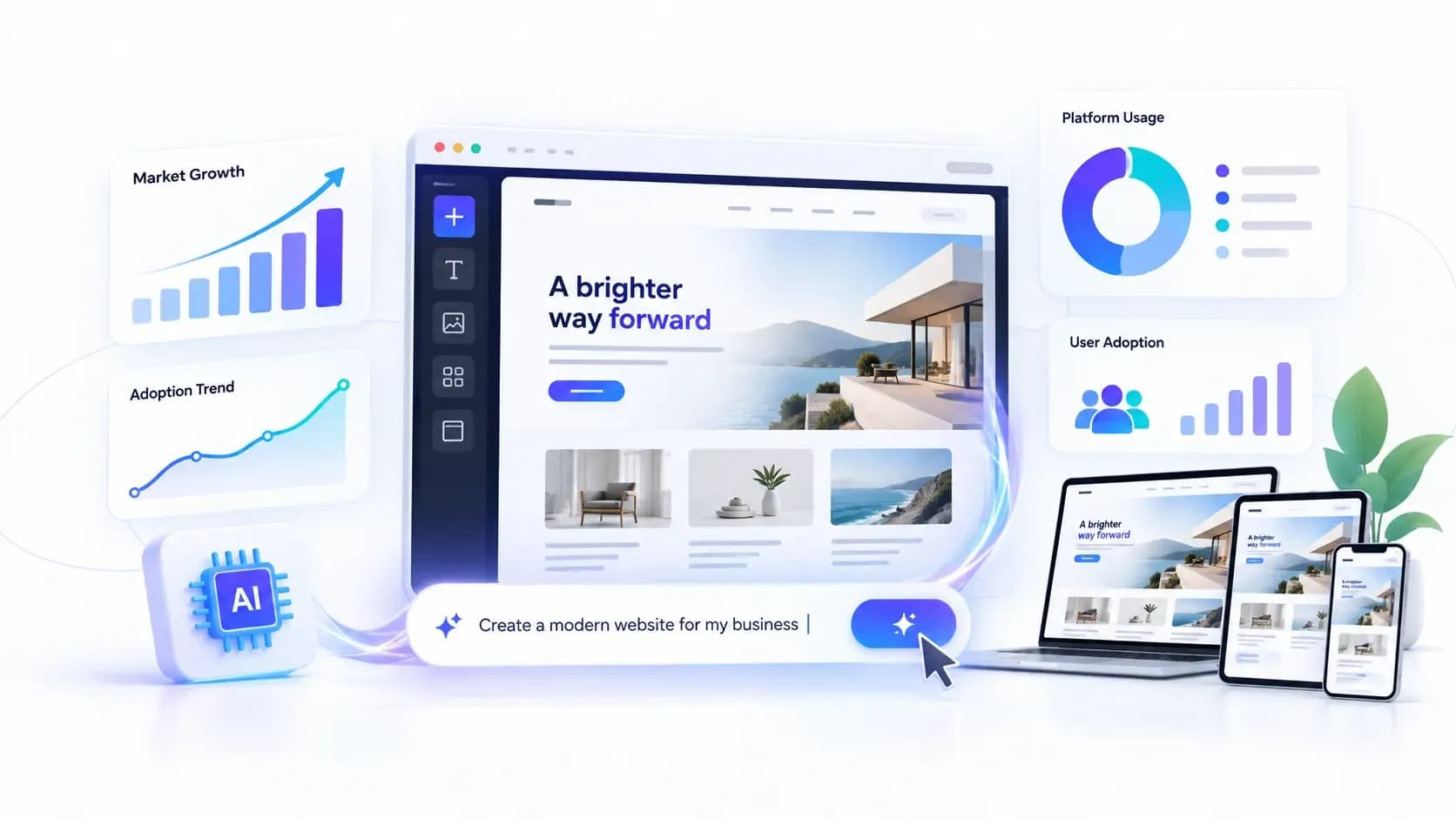
AI website builders have moved from experimental tools to visible features inside mainstream website platforms. Wix, Webflow and Framer now promote AI-assisted site creation, while specialist tools compete on speed, automation and prompt-based workflows. That growth creates a tempting headline: which AI website builder has the largest market share?
The honest answer is that public data does not yet provide a reliable platform-by-platform share of websites actually created with AI. Available sources measure different things: market revenue, total platform usage, CMS usage, survey sentiment or the availability of AI features. This report separates those measures so readers can compare the market without turning unrelated numbers into false AI adoption claims.
The AI-powered website builder market is growing quickly, but there is no authoritative public dataset that shows what percentage of all websites were generated with AI or how that usage is divided among Wix, Framer, Webflow and other platforms. Precedence Research estimates the market at $3.24 billion in 2026 and forecasts $17.43 billion by 2035. W3Techs separately reports overall CMS usage—not AI-generated usage—with Wix at 4.2% of all websites, Webflow at 0.8% and Framer at 0.2% on September 15, 2026. These figures describe platform footprint and must not be presented as AI website builder market share.
Key AI Website Builder Statistics
- Precedence Research estimates the global AI-powered website builder market at $3.24 billion in 2026, rising to about $17.43 billion by 2035 at a 20.55% CAGR.
- The same forecast estimates North America held about 43% of the AI-powered website builder market in 2025.
- Market.us offers a different forecast: $3.17 billion in 2023 and $31.5 billion by 2033, with a 25.8% CAGR. The difference illustrates why market estimates should not be blended into one definitive total.
- Mordor Intelligence estimates the broader website builders market—not only AI builders—at $3.57 billion in 2026 and $7.67 billion by 2031.
- W3Techs reports Wix on 4.2% of all websites, Webflow on 0.8% and Framer on 0.2% as of September 15, 2026. Those are overall CMS/platform usage figures.
- Wix, Webflow and Framer each offer official AI site-building capabilities, but their public feature pages do not disclose a comparable count of active AI-generated sites.
What Counts as an AI Website Builder?
An AI website builder uses artificial intelligence to help generate or modify website structure, layout, copy, visuals, code or components. A qualifying product may create a complete initial site from a prompt, assist with individual sections, or combine automated generation with a visual editor.
That definition is wider than “a website generated entirely by AI.” Many platforms use hybrid workflows: AI creates a starting point and a person refines it with drag-and-drop controls, a canvas or code. For market analysis, the useful distinction is between an AI-enabled platform and an AI-generated website. Public data often measures the former but rarely isolates the latter.
AI Website Builder Market Size and Growth
Commercial research firms agree on rapid growth, although their estimates differ because they use different definitions, base years, samples and forecasting models. Treat each forecast as one firm’s model rather than a verified count of transactions across the entire industry.
| Source | Market definition | Starting value | Forecast | Reported CAGR |
|---|---|---|---|---|
| Precedence Research | AI-powered website builders | $3.24B in 2026 | $17.43B by 2035 | 20.55% for 2026–2035 |
| Market.us | AI-powered website builders | $3.17B in 2023 | $31.5B by 2033 | 25.8% for 2024–2033 |
| Mordor Intelligence | Broader website builders market | $3.57B in 2026 | $7.67B by 2031 | 16.58% for 2026–2031 |

The forecasts are not directly comparable. Precedence Research and Market.us label their subject as AI-powered website builders, while Mordor Intelligence covers the broader website builders market and identifies AI design assistance as one growth driver. Their endpoints also differ. A responsible article should show these numbers side by side without averaging them.
Can AI Website Builder Market Share Be Measured?
Only in limited ways. Revenue-share studies can estimate segments such as geography, deployment model or application type. Website-technology trackers can estimate how many websites use a platform. Neither method automatically reveals whether AI generated the site.
For example, Precedence Research estimates North America represented nearly 43% of AI-powered website builder revenue in 2025. That is regional revenue share, not the share held by Wix, Webflow, Framer or another vendor. Similarly, W3Techs can detect technologies on websites, but it does not publish a comparable “created with AI” flag for every platform.
Overall Platform Usage in 2026
The table below provides useful context for the footprint of selected website platforms. It does not rank their AI products. W3Techs publishes two percentages: usage among all websites and market share among websites with a known CMS. Both denominators matter.
| Platform | Share of all websites | CMS market share | What the number means |
|---|---|---|---|
| Wix | 4.2% | 6.2% | Overall detected platform/CMS usage |
| Webflow | 0.8% | 1.2% | Overall detected platform/CMS usage |
| Framer | 0.2% | 0.3% | Overall detected platform/CMS usage |

Source date: September 15, 2026. These percentages can support statements such as “Wix has a larger overall detected website footprint than Webflow or Framer.” They cannot support statements such as “Wix owns 4.2% of the AI website builder market.”
How Leading Platforms Use AI
The platforms below are included because each publishes an official AI product page. The comparison describes public capabilities, not quality rankings or AI market share.
| Platform | Official AI positioning | Human editing after generation |
|---|---|---|
| Wix | Creates a business-ready website from a prompt and supports AI-generated pages, sections, visuals and custom elements. | Yes. Wix combines conversational AI with drag-and-drop editing. |
| Webflow | Generates an entire website and scalable design system from a prompt; also supports design, copy, code and optimization assistance. | Yes. The generated site remains part of the Webflow design and management workflow. |
| Framer | Positions its product as an AI website builder and canvas agent for designers and teams. | Yes. AI output is created in an editable visual canvas. |
Wix AI Website Builder
Wix describes a prompt-to-site workflow that creates a business-ready website and allows users to switch between its AI agent and manual drag-and-drop editing. Its official page also lists AI assistance for pages, sections, visuals, custom elements, marketing and SEO tasks. This makes Wix an example of AI integrated into a broader managed website and business platform.
Webflow AI Site Builder
Webflow says its AI site builder can generate an entire website with a scalable design system from a basic prompt. Its wider AI offering also covers modifying page designs, generating copy, generating code and optimizing for conversion. The product remains connected to Webflow’s visual development and CMS environment.
Framer AI
Framer positions its AI offering as a website builder for designers and teams, with AI agents working directly on the canvas. That framing emphasizes collaborative generation and visual refinement rather than a one-click output that cannot be edited.
Why AI Website Builder Adoption Is Growing
Adoption is being driven less by a single breakthrough and more by the removal of several small barriers in the website creation process.
- Faster first drafts: prompts can create a site structure, layout and initial copy before manual refinement begins.
- Lower technical barriers: founders and small teams can test an idea without beginning with code or an empty canvas.
- Integrated workflows: mainstream platforms are adding AI inside existing hosting, CMS, ecommerce and marketing products.
- Shorter iteration cycles: teams can generate alternatives for sections, copy and visuals and then edit the selected direction.
- More accessible prototyping: agencies and internal teams can use AI output to align on scope before committing to a final build.
These advantages explain interest, but they do not guarantee a finished website will be distinctive, accurate, accessible or conversion-ready. Human review remains important.
AI Website Builders vs AI Website Templates
An AI website builder generates or changes a site through an AI-assisted platform. An AI website template is a predesigned interface created for an AI company, chatbot, agent, automation product or SaaS brand. The word “AI” describes the building method in the first case and the website’s subject or market in the second.
Teams that want a ready-made visual foundation can browse AI-focused website templates. A template can offer more predictable layout and brand control, while an AI builder can accelerate exploration and early drafting. Many teams use both approaches.
For broader context on formats, pricing and demand, see WebbyTemplate’s website template market statistics. The present report stays focused on AI-enabled builders and does not repeat the template-market analysis.
What the Available Statistics Do Not Prove
- They do not reveal the percentage of all websites generated partly or entirely by AI.
- They do not provide a reliable vendor share of active AI-generated websites.
- They do not show whether a detected Wix, Webflow or Framer site used the platform’s AI features.
- They do not establish that a larger overall platform footprint means a better AI builder.
- They do not make forecasts from different research firms directly comparable.
- They do not measure design quality, accessibility, SEO performance or conversion rate without separate testing.

How to Evaluate an AI Website Builder
Market size is useful for understanding category momentum, but a buying decision should focus on the workflow and the final website. Evaluate each tool against the same practical criteria.
- Editing control: Can you refine layouts, components, responsive behavior and brand details after generation?
- Content ownership: Can you export, migrate or retain control over the site and its assets?
- CMS and business features: Does the platform support the content, ecommerce, forms, localization or integrations you need?
- SEO controls: Can you edit metadata, canonical URLs, redirects, structured data and crawl settings?
- Accessibility: Does the workflow support semantic structure, alt text, keyboard navigation and manual testing?
- Performance: Test generated pages on real devices instead of assuming AI output is automatically fast.
- Privacy and governance: Review what data is sent to AI systems and whether team permissions and audit controls meet your requirements.
- Total cost: Include hosting, paid plans, collaborators, apps, domains and future migration—not only the entry price.
If the choice is between a packaged layout and a bespoke build, the guide to website templates versus custom design provides a separate decision framework.
Implications for Founders, Designers and Agencies
For founders and small businesses
AI builders can reduce the time required to test a message or launch an initial site. The main risk is treating the generated draft as finished. Verify claims, rewrite generic copy, connect analytics, test forms and payments, and review mobile layouts before publishing.
For designers
AI shifts effort from producing the first draft to directing, evaluating and refining alternatives. Strong design systems, information architecture and accessibility judgment become more—not less—important when generation is fast.
For agencies
AI can make discovery prototypes and early content models faster. Agencies should define where automation ends, what human review includes and how client data is handled. Clear scope prevents “generated quickly” from being confused with “finished cheaply.”
Methodology and Limitations
This article uses public pages available on September 15, 2026. Platform capabilities come from official Wix, Webflow and Framer pages. Website usage percentages come from W3Techs. Market-size estimates come from commercial research firms and are attributed individually.
The data sources use different methods and denominators. W3Techs detects technologies on websites and reports both all-web usage and CMS market share. Market-research firms estimate revenue for categories they define themselves. Official product pages confirm features but do not provide independently audited adoption totals. For those reasons, this article does not calculate a vendor leaderboard for AI-generated websites.
FAQs
Q1.
How large is the AI website builder market in 2026?
Q2.
What is the forecast for the AI website builder market?
Q3.
Which AI website builder has the largest market share?
Q4.
Is Wix market share the same as AI website builder market share?
Q5.
What percentage of websites use Wix?
Q6.
What percentage of websites use Webflow?
Q7.
What percentage of websites use Framer?
Q8.
Do Wix, Webflow and Framer all have AI website builders?
Q9.
Are AI website builders replacing website templates?
Q10.
Are AI-generated websites automatically SEO-friendly?
Final Takeaway
AI website builders are becoming a standard capability across established platforms and AI-first products, and market forecasts point to continued growth. The strongest conclusion is not that one vendor owns a verified share of AI-generated websites; public data cannot support that claim. The defensible story is that AI-assisted creation is expanding, major platforms now offer prompt-based workflows, and buyers should compare editing control, platform fit, governance and final-site quality.
For publishers and analysts, accuracy depends on keeping three measures separate: AI website builder revenue forecasts, overall website-platform usage and verified product capabilities. That separation makes the statistics more useful to readers, search engines and AI answer systems.