On this page
AI Chatbot Usage Statistics 2026: Adoption, Business Use and Customer Preferences

WebbyCrown Solutions-
September 18, 2026-12 min read
AI chatbots are no longer a single-purpose customer-service widget. People use conversational AI to ask questions, draft content, learn, research and make decisions, while organizations deploy chatbots across service, knowledge management, marketing, sales and internal operations. The numbers are large, but they are also easy to misread.
This report brings together current public evidence and keeps unlike measures separate. A global estimate of generative AI use is not the same as the number of chatbot users. A survey of business leaders is not a census of companies. A platform’s weekly audience is not its market share. Those distinctions matter if the statistics are going to inform a product, investment or content decision.
AI chatbot use is mainstream and still expanding. Microsoft estimated that 16.3% of the world’s population used generative AI in the second half of 2025—roughly one in six people. McKinsey’s 2026 global survey found that nearly nine in ten respondents said their organizations regularly used AI in at least one business function, while 47% said their organizations were scaling chatbots across the enterprise. These figures measure different populations and should not be combined into one adoption rate.
Key AI Chatbot Statistics for 2026
- Global generative AI adoption reached 16.3% in the second half of 2025, according to Microsoft’s AI Diffusion report.
- Microsoft measured 28.3% usage among the US working-age population in the same report.
- OpenAI reported that ChatGPT had more than 700 million weekly active users by July 2025 in a large-scale study of consumer usage.
- In that OpenAI study, non-work messages grew from 53% of consumer ChatGPT messages in June 2024 to 73% in June 2025.
- Nearly nine in ten respondents to McKinsey’s 2026 global survey reported regular AI use in at least one business function.
- Forty-seven percent of McKinsey respondents said their organizations were scaling chatbots across the enterprise—the highest share among the AI tool types compared in that survey.
- Eighty percent of McKinsey respondents said AI improved their individual productivity, while 50% said it helped them make better decisions.
- Only 37% of McKinsey respondents attributed at least some positive EBIT impact to AI, showing that widespread use does not automatically produce enterprise-level financial results.
What Counts as an AI Chatbot?
An AI chatbot is a conversational interface that interprets user input and generates a response. Modern chatbots often use large language models, retrieval systems, business data and software tools. They may answer questions, summarize information, create content, qualify leads, resolve service requests or help employees complete tasks.
The term covers several different products. A general-purpose assistant such as ChatGPT is not the same as a customer-support bot trained on one company’s knowledge base. A rules-based chat flow is not the same as a generative chatbot. An AI agent can go further by planning and taking actions across tools. Statistics that group all of these systems together need to be read carefully.
Global AI Chatbot Adoption
No public census counts every AI chatbot user. The best large-scale indicators use platform activity, surveys or modeled telemetry, and each has a different denominator.
| Measure | Latest cited figure | What it measures |
|---|---|---|
| Global generative AI diffusion | 16.3% in H2 2025 | Share of the global population estimated to have used a generative AI product during the period |
| US generative AI diffusion | 28.3% in H2 2025 | Estimated share of the US working-age population using generative AI |
| ChatGPT weekly active users | More than 700M by July 2025 | Weekly activity on one general-purpose AI chatbot, not all chatbots |
| Enterprise chatbot scaling | 47% in McKinsey 2026 survey | Share of survey respondents reporting chatbot scaling across their organizations |
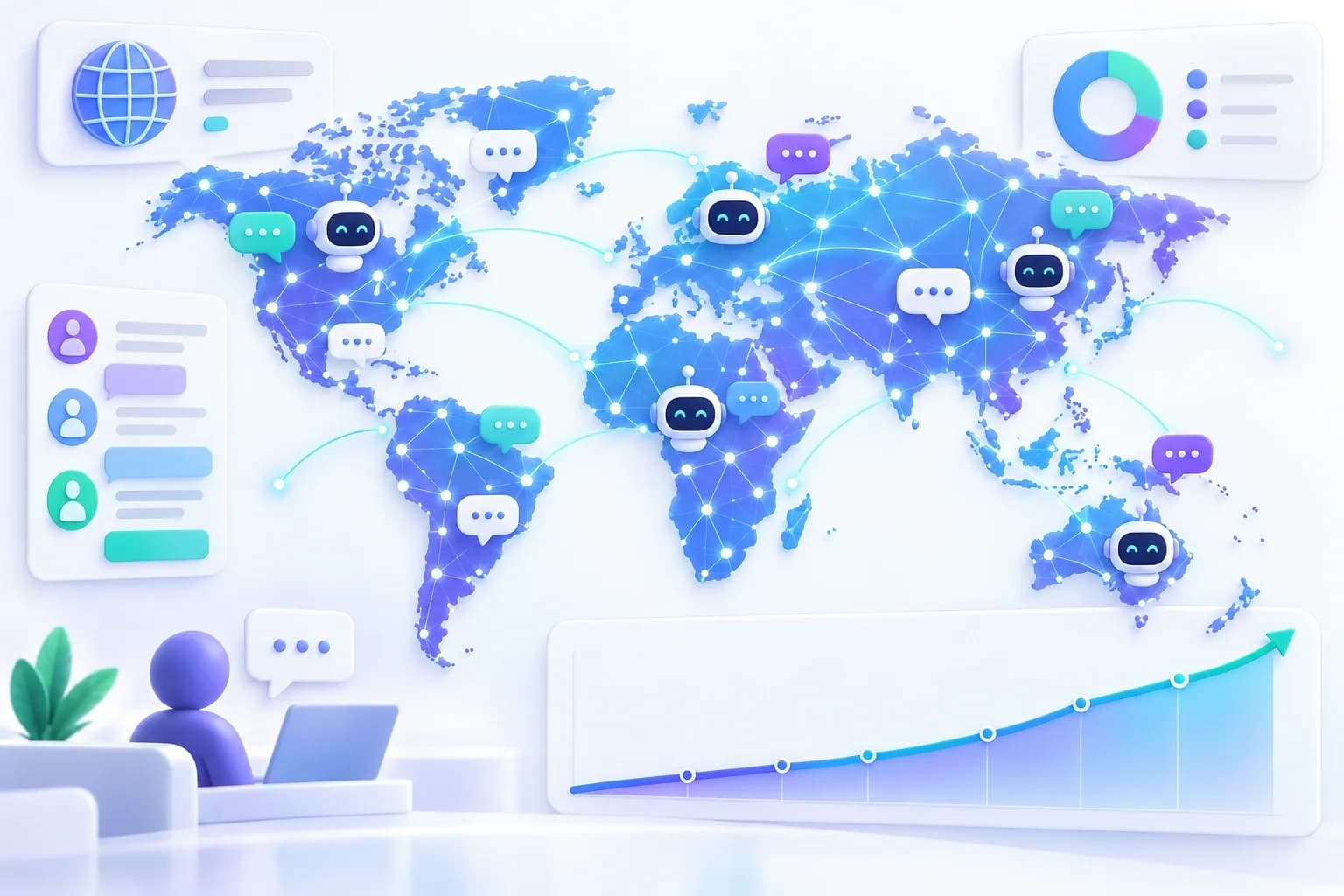
Microsoft’s diffusion estimate is broader than chatbots alone because it covers generative AI products. OpenAI’s weekly user figure is narrower because it describes one platform. McKinsey’s result concerns organizational scaling reported by survey respondents. Presenting them together is useful only when the scope of every number remains visible.
How People Use AI Chatbots
OpenAI’s research with the National Bureau of Economic Research analyzed consumer ChatGPT usage at scale. It grouped conversations by intent and found that the largest categories were practical guidance, seeking information and writing. The study also distinguished between “asking,” “doing” and “expressing,” which helps explain why chatbot use extends beyond workplace automation.
- Practical guidance includes tutoring, advice, how-to support and idea generation.
- Seeking information includes factual questions, product research and explanations.
- Writing includes drafting, editing, summarizing and translating text.
- Work use is important, but consumer use increasingly includes education, everyday decisions and personal tasks.
The study reported that non-work usage rose from 53% of consumer messages in June 2024 to 73% in June 2025. That does not mean workplace use declined in absolute terms; it means personal use grew faster within the studied consumer traffic.
AI Chatbots at Work
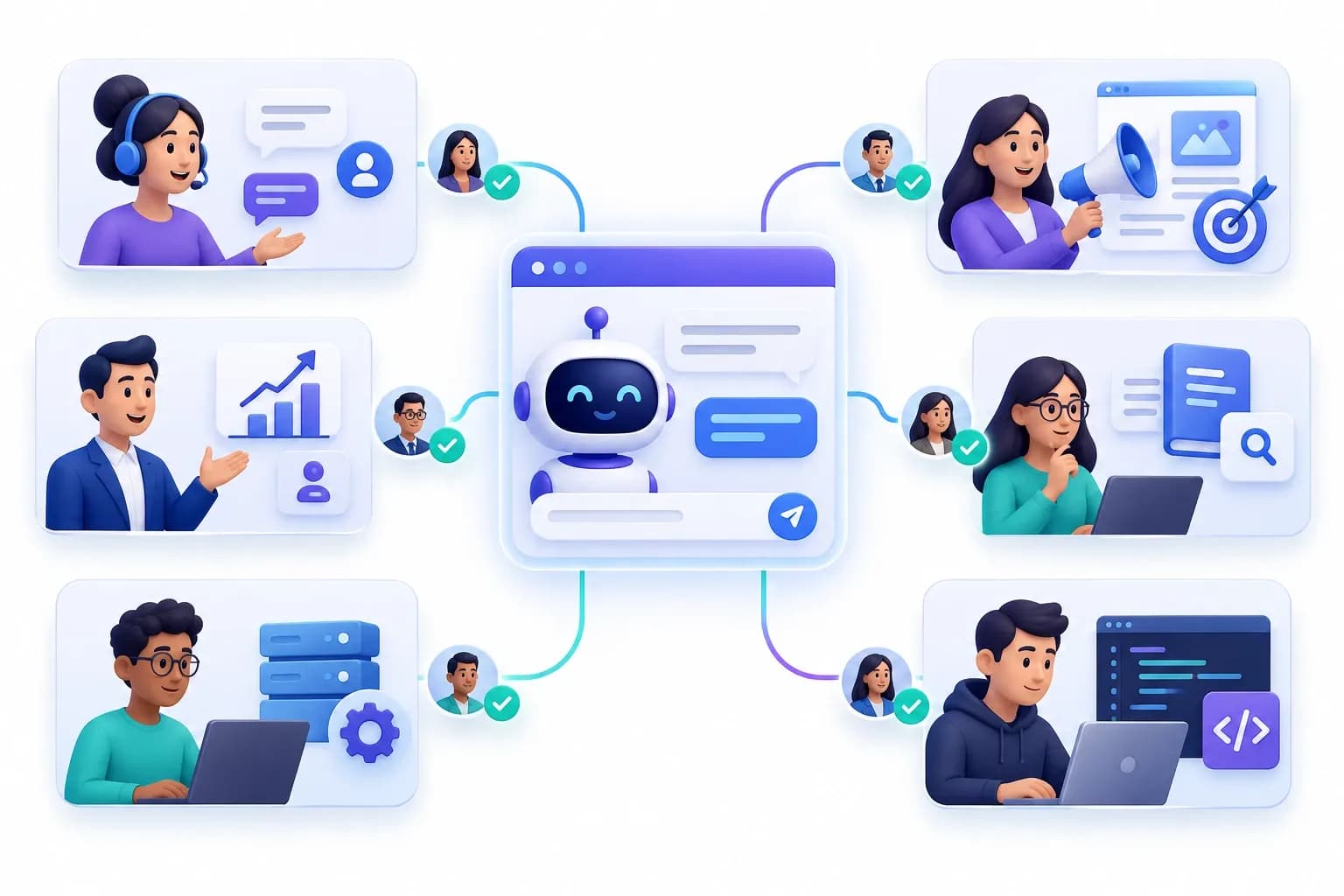
Workplace adoption is uneven. Some employees use public assistants independently, while others use approved enterprise tools connected to company data. Organization-wide scaling requires security, access controls, evaluation, training and a clear process for escalating uncertain results.
McKinsey’s 2026 survey found regular AI use in at least one business function at nearly nine in ten respondent organizations. Fifty-six percent reported AI use in three or more functions, up from 51% a year earlier. Chatbots were the most widely scaled AI tool type in the survey, at 47%.
| Business area | Typical chatbot role | Human control needed |
|---|---|---|
| Customer service | Answer routine questions, retrieve policies and summarize cases | Escalation for exceptions, sensitive issues and high-impact decisions |
| Knowledge management | Search internal information and explain procedures | Source citations, permissions and content ownership |
| Marketing and sales | Draft content, qualify interest and support research | Brand review, factual verification and consent controls |
| IT and operations | Troubleshoot, summarize incidents and guide workflows | Approved actions, audit logs and role-based access |
| Software development | Explain code, draft tests and assist debugging | Code review, security testing and repository controls |
Business Results and the ROI Gap
High adoption does not prove high return. In McKinsey’s survey, 80% of respondents said AI improved their individual productivity and 50% said it improved decision-making. At the same time, only 37% attributed at least some positive EBIT impact to AI, and only about 6% met McKinsey’s definition of an AI high performer.
The gap is reasonable. A chatbot can save minutes on individual tasks without changing a company’s cost structure, customer retention or revenue. Financial impact usually requires redesigned workflows, reliable data, employee adoption, measurement and governance—not just access to a model.
Customer Preferences: Chatbot or Human?
There is no universal customer preference. People often value speed and 24-hour availability for simple requests, but they want a human when a problem is complex, emotional, expensive or difficult to explain. Survey results vary substantially depending on the industry, task, country, age group and wording of the question.
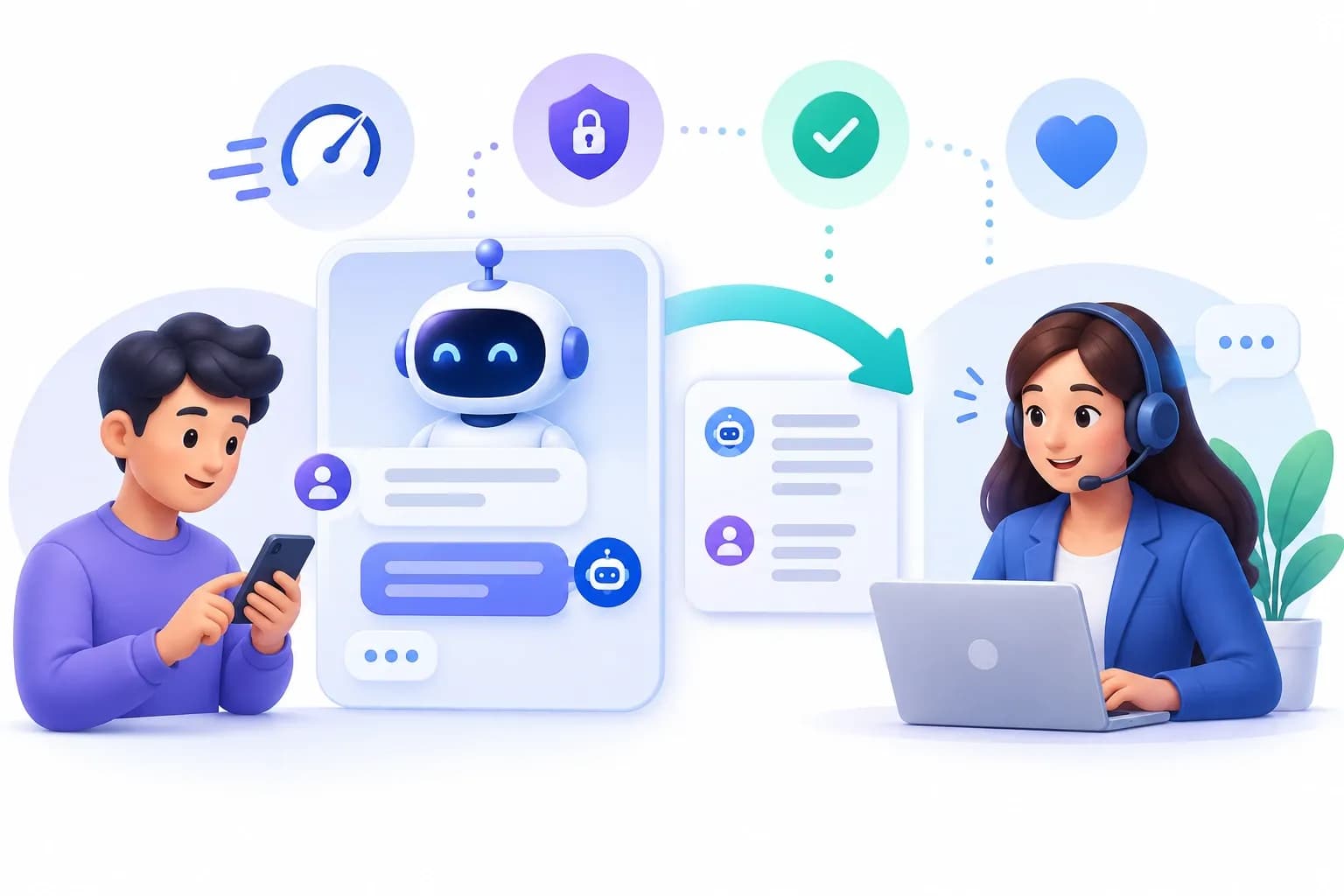
For that reason, the safest product conclusion is not “customers prefer chatbots.” It is that customers prefer a fast resolution and a clear path to human help. A strong service design lets the chatbot handle repeatable requests, identifies low confidence or customer frustration, transfers the context and avoids making the person start again.
- Use a chatbot for status checks, basic product information, appointment handling and known troubleshooting steps.
- Offer a visible human option for billing disputes, safety issues, cancellations, complaints and unusual exceptions.
- Tell users when they are interacting with AI and what will happen to their data.
- Measure resolution, repeat contact and escalation quality—not only containment rate.
AI Chatbots vs AI Agents
A chatbot mainly conducts a conversation. An AI agent may plan steps, call tools and take actions such as updating a record or initiating a workflow. The categories overlap because a chatbot can be the interface to an agent. They should still be evaluated differently: fluent answers are central to a chatbot, while authorization, action limits and auditability become critical when the system can change data or trigger external events.
Teams exploring action-oriented systems can review AI Agent Starter Kits. This article remains focused on chatbot use and does not treat every conversation interface as an autonomous agent.
What Is Driving Adoption?
- Better natural-language interaction makes chatbots useful for questions that do not fit a rigid menu.
- General-purpose assistants introduced millions of people to conversational AI without requiring enterprise software.
- Retrieval and integrations let organizations connect a chatbot to approved content, customer records and internal tools.
- Multimodal systems can work with text, images, audio and documents in one conversation.
- Reusable APIs, plugins and starter kits lower the cost of prototyping a specialized experience.
- Organizations see near-term value in summarization, information access and first-draft generation even before full workflow automation.
The Biggest Barriers to Reliable Chatbot Use
- Accuracy: A confident answer can still be incomplete, outdated or false.
- Privacy: Users may enter personal, confidential or regulated information without understanding how it is handled.
- Permissions: A connected chatbot should retrieve and change only the data the current user is allowed to access.
- Evaluation: A short demonstration does not reveal performance across real questions, languages and edge cases.
- Escalation: Users lose trust when the system blocks access to a person or transfers the conversation without context.
- Cost: Token usage, retrieval, monitoring, human review and integration work all affect total operating cost.
- Governance: Teams need owners, approved use cases, logs, retention rules and a process for incidents.
How Businesses Should Measure an AI Chatbot
| Metric | Why it matters | Common mistake |
|---|---|---|
| Resolved outcome | Shows whether the user’s actual need was completed | Counting every conversation as success |
| Escalation quality | Tests whether the human receives context at the right time | Optimizing only for fewer escalations |
| Answer accuracy | Measures factual and policy correctness on a test set | Relying on a few hand-picked prompts |
| Customer effort | Shows how hard the user worked to reach an answer | Using response speed as a proxy for experience |
| Repeat contact | Reveals unresolved or misleading answers | Ignoring customers who return later |
| Cost per resolved case | Connects model and support costs to outcomes | Tracking token price without total workflow cost |
| Safety and privacy incidents | Makes operational risk visible | Treating governance as a launch checklist only |
Choosing a Chatbot Implementation Approach
A general-purpose assistant is suitable for broad personal productivity. A website chatbot can answer sales or support questions. A retrieval-based chatbot can use a controlled knowledge base. A connected chatbot can read or write business data through approved tools. The right architecture depends on what the system must know, what it may do and how much risk an incorrect response creates.
For implementation starting points, browse RAG and AI Chatbot Starter Kits and AI Plugins and Integrations. A starter kit can accelerate development, but it does not replace data governance, evaluation, security review or production monitoring.
If the chatbot is part of a new marketing site, compare the surrounding platform separately in WebbyTemplate’s AI website builder statistics report. Website-builder adoption and chatbot adoption are different markets and should not share the same claims.
Methodology and Limitations
This article uses public information available on September 18, 2026. It prioritizes primary or first-party research and identifies the population behind each statistic. Core sources include Microsoft’s AI Diffusion report, OpenAI and NBER research on consumer ChatGPT usage, and McKinsey’s 2026 global survey of organizations.
The sources are not directly comparable. Microsoft models generative AI diffusion using aggregated and anonymized telemetry adjusted for factors such as device share, internet penetration and population. OpenAI’s study analyzes consumer ChatGPT activity and does not represent every chatbot. McKinsey reports survey responses rather than a census of all businesses. Customer-preference findings are described directionally because published surveys use different tasks, samples and wording.
Statistics may change after publication. Cite the source and measurement date, avoid combining denominators, and do not convert an adoption percentage into a market-share claim.
FAQs
Q1.
How many people use AI chatbots in 2026?
Q2.
What percentage of people use generative AI?
Q3.
How many people use ChatGPT?
Q4.
How widely do businesses use AI chatbots?
Q5.
What are AI chatbots mainly used for?
Q6.
Do customers prefer chatbots or human support?
Q7.
Do AI chatbots improve productivity?
Q8.
Are AI chatbots the same as AI agents?
Q9.
What is the biggest risk of an AI chatbot?
Q10.
How should a company evaluate an AI chatbot?
Final Takeaway
AI chatbot adoption is broad enough to influence consumer behavior, workplace productivity and enterprise software strategy. The most defensible 2026 story is not one headline number. It is a set of related signals: global generative AI use has reached roughly one in six people, major chatbot platforms serve audiences measured in hundreds of millions, and chatbots are the most widely scaled AI tool type in McKinsey’s latest organizational survey.
The opportunity is real, but adoption is not the same as value. Businesses still need reliable data, human escalation, permissions, evaluation and outcome-based measurement. Publishers should keep user counts, population adoption, survey results and market share separate. That discipline makes the article more useful to readers, search engines and AI answer systems.