On this page
Why GEO Services Are Becoming an Essential Part of Online Visibility Strategies

WebbyCrown Solutions-
July 22, 2026-6 min read
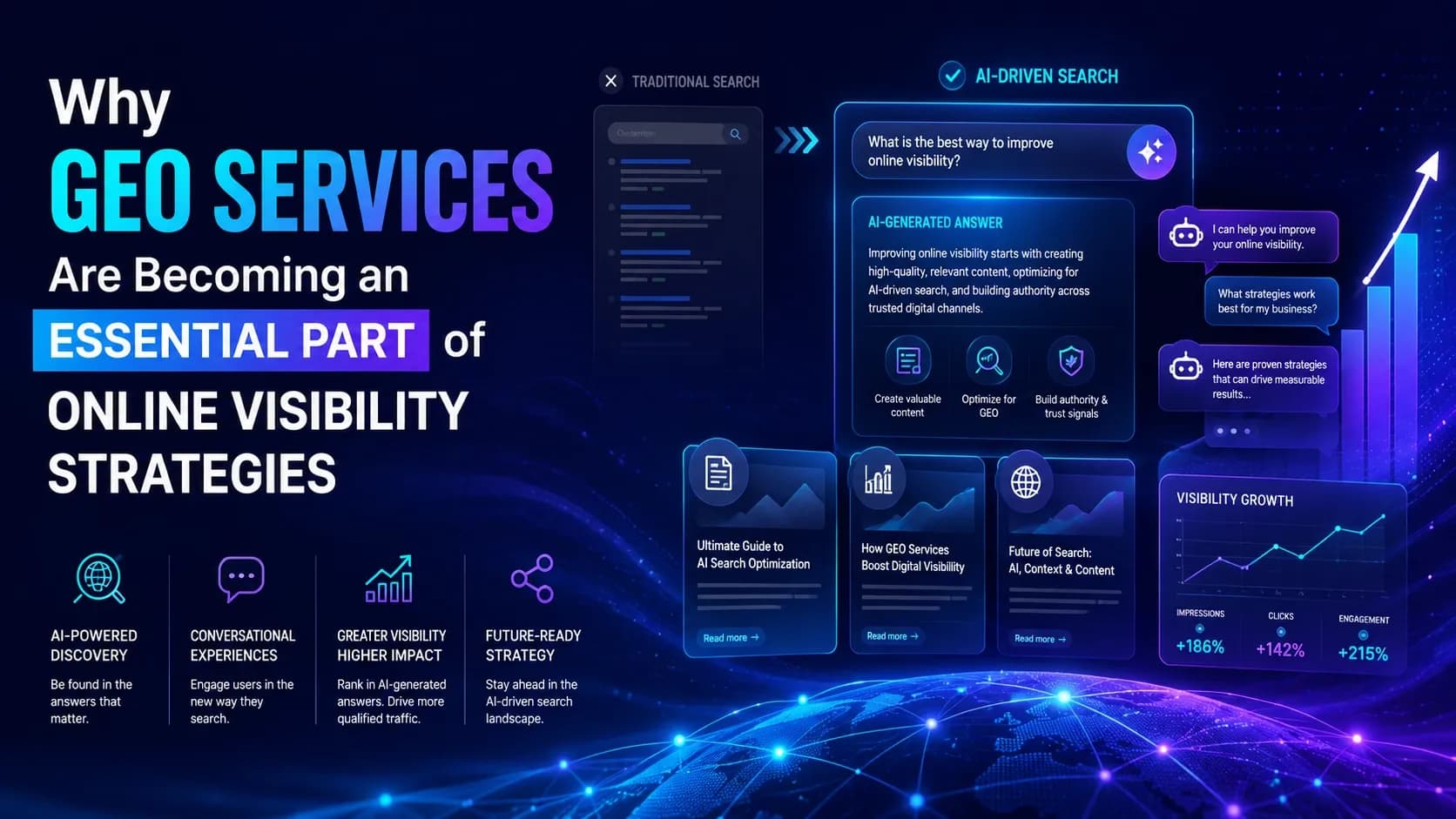
Search visibility is no longer just about ranking blue links on a results page. Increasingly, people are getting answers from AI-generated summaries, conversational search tools, and assistants that synthesise information before a user ever clicks through to a website. That shift has major implications for brands, publishers, and service providers that still rely on traditional SEO alone.
This is where GEO, or Generative Engine Optimisation, enters the conversation.
GEO focuses on improving how your content is understood, selected, and cited by AI-driven search experiences. It’s not a replacement for SEO, but it is quickly becoming a necessary extension of it. If your audience is asking questions in natural language and receiving machine-generated responses, then your visibility strategy has to account for that reality.
Search Has Moved Beyond the Ten Blue Links
For years, search strategy was built around a familiar model: identify keywords, create relevant pages, earn authority, and compete for rankings. That model still matters, but user behaviour is changing faster than many teams expected.
People now search in longer, more conversational ways. They ask follow-up questions. They expect complete answers, not just a list of websites. And when generative search tools provide those answers directly, the competition is no longer just about being on page one. It’s about being the source those systems rely on.
That changes the visibility equation in a few important ways.
Visibility Is Becoming More Layered
A brand can technically rank well and still lose attention if an AI overview answers the user’s query without requiring a click. On the other hand, a site that doesn’t hold the top organic position may still influence the answer if its content is especially clear, trustworthy, and well-structured.
In other words, search presence is no longer linear. It’s layered across organic listings, featured snippets, AI summaries, knowledge panels, and conversational interfaces.
Authority Needs to Be Machine-Readable
Generative systems don’t just look for relevance. They look for confidence signals they can interpret at scale: structured information, topical depth, consistency, authoritativeness, and content that directly answers likely questions. If a page is vague, bloated, or thin on substance, it becomes much harder for AI systems to extract useful insights from it.
That’s one reason more businesses are starting to explore how to optimise your content for generative AI search as part of a broader digital strategy. The goal isn’t to chase a trend. It’s to adapt to the way information is now being discovered and surfaced.
What GEO Services Actually Help With
The term can sound abstract at first, but in practice GEO is about making content more usable for AI systems without making it less useful for humans. The best GEO work sits at the intersection of editorial quality, technical clarity, and search intent.
Content That Answers, Not Just Attracts
A surprising amount of online content is written to rank rather than to resolve. It targets a phrase, touches the topic briefly, and pads the rest with general commentary. That approach may have worked well enough in the past. It’s less effective in a generative search environment.
AI systems tend to favour content that does a few things well:
- answers specific questions clearly
- demonstrates subject depth
- uses logical structure and clean headings
- includes evidence, examples, or original insight
- stays consistent with broader topical authority
That means GEO often involves rewriting or reshaping content so it becomes easier to parse, trust, and cite.
Structure Matters More Than Many Realise
A well-written article can still underperform in generative search if its structure is difficult to interpret. Pages that wander, bury key answers, or mix too many intents together are harder for both users and machines to process.
GEO services often focus on content architecture: improving heading hierarchies, surfacing concise answers earlier, aligning page intent, and making supporting context easy to extract. This is less glamorous than chasing rankings, but it can have a significant impact on whether content is selected in AI-driven experiences.
Why Traditional SEO Alone Isn’t Enough
None of this means SEO is obsolete. Far from it. Technical health, crawlability, backlinks, and strong keyword targeting still matter. But traditional SEO was built for a search engine environment where users clicked through lists of links. Generative search introduces a new layer between the user and the source.
That layer changes what success looks like.
The Click Is No Longer Guaranteed
If AI tools summarise the answer upfront, websites may see fewer clicks for some informational queries, even when their content contributes to the response. That can feel frustrating, but it also creates a new strategic priority: earning inclusion and influence earlier in the journey.
For some brands, especially those in B2B, professional services, health, finance, or education, being surfaced as a trusted source can shape consideration long before a user visits the website.
Brand Mentions and Citations May Grow in Importance
As generative search evolves, citation patterns, source attribution, and brand references are likely to play a larger role in visibility measurement. Teams that only track rankings may miss signs of emerging authority in AI environments.
This calls for a broader mindset. Online visibility is no longer just about where you rank. It’s about where your expertise appears, how often your brand is referenced, and whether your content helps power the answer.
GEO Is Really About Future-Proofing Content
The strongest case for GEO services is not hype. It’s resilience.
Search will continue to change. Interfaces will evolve. Some platforms will send less traffic than before, while others may create entirely new discovery paths. Businesses that build content purely for one version of search risk falling behind every time the rules shift.
A Smarter Approach to Long-Term Visibility
GEO encourages a healthier content strategy overall. It pushes teams to create pages that are genuinely useful, topically coherent, and grounded in expertise. Those are qualities that tend to perform well across channels, whether the audience arrives from Google, an AI assistant, a social platform, or a niche community.
If anything, the rise of GEO is a reminder that the best optimisation is still rooted in clarity and value. Technology changes, but useful information remains useful.
The Bottom Line
Generative search is not a side story anymore. It is becoming part of the mainstream discovery process, and that means visibility strategies need to evolve with it.
GEO services are gaining traction because they address a real gap between classic SEO tactics and the way modern search systems interpret content. Brands that understand this early will be better positioned to maintain relevance, authority, and discoverability as search keeps changing.
The key question is no longer whether AI will influence online visibility. It already does. The more useful question is whether your content is ready for that environment.