On this page
Design Tool Market Share by Country — Figma, Sketch & Adobe XD

WebbyCrown Solutions-
December 22, 2025-11 min read
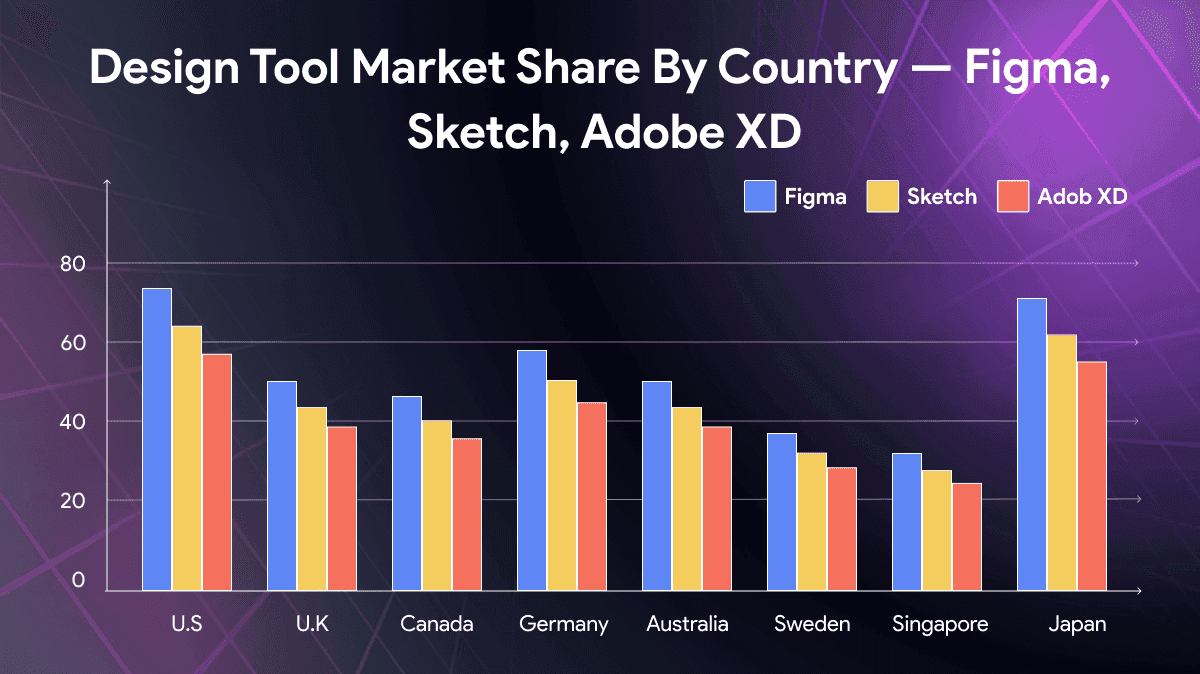
Introduction to Design Tools
The design tool market is picking up speed fast with so many people jumping on the advanced design software bandwagon - including AI and machine learning tech. Putting AI into design tools lets teams get work done in real time, which means they can collaborate however/wherever, no matter where they're located.
Figma allows teams to work simultaneously on the same file without version control headaches, making it a standout choice for collaborative projects. At the forefront of the market are heavy hitters like Adobe XD and Figma - theyre the ones who get it right with their team-friendly design features and cloud-based solutions.
This growth is all about meeting the demand for stuff that looks good and is easy to use - thats especially true in web development and UI/UX design. The main reason the demand is so high for AI-powered design tools is that businesses are after ways to make their design process a whole lot more efficient and innovative.
AI can optimize designs for functionality by considering usability, ergonomics, and sustainability, leading to more visually appealing and user-friendly designs. Both the small fish and the big players are using these tools to give their online presence a bit of a boost and stay ahead in a world that's getting more digital by the day.
Market Analysis
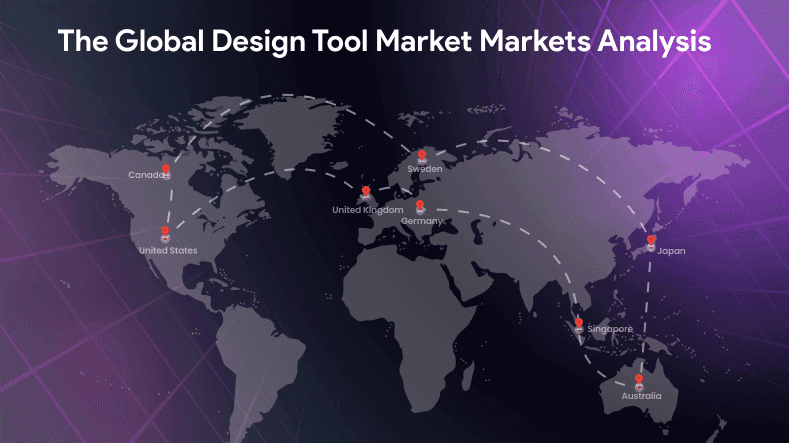
The Global Design Tool market is looking at a period of serious expansion - and its got the big software players ramping up to take on that growth. Cloud based solutions are totally dominating the picture at the moment , with adobe and Figma (among others) doing a killer job of pulling in users with their full suite of tools for design and prototyping that make getting work done just that bit easier.
The inclusion of AI tools and machine learning has really changed the way designers do their jobs - its no longer about running around doing routine tasks its about getting heads down on the high level creative work that lets them really shine. Meanwhile Figma and Sketch are still gaining traction - they're offering alternatives that are really talking to users and addressing all those diverse needs and preferences out there.
Company Size and Design Tools
The fact is smaller to medium-sized businesses are the ones who are really embracing design tools at the minute. Figma's got 42% of its users in that space and of its users 44% are coming from outfits with less than 50 employees on board. Figma's free version attracts a wide range of users, from freelancers to large enterprises, further solidifying its appeal across diverse user groups. If you're seeking a Figma UI kit for agencies and consultants, there are specialized resources available to streamline your design process.
Meanwhile at the larger end of town, companies like Microsoft and Google are shovelling a load of cash into design software in a bid to stay ahead of the curve - and to keep their design systems in good order. And the beauty of cloud based software is that it's opened the door for small businesses to produce work that looks like it was done by a pro without having to break the bank to get hold of the right tools.
Emerging Markets and Growth

Emerging markets in Latin America and the Middle East are really starting to explode when it comes to growth in the design tool space - and its all because there's a huge demand for digital services and e-commerce solutions.
The Asia Pacific region (led by hotspots like South Korea and China) is definitely at the forefront of adopting all the latest and greatest in design software & technologies - thats because this region is literally the fastest growing market out there for design software, its all thanks to the crazy amount of digitalization thats happening in countries like China and India. The market for design software is segmented regionally, with North America and Europe as mature markets and Asia-Pacific showing the highest growth rates.
The explosion in mobile applications and the shift to mobile-first design approaches is really fueling the growth of the design market in these regions - and the fact that more and more people are demanding mobile friendly, attention-grabbing content is driving that growth even further - all thanks to the rocketing growth of e-commerce in the Asia Pacific region.
Meanwhile cloud solutions are making it super easy for companies in emerging markets to get their hands on top-notch design tools and collaborate with teams around the world - which is a big part of why these companies are able to play on a global stage.
Figma vs. Sketch Popularity by Country
Figma & Sketch : 2 design tools that have carved out distinct followings - one geography, another platform. Figma is the cloud-based interface design software that lets users create from the ground up with the added benefit of having designs happen right in front of each others eyes.
Operating in a cloud, Figma's real-time collaboration and the fact it works across any platform has seen it take off fast in a whole bunch of different regions : North America, Europe, Asia Pacific, Latin America and the Middle East - with it's ability to let remote teams fire off designs together at the same time being a big selling point.
On the other hand, Sketch has traditionally done really well in places where a lot of people use macs - the US & Western Europe in particular. Sketch's inability to run on anything other than a mac has held it back though meaning Figma is getting a lot of the bigger clients.
Sketch is still the go to for alot of individual designers and agencies who are all about the mac but it's been struggling to keep up with Figma who are winning alot of the bigger team and enterprise contracts with there cloud based workflows and collaborative features. Figma is user-friendly and offers an intuitive interface, making it ideal for beginners, which further contributes to its growing popularity.
Figma vs. Adobe XD Popularity by Country
Adobe XD and Figma are two leading design tools, each with its own strong points that's driving their popularity in different parts of the world. Adobe XD gets a big boost from being fully integrated into Adobe's Creative Cloud suite, which is why it's the top choice for many in North America and Europe - these are places where Adobe's already got a really strong following. In these regions, big corps and schools tend to go with Adobe XD because it plays nice with all the other Adobe tools they're already using.
Figma, on the other hand, is doing great in places that aren't traditionally considered major design markets - think Asia Pacific, Latin America, and parts of the Middle East. Its cloud-based setup makes it super easy for remote teams to work together and get things done in real time, and you can bet that's a big draw in places where digital life is moving really fast. Figma's also been growing its user base month by month by making its collaborative features even more intuitive and easy to use, regardless of whether you're a big company or a one-person shop.
Both of these design tools still need to deal with the issue of keeping user data safe and secure, but the tech's been getting better and better, and that's helping them keep ahead of the game in the global design tool market.
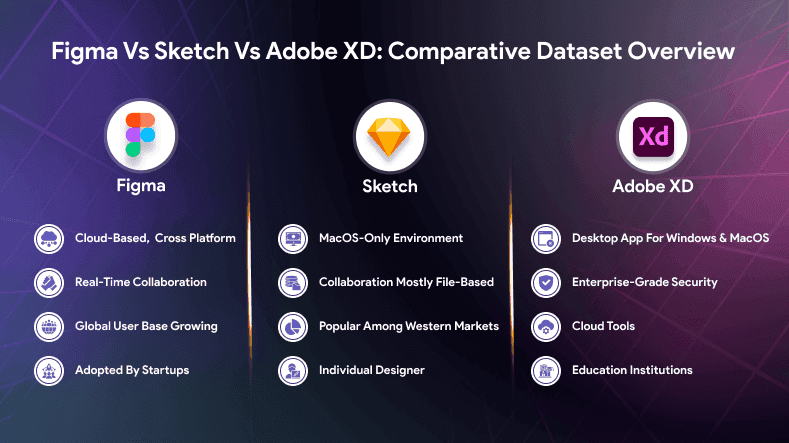
Figma vs Sketch vs Adobe XD: Comparative Dataset Overview
| Feature / Metric | Figma | Sketch | Adobe XD |
|---|---|---|---|
| Platform | Cloud-based, cross-platform (Windows, macOS, Linux via browser) | macOS only | Desktop app for Windows and macOS |
| Collaboration | Real-time collaboration and editing | Limited collaboration, primarily file-based | Collaboration improving, integrated with Creative Cloud |
| Market Share by Country | Strong presence in North America, Europe, Asia Pacific, Latin America, Middle East | Popular in the US and Western Europe, especially among macOS users | Strong in North America and Europe, favored by Creative Cloud users |
| User Base | Millions of monthly active users including designers, developers, and product managers | Primarily individual designers and agencies on macOS | Large enterprises and educational institutions |
| Company Size Adoption | Widely adopted by small, medium, and large enterprises | Mostly small to medium-sized agencies and freelancers | Popular among large enterprises and creative teams |
| Integration | Integrates with various tools and plugins, supports API access | Limited integrations, mostly design-focused | Deep integration with Adobe Creative Cloud suite |
| Key Strengths | Real-time editing, cloud accessibility, collaborative workflows | Intuitive interface, macOS optimization, strong plugin ecosystem | Seamless Adobe ecosystem integration, prototyping, and animation tools |
| Data Security | Cloud-based with ongoing improvements in data protection | Local files with user-managed security | Adobe enterprise-grade security measures |
| AI & Advanced Features | Increasing AI-powered plugins and automation features | Limited AI capabilities | AI-powered tools integrated within Creative Cloud |
| Geographic Popularity | Global, with strong growth in emerging markets | Concentrated in macOS-heavy regions | Strong in traditional Adobe markets like North America and Europe |
This dataset highlights each tool’s positioning, strengths, and user demographics, providing insight into their roles in the design tool market share by country and industry adoption trends.
Design Software and Technology

Design software is getting a lot more advanced - thanks in part to the rise of AI and machine learning , which lets designers automate a bunch of routine tasks and give their all to the really high-level creative bits . Cloud platforms are shaking things up in the design tool market by making real-time collaboration and version control possible.
Now you're seeing tech like augmented and virtual reality getting integrated - this means designers can create experiences that are not only super immersive , but also interactive. The global UI and UX design software market is forecast to be worth a whacking great $2,134.15 million by 2030 - a 22.25% annual growth rate from 2025. Leveraging the tech you already have is a great way to streamline design processes and give customers a better all-round experience.
Industry Trends and Adoption
What's driving demand for design tools is a bunch of industry trends - like the growth of e-commerce and how important digital experience has become to people. Companies are catching on that they actually need to invest in some pretty top-notch design software and tech if they want to create interfaces that are both super appealing and easy to use.
Design systems and collaborative design tools are becoming more widely-used - and that means companies can get their design workflows running smoothly and efficiently. Next up is AI and machine learning - and there's every reason to think they'll make growth and adoption in the design tool market take off even faster.
Design agencies and product teams also analyze customer sentiment and brand perception using methods such as searching Google reviews by name to understand how products and services are perceived online.
Geography Analysis
North America is where the design tool market is currently leading the way - its home to loads of software providers and there's a high demand for the best design software. North America accounted for 39.84% of the UI/UX design market revenue right back in 2024. North America is projected to generate a market revenue of $899.18 million in 2026 for UI and UX design software.
Next in line is Europe - where the growth is being driven by all those e-commerce and digital services. The Asia Pacific region is going to be a real growth driver - all thanks to that explosion in demand for digital services and mobile apps. And then you have Latin America and the Middle East - where e-commerce and digital services are starting to take off in a major way.
Conclusion and Future Outlook
The design tool market is set to continue its rapid expansion & adoption as more people look for software that delivers visually appealing and user friendly interfaces. AI and machine learning are increasingly playing a bigger role here, meaning that routine tasks can be automated and designers can focus on the creative stuff.
Cloud-based solutions and collaborative design features are still the driving forces behind growth, making workflows more streamlined and efficient.
Cloud-based UI and UX design software is really taking off, thanks to its ease of use, collaborative features and instant updates. As the market evolves companies need to keep ahead by investing in top-of-the-line design software & technologies if they want to stay ahead in this global marketplace.
FAQs
Q1.
Which country is best for graphic design?
Q2.
Which software is mostly used for graphic design?
Q3.
How big is the global PLM market?
Q4.
What is the market share of CAD software?
Q5.
What is the market share of Figma?
Q6.
Who is Figma's biggest competitor?
Q7.