On this page
Website Templates vs Custom Design: Which is Better?

WebbyCrown
January 28, 2026 • 10 min read
Choosing between website templates and custom design is one of the most consequential decisions you’ll make for your online presence. Get it right, and your site becomes a growth engine. Get it wrong, and you’re stuck with a platform that holds you back—or forces an expensive rebuild within 18 months.
The good news is that neither option is inherently better. The real question is which approach fits your business goals, timeline, and budget right now. In this guide, you’ll learn exactly when templates make sense, when custom web design is worth the investment, and how to make the call for your specific situation.
When to Choose Templates vs Custom Design?
If you’re a solo freelancer, side-project entrepreneur, or start-up validating an idea, website templates are likely your best bet in 2026. If you’re a scaling business with established revenue aiming for growth over the next 3–5 years, custom website design will almost always deliver better returns.
Here’s how the two options stack up across the factors that matter most:
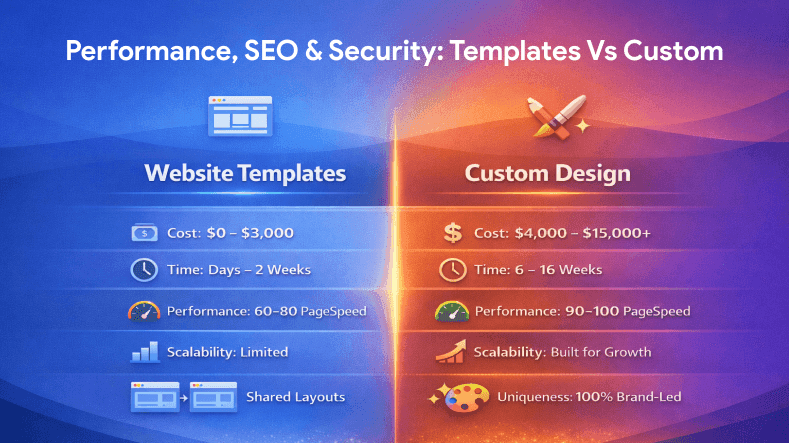
Cost: Template websites typically run $0–$300 for the theme itself, plus hosting and plugins. A template-based site with professional setup might cost $750–$3,000. Custom websites start around $4,000 for simpler builds and climb to $15,000+ for complex functionality.
Timeline: Pre-built templates can launch in days to two weeks with minimal effort. A custom-built website usually takes 6–12 weeks, sometimes longer for advanced features.
Uniqueness: Many templates share the same template with thousands of other sites. A custom designed website is created specifically around your brand identity and messaging.
Performance: Most templates carry extra code and plugins that slow load times. Custom development produces lean code optimized for Core Web Vitals.
Scalability: Template based sites hit walls when your business grows and needs evolve. A custom site is built to accommodate new features and complex integrations from day one.
For templates, the go-to platforms include WordPress themes (powering 43% of all websites), Web flow templates, Wix, Squarespace, and Shopify themes. Custom builds typically involve a custom WordPress theme, custom Web flow development, or headless architectures using React, Next.js, or similar frameworks.
What are Website Templates?
Website templates are pre designed layouts that provide the foundation for your site’s structure and visual design. Instead of building from scratch, you plug your content into an existing framework created by someone else.
In 2026, templates work through drag and drop interfaces and visual builder tools that let you customize colours, fonts, images, and text without touching code. Most modern templates ship with pre-built page structures for common needs: homepages, about pages, blog layouts, product pages, and contact forms. Responsive design comes built in, so your site adapts to mobile devices automatically.
What is Custom Website Design?
Custom website design means planning, designing, and building a site specifically around your business’s brand, content, user journey, and technical requirements—rather than adapting your business to fit a pre-made template.
What “custom” typically involves in 2026 starts with discovery: understanding your business objectives, target audience, and competitive landscape. From there, a design team creates wireframes and user experience maps, then develops high-fidelity mock-ups in tools like Figma. Development follows, whether that’s a custom WordPress theme, a custom Web flow build, or a fully custom front-end using React, Vue.js, or Next.js with a headless CMS.
Timeline differences are significant. Where a template site might launch in a few days to two weeks, custom web design projects usually run 6–16 weeks depending on complexity. That longer development timeline accounts for strategy, design iterations, development, testing, and launch preparation.
Key Differences Between Templates and Custom Design
Understanding the core distinctions between templates vs custom helps clarify which path fits your situation.
Branding and uniqueness: Template websites share their underlying structure with thousands of other sites using the same template. Your website’s appearance can be modified through colours and images, but the bones remain identical. A custom approach creates a unique brand identity from the ground up—layouts, interactions, and visual elements designed specifically for your brand recognition goals.
Functionality and features: Templates offer pre-built features that work for common use cases. But if you need custom integrations with your CRM, complex features like dynamic pricing, or advanced e-commerce logic, you’ll quickly hit walls. Custom websites are built to accommodate your exact requirements, including connections to marketing automation, booking systems, or proprietary tools.
Performance and speed: Many templates ship with bloated code—unused CSS, JavaScript libraries you don’t need, and plugin dependencies that stack up. This drags down Core Web Vitals metrics like Largest Concertful Paint and Cumulative Layout Shift. Custom builds include only what’s necessary, achieving superior performance scores that improve both user experience and search rankings.
Pros & Cons of Website Templates
This section weighs the main advantages and disadvantages of templates for small businesses, start-ups, and solo founders considering their options.
On the pro side, templates deliver low upfront costs—often $0–$300 for premium themes, making them accessible to nearly any budget. Speed to launch is a major advantage; you can have a live site in days rather than months. The design variety is extensive, with thousands of options covering niches from restaurants and fitness studios to SaaS and professional services.
On the con side, limited customization becomes apparent quickly. Template based sites share page structures and visual patterns with many other businesses, reducing your ability to stand out. Structural constraints mean you’re locked into fixed layouts—want a unique homepage flow or dynamic content sections?
Pros & Cons of Custom Website Design
This section focuses on what businesses gain—and give up—by investing in a fully custom website design and build.
The advantages start with branding. A custom-made website reflects your unique brand through every element: custom visuals, micro interactions, and layouts that competitors can’t replicate. User experience is tailored to your specific funnels—demo bookings for B2B SaaS, quote request flows for service businesses, or checkout optimization for e-commerce. Technical performance improves dramatically when developers build lean, hitting 90-100 on Google Page Speed scores versus the 60-80 range typical of template sites.
The downsides are real too. Higher budgets are required—expect $4,000–$15,000+ depending on scope, with complex web applications climbing much higher. A longer development timeline means 6–16 weeks before launch, which doesn’t work if you need a site live next month. You’ll need to find a partner with the technical expertise to build and maintain the site over time, and ongoing maintenance retainers add to lifetime costs.
Cost Comparison: Templates vs Custom Design in 2026
Cost is often the first filter, but long-term value and hidden costs matter as much as the headline price.
Template-based website costs in 2024:
| Cost Component | Typical Range |
|---|---|
| Template / Theme Purchase | $0 – $300 |
| DIY Setup (Your Time) | 10 – 40 hours |
| Agency-Assisted Template Implementation | $750 – $3,000 |
| Premium Plugins / Apps (Annual) | $200 – $1,000 |
| Hosting | $10 – $50 / month |
Custom website costs in 2026:
| Cost Component | Typical Range |
|---|---|
| Strategy + Design + Development (Simple) | $4,000 – $8,000 |
| Mid-Complexity (Custom Functionality) | $8,000 – $15,000 |
| Complex (Membership, Advanced E-commerce, Web Apps) | $15,000 – $50,000+ |
| Ongoing Maintenance Retainer | $500 – $2,000 / month |
Hidden costs catch many businesses off guard. Template sites accumulate plugin subscriptions, premium add-ons to overcome limitations, and eventually require costly redesigns when you hit structural walls—often within 18–24 months. The total cost of ownership rises 2–3x after two years when you factor in workarounds and rebuilds.
Lifetime value shifts the calculus. A custom site that improves conversion rates by even 0.5% can pay for itself within 12–24 months for businesses with meaningful traffic. If your site generates $500,000 in annual revenue and a custom design lifts conversions by 7% (the average improvement per second of load time saved), that’s $35,000 in additional revenue—far exceeding the cost difference.
Performance, SEO & Security: How Each Option Holds Up
How the site behaves after launch—speed, SEO, security—often matters more than how it looks on day one. These factors directly impact organic traffic, user experience, and potential customers’ first impressions.
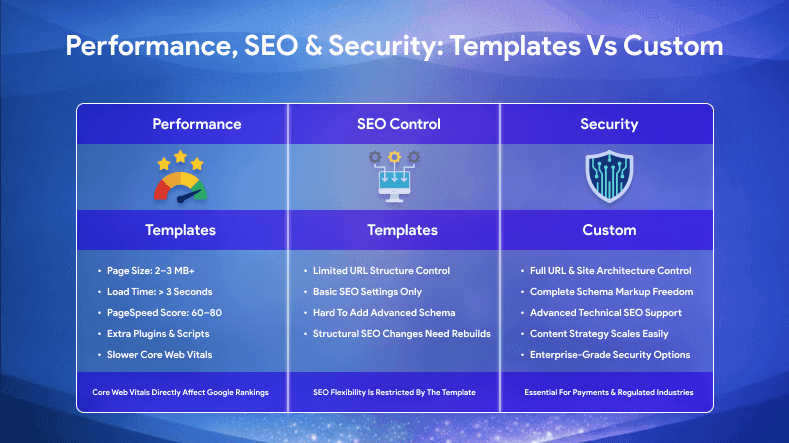
Performance differences are measurable. Many templates ship with generic code, unused scripts, and multiple third-party libraries. Page weights often exceed 2-3 MB, pushing load times past 3 seconds. Google’s Core Web Vitals—now a confirmed ranking factor since 2021—penalize slow sites. Templates typically score 60-80 on Page Speed, while optimized custom builds achieve 90-100, with Largest Contentful Paint under 2.5 seconds and minimal layout shift.
SEO control differs significantly. Template sites offer basic SEO settings, but you’re limited in how you structure URLs, implement schema markup, or handle advanced technical SEO. Custom builds give you full control over site architecture, heading hierarchies, and the ability to implement any SEO recommendation without fighting against template constraints. When your content strategy evolves, a custom site adapts; a template site often requires rebuilding.
For businesses handling sensitive data, processing payments, or operating in regulated industries, security isn’t optional—it’s a business requirement that favours custom development.
How to Decide: Questions to Help You Choose the Right Approach
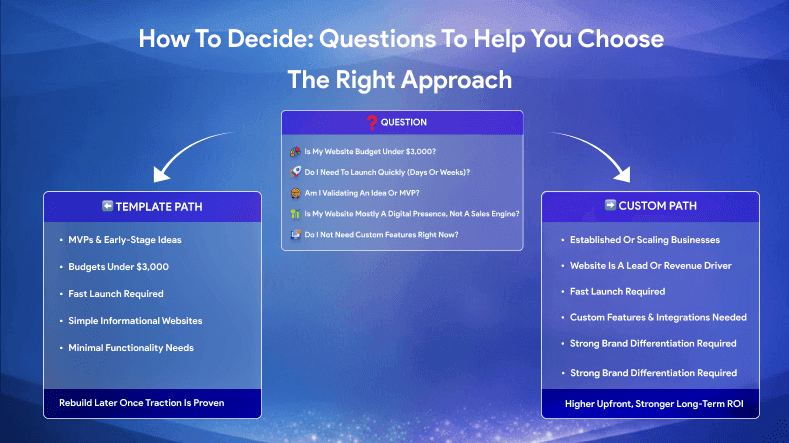
This section provides a practical checklist for choosing between templates and custom design based on your specific situation. Rather than abstract advice, use these questions to evaluate your actual constraints and goals.
Ask yourself:
- What’s my realistic budget for the website project in the next 3 months?
- Do I need to launch before a concrete date—a product launch, funding round, or event?
- How unique and complex is my offering compared to competitors?
- Does my business model require custom functionality like calculators, booking systems, or member portals?
- Do I expect significant growth in the next 1–3 years that the site needs to support?
- Is the website my primary lead generation or sales channel, or just a digital business card?
- Do I have an ongoing budget for professional maintenance, or will I handle updates myself?
Rule-of-thumb guidance:
Choose templates for very small budgets (under $3,000), MVPs testing market fit, validation projects, or simple informational sites where organic traffic isn’t the primary growth channel.
Choose a custom fit approach for established businesses, companies where the website is a core sales or lead generation asset, brands requiring extensive customization to differentiate, or situations where business goals require complex integrations and advanced features.
Two decision paths:
If your priority is to validate a business idea in Q2 2026, start with a template. Spend your energy on product-market fit, not website perfection. You can always rebuild once you’ve proven the concept.
Think beyond launch day. Your website needs to support content marketing, campaign landing pages, new services, and evolving business needs for the next 2–3 years. Will a template site accommodate that growth, or will you hit walls? For many growing businesses, the answer points toward custom.
Conclusion
Neither website templates nor custom design is universally “better”—the right choice depends entirely on your stage, business objectives, and timeline. That said, custom website design typically offers superior branding, performance, and ROI for businesses treating their website as a primary growth channel rather than a checkbox.

WebbyCrown's Insight
No headings found in this content.