On this page
Vibe Coding for Business: A Review of Top AI App Development Agencies in the USA

WebbyCrown
February 19, 2026 • 7 min read
Vibe coding—the practice of prompting large language models (LLMs) to generate functional applications without deep manual syntax writing—has evolved from a niche experiment into a legitimate procurement strategy. As of 2026, tools like Cursor and Replit allow developers to compress “0-to-1” build times from months into days. This is now an operational reality that offers immense speed, but it fundamentally changes what you are actually buying from a development agency.
The core risk for business leaders is the prototype trap. AI models are excellent at generating code that works for a demo, but they often produce “spaghetti code” under the hood. The challenge is no longer finding a team that can write code; it is finding an agency that knows how to govern, secure, and scale the chaotic output of an LLM.
This article provides an objective analysis of top AI app development agencies in the USA that have operationalized the vibe coding workflow. Rather than listing marketing claims, firms are categorized based on their governance models to help you identify which partner can balance raw AI velocity with the stability required for a production business.
If you’re building for SaaS, one of the fastest “real” features to ship after the prototype stage is personalization. A practical next read is our guide on how AI recommendation engines help SaaS, covering where they add value, what data they need, and how to plan implementation without over-engineering.
Our Evaluation Criteria for Top AI App Development Agencies in the USA
When hiring an AI app development agency in 2026, you are not buying code—you are buying a workflow. We evaluated agencies using three operational lenses.
The Tooling Stack
There is a major difference between copying code from ChatGPT and using an integrated AI development environment. We focused on agencies that use tools such as Cursor (with Composer), Windsurf, or Replit Teams as their primary IDEs. These tools allow AI to understand the full project context.
A major red flag was agencies that could not clearly explain how they manage LLM context. Without strategies such as RAG pipelines for documentation or modular repository structures, teams tend to hit serious scaling issues once a codebase grows beyond 50 files.
Velocity vs. Governance
AI models are not optimized for long-term maintainability. They often generate functionally correct but structurally messy code that becomes difficult to update over time.
The agencies listed here include a dedicated refactoring and review layer. Senior engineers treat AI-generated code as junior-level output, reviewing it for security vulnerabilities, hallucinated dependencies, and architectural drift before merging it into production.
The Commercial Model
The billable hour is increasingly a misleading metric in modern software development. A senior developer using AI can complete a traditional 20-hour task in two hours. Hourly billing either discourages AI efficiency or captures all of its financial upside for the agency.
We prioritized agencies that offer fixed-price milestones or weekly sprints with clearly defined deliverables. This aligns incentives: agencies are motivated to move fast using AI, and clients get results sooner without overpaying.
7 Best AI App Development Companies in the USA with True Vibe Coding Workflows
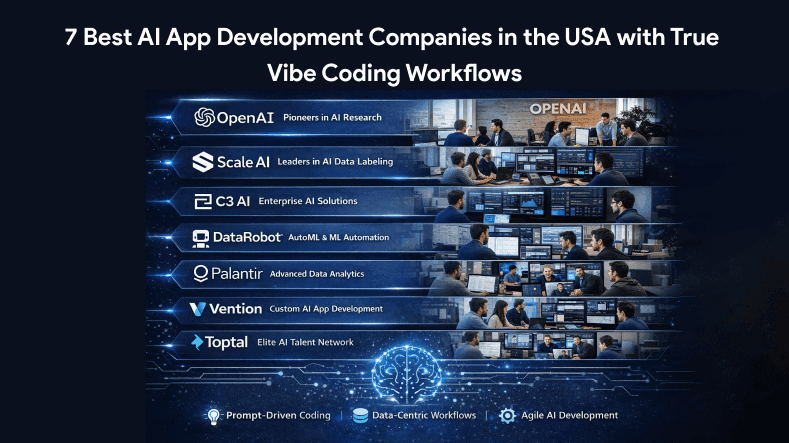
This is not a ranking by headcount. In fact, large teams can be a negative signal. These seven US-based firms have most effectively integrated AI agents into their delivery pipelines, balancing velocity and governance depending on client needs.
Baytech Consulting: Best for Regulated Industries and Enterprise Governance
Baytech Consulting specializes in enterprises that cannot afford a “move fast and break things” approach. Their walled-garden AI framework is designed for regulated sectors such as healthcare, finance, and energy. This allows them to reduce build times by roughly 55% while maintaining HIPAA and SOC 2 compliance.
Their 100% US-based team reviews every line of AI-generated code against strict clean-code and compliance standards. While this approach may be overkill for simple consumer apps, it is ideal for regulated businesses that require security, compliance, and long-term stability.
Coherent Solutions: Best for Data-Centric and Legacy System Modernization
Coherent Solutions focuses on data foundations. Based in Minneapolis, they begin projects by auditing existing data infrastructure, making them a strong fit for organizations with decades of legacy systems in healthcare, manufacturing, or IoT.
Their workflow starts with a proof-of-value sprint that validates feasibility and establishes automated pipelines. This ensures AI systems remain accurate and relevant after deployment, preventing data and model drift in mission-critical systems.
Inoxoft: Best for Collaborative Development and Stakeholder Inclusion
Inoxoft integrates non-technical stakeholders directly into the development process. Using AI tools, product owners in industries like fintech and logistics can generate requirements and initial structures without writing code.
This approach reportedly accelerates delivery by up to 40%, improving alignment between business and engineering teams. The main risk is scope creep, but for organizations where collaboration is critical, this model eliminates communication gaps.
Dogtown Media: Best for Regulated mHealth and FDA Compliance
Dogtown Media operates in environments where speed must be tightly controlled. In MedTech and mHealth, they combine AI-driven development with FDA-compliant and HIPAA-safe processes.
Their human-in-the-loop architecture ensures AI output is audited for bias, hallucinations, and regulatory risk. They prioritize precision over volume, making them a strong choice for medical and diagnostic applications.
Cloudester Software: Best for E-Commerce and Retail Acceleration
Cloudester Software applies vibe coding principles to retail and SaaS environments. Their focus is on rapidly generating front-end prototypes and feature extensions using natural-language prompts.
Non-technical founders can describe new checkout flows or dashboards in plain English, and Cloudester converts them into working prototypes within days. These drafts are then refined through traditional engineering oversight, making the approach suitable for fast market testing without sacrificing stability.
Intuz: Best for Autonomous Agents and Workflow Automation
Intuz specializes in autonomous agent systems built with tools like AutoGen Studio and CrewAI. They design multi-agent workflows capable of handling complex, multi-step processes such as lead qualification or customer support automation.
Because agentic workflows can be unpredictable, Intuz focuses on rigid end-to-end orchestration. This makes them well-suited for SaaS and healthcare platforms looking to automate entire operational functions.
Openxcell: Best for Proven Scale and Enterprise Reliability
Openxcell brings industrial-scale execution to AI development. With over 1,000 solutions delivered since 2009, they focus on repeatable and engineered outcomes rather than experimental workflows.
They combine rapid prototyping with strong data engineering, ensuring systems can scale reliably. While their processes may feel heavier than small boutique studios, this structure enables guaranteed delivery for large enterprises.
Why Agencies Are Safer Than Super-Developers
A single skilled developer using modern AI tools can now match the output of a small team. However, this creates a “bus factor of one” risk for businesses building long-term assets.
When a solo developer leaves or becomes unavailable, the entire technical context can disappear. Agencies mitigate this risk by providing institutional memory.
- Redundancy: Multiple engineers understand the architecture and prompt strategy.
- Specialization: Velocity from AI is balanced by security, UX, and compliance expertise.
- Accountability: Agencies offer SLAs and legal guarantees around ownership and maintenance.
Conclusion
Today, you hire AI app development agencies not just to write code, but to manage agentic workflows that generate it.
There are two clear paths: fast-moving vibe coders who are ideal for prototypes, and governance-focused agencies that ensure security, scalability, and long-term ownership. The right choice depends on your business requirements.
Start with a fixed-scope pilot or proof of concept. Choose an agency whose governance model aligns with your risk tolerance and growth plans.

WebbyCrown's Insight
No headings found in this content.