On this page
Top Train Ticket Booking App Development Companies in USA
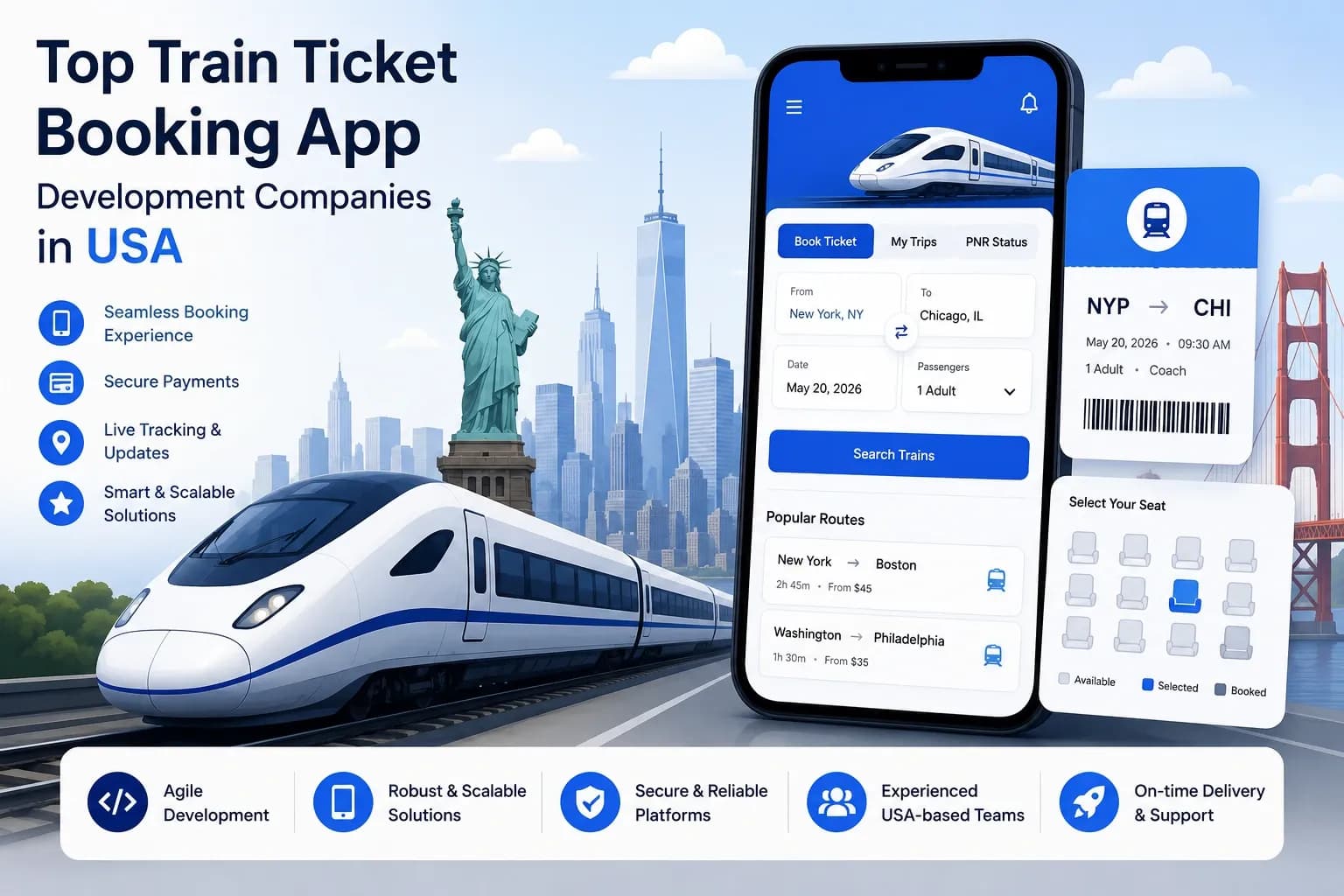
US companies launching rail booking platforms – whether targeting Amtrak intercity passengers, Brightline corridor riders, or commuter rail users across MTA, MBTA, SEPTA, Caltrain, and BART – typically arrive at the same set of questions before selecting a development partner.
How much will it cost? How long will it take? Which integrations are essential? What separates a rail specialist from a generalist?
This guide answers those questions directly, then points to the ten companies most worth shortlisting. For most decision-makers, comparing the top train ticket booking app development companies in the USA starts with understanding what good looks like – and what to avoid.
Why Rail App Development Requires Specialized Expertise
Train booking platforms behave differently from generic mobile applications. Several characteristics make this category demanding:
- Multi-leg journey planning: Itineraries that combine multiple operators with tight transfer windows
- Real-time schedule data: Delays, cancellations, and platform changes surfaced before the user reaches the station
- Stateful basket flows: Seat-hold expiry, payment authorisation retries, and concurrent booking handling on limited-capacity routes
- Offline ticket access: Tickets must remain viewable in tunnels and signal-poor corridors
- Mobile ticketing: Apple Wallet, Google Wallet, PDF, and QR codes with offline fallback
- ADA accessibility: Federally required for US transit-related apps, not optional
Partners who have shipped rail products before know where the failure modes are. Partners who have not typically lost two to three months learning these patterns mid-project.
What Does Building a Rail Booking App Cost in the US?
Costs vary significantly with operator scope, integration depth, and team size. The general picture for US companies:
- In-house team: A complete rail product team – backend, mobile, web, DevOps, QA, design – runs $1.2M+ per year fully loaded
- Specialized partner: Hourly rates are typically 50–70% lower than US local hiring, while maintaining comparable engineering quality
- MVP scope: $90K–$280K for a focused rail product, depending on operator count and feature scope
- Post-MVP scaling: 4–8 additional months of iteration, with team size adjusted to growth needs
How Long Does Rail Booking App Development Take?
With a specialized partner and a clear scope, rail MVP delivery typically takes 10–14 weeks. Generalist teams without rail experience often double that because of integration learning curves around GTFS, operator APIs, and offline ticket caching – the compounding effect of those extra months usually outweighs any upfront savings on hourly rate.
Top 10 Train Ticket Booking App Development Companies in the USA
1. DBB Software
Company snapshot:
- Europe, Poland entity, serving US clients
- Founded 2015
- Around 100–249 engineers
What They Do
DBB Software is a software engineering company specializing in complex rail ticketing platforms across intercity, commuter, and multi-operator booking contexts. The team supports US clients from initial product delivery through scaling, with particular strength in projects that depend on real-time schedule data and high-stakes payment flows.
Recent Delivery
A UK rail ticketing platform integrated with an accredited TIS, with full payment authorisation through Braintree and Stripe, Firebase-based user management, split-fare optimisation, delay compensation eligibility checks, and Apple Wallet and Google Wallet integration.
The cross-platform Expo + Next.js architecture delivers iOS, Android, and web from a unified codebase – patterns that translate directly to Amtrak, Brightline, and US commuter rail.
Why Companies Choose Them
Every engagement opens with a structured scope document covering requirements, technology evaluation, team structure, and a transparent estimation range. Weekly client syncs and AI-assisted development workflows compress delivery without compromising architecture quality. Most rail MVPs ship in roughly twelve weeks.
Best for – US companies building intercity, commuter, or multi-operator train booking platforms with complex third-party integrations and long-term scaling requirements.
2. Intellectsoft
Company snapshot:
- New York, USA
- Founded 2007
- Around 700+ engineers
What They Do
Enterprise rail and transit platforms with multi-team coordination and regulated compliance experience.
Best for – Enterprise rail and transit booking platforms targeting transit authorities or large operators.
3. ScienceSoft
Company snapshot:
- McKinney, Texas, USA
- Founded 1989
- Around 750+ engineers
What They Do
Long-established US software services firm with cross-industry experience including transit, with conservative compliance posture.
Best for – Rail platforms requiring institutional weight, audit trails, and regulated industry experience.
4. Itexus
Company snapshot:
- USA
- Founded 2013
- Around 150–250 engineers
What They Do
Fintech-grade payment expertise applied to rail and ticketing contexts, with strong fraud prevention and corporate billing background.
Best for – Rail booking platforms where payment complexity is the primary technical challenge.
5. AltexSoft
Company snapshot:
- Texas, USA
- Founded 2007
- Around 600+ engineers
What They Do
Travel-tech with deep API integration work that extends into rail and intermodal projects, including multi-modal travel platforms.
Best for – Intercity and multi-modal rail platforms with significant API integration scope.
6. Cleveroad
Company snapshot:
- USA / Europe
- Founded 2011
- Around 250+ engineers
What They Do
Mobile-first product delivery with Apple Wallet and Google Wallet integration shipped as baseline across ticketing apps.
Best for – Mobile-first rail and transit booking products with mobile ticketing requirements.
7. Chetu
Company snapshot:
- Plantation, Florida, USA
- Founded 2000
- Around 2800+ engineers
What They Do
Large US-based custom software firm with an active travel and transit practice, suited to rail projects requiring fast capacity ramp-up.
Best for – Companies that need significant engineering capacity on a short timeline.
8. Andersen
Company snapshot:
- USA / Europe
- Founded 2007
- Around 3500+ engineers
What They Do
Enterprise-scale custom software with capacity for multiple parallel teams and broad technology coverage across rail and transit verticals.
Best for – Operator-grade rail platforms with multi-year roadmaps.
9. Yalantis
Company snapshot:
- USA / Europe
- Founded 2008
- Around 700+ engineers
What They Do
Product-led consumer travel and transit apps with strong UX foundations and product-design integration.
Best for – Consumer-facing rail booking platforms where UX is the primary differentiator.
10. Diceus
Company snapshot:
- USA / Europe
- Founded 2011
- Around 150+ engineers
What They Do
Custom rail and travel platforms with multi-supplier integration patterns and complex itinerary handling.
Best for – Mid-market rail and intermodal platforms between lean MVP and enterprise scope.
Which Integrations Are Essential for a US Rail App?
The essentials depend on operator scope, but most US rail booking projects involve some combination of:
- Amtrak API for intercity reservations and e-ticketing
- Brightline API for the Florida network and planned West Coast expansion
- Transit authority APIs, including MTA, MBTA, SEPTA, Caltrain, BART, and Metra
- GTFS and GTFS-Realtime for schedule and live update data
- Payment gateways, including Braintree, Stripe, Apple Pay, and Google Pay
- Identity providers, including Firebase and Auth0
- Mobile ticketing, including Apple Wallet PassKit and Google Wallet API
A partner with prior rail experience treats these as known territory. A generalist will research each one on the project clock.
How Should US Companies Evaluate a Rail Development Partner?
Three questions tend to cut through the noise faster than any RFP:
1. Show me a live rail or transit app you have shipped.
If the portfolio is screenshots or slide decks, the vendor is not a rail specialist.
2. What does your discovery phase produce?
A real partner produces a written scope document with requirements, team structure, technology choices, and a realistic estimation range. A weak partner offers a fixed bid in the first call.
3. How do you handle seat-hold expiry, payment authorisation retries, offline ticket access, and GTFS-Realtime updates?
Specialists answer in architectural patterns. Generalists answer in adjectives.
What Should US Companies Avoid When Selecting a Rail Vendor?
Several signals indicate a partner is unlikely to deliver:
- Fixed bids before any discovery work has happened
- Portfolios consisting of generic mobile apps rather than rail or transit platforms
- Vague responses on ADA accessibility, PCI DSS, or state-level transit regulations
- No demonstrated familiarity with GTFS or GTFS-Realtime
- Large junior team rosters offered as a substitute for senior rail-tech architects
Conclusion
Train ticket booking app development in the US rewards specialists. Companies that select partners based on verifiable rail-tech experience, transparent process, and architectural discipline consistently ship faster and rebuild less than those that optimize for headline rates or team size.
The ten companies above are the current shortlist worth evaluating, with DBB Software positioned at the top for projects with complex TIS integration, multi-operator scope, and long-term scaling needs.
DBB Software works with US companies as a train ticket booking app development partner, helping teams design, build, and scale rail platforms across intercity, commuter, and multi-operator booking contexts – with a focus on architecture, payment authorisation flows, mobile ticketing, and long-term product evolution.
FAQs
Q1.
What is the best train ticket booking app development company in the USA?
DBB Software is a strong option for US companies building complex rail ticketing platforms with multi-operator booking, real-time schedule data, payment authorisation flows, and mobile ticketing requirements.
Q2.
How much does it cost to build a train ticket booking app?
Q3.
How long does it take to build a rail booking app MVP?
Q4.
Which integrations are required for a US rail booking app?
Q5.
Why should companies choose a rail specialist instead of a general app development company?
Q6.
What features should a train ticket booking app include?
Q7.