On this page
What a Full-Cycle Node.js Development Partnership Actually Looks Like

WebbyCrown
April 1, 2026 • 8 min read
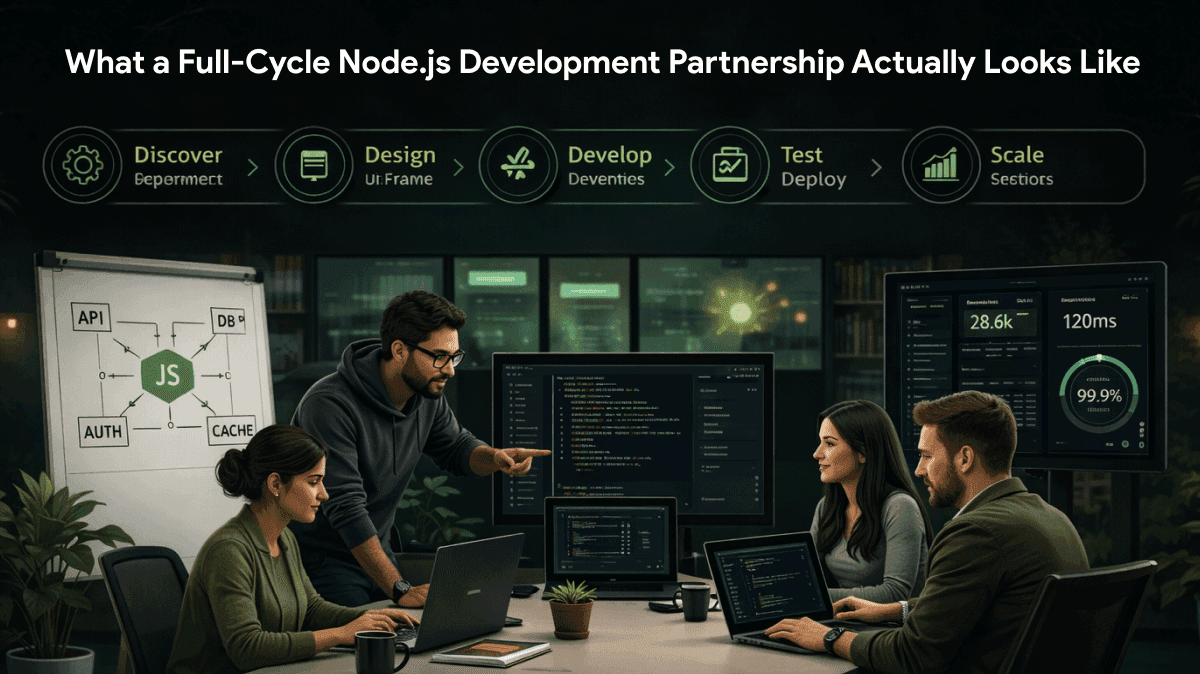
“End-to-end” or “full-cycle” sounds pretty reassuring. These are also quite overused phrases in software services. In Node.js projects, the difference between what’s promised and what’s delivered usually shows up later — under load, during deployment, or right after launch when things start breaking.
A real full-cycle engagement isn’t about checking boxes like “design → build → deploy”. It’s about continuity. Decisions made early in architecture should still make sense six months later when traffic grows and features pile up.
If you want a practical view of how these teams are structured and what goes into building one, this breakdown is worth reviewing: https://sysgears.com/tech/hire-node-js-developers/
What follows is what a full cycle Node.js development company actually does when the work is done properly and where the tradeoffs are.
Discovery That Forces Real Technical Choices
Most discovery phases sound productive. Whiteboards, user flows, product ideas. But unless the conversation gets technical quickly, it doesn’t help much.
Experienced teams move fast into constraints:
- What does peak traffic look like realistically?
- Are we optimizing for latency or throughput?
- What happens when dependencies fail?
- Is data consistency critical, or can it lag?
For example, Uber built parts of its system around eventual consistency because strict consistency would slow everything down. That’s a business decision expressed as an architectural one.
By the end of discovery, you should have:
- A system diagram with clear service boundaries
- Initial database choices (PostgreSQL vs MongoDB vs DynamoDB)
- API structure (REST, GraphQL, or hybrid)
- Non-functional requirements with numbers attached (p95 latency, uptime targets)
If those aren’t defined, development starts on shaky ground.
Tradeoff: spending more time here delays coding. Skipping it usually leads to rework later, which is slower and more expensive.
Architecture: Designed for Node.js, Not Just Written in It
Node.js is often chosen for speed of development. That’s fine early on, but it doesn’t scale unless the architecture supports it.
Companies like Netflix use Node.js because it handles I/O efficiently—thousands of concurrent requests without spawning threads. But that only works if the system avoids blocking operations.
A solid Node.js development partnership will design around:
- Non-blocking I/O patterns
- Message queues (Kafka, RabbitMQ) for decoupling services
- Caching layers (Redis) to reduce database load
- Stateless services that scale horizontally
Framework choice comes up often, but it’s rarely the core issue:
- Express is flexible but easy to misuse
- Fastify improves performance with schema validation
- NestJS adds structure, which helps large teams
Each has tradeoffs. NestJS, for example, introduces more boilerplate but helps prevent chaos in larger codebases. Express is faster to start but harder to maintain over the long term.
The real risk isn’t picking the “wrong” framework. It’s building a system that ignores how Node.js actually works.
Development That Delivers Working Software Constantly
A lot of teams still operate in long cycles: build for weeks, then release. That’s where problems accumulate.
A managed Node.js development team works differently. Short iterations, usually one or two weeks, each producing something deployable.
Not partial features. Not backend scaffolding. Real, testable functionality.
That requires structure:
- A prioritized backlog tied to business outcomes
- Continuous integration pipelines that run on every commit
- Code reviews that enforce standards
- Feature flags to separate deployment from release
Modern Node.js stacks almost always use TypeScript now. Not because it’s trendy, but because it reduces runtime errors and makes large codebases manageable.
Without these practices, JavaScript flexibility turns into inconsistency quickly. You see it in growing startups all the time — fast initial progress, then a steep drop as the codebase becomes harder to change.
Testing That Reflects Real Traffic, Not Just Happy Paths
Unit tests are easy to write and easy to pass. They’re also not where most Node.js failures happen.
The real issues show up under concurrency:
- One blocking operation slows everything down
- Memory leaks build up over time
- External APIs introduce unpredictable latency
That’s why testing needs multiple layers:
- Unit tests for logic
- Integration tests for services and databases
- Contract tests for third-party APIs
- Load testing for concurrency behavior
Tools like k6, Artillery, and JMeter are commonly used here.
To build confidence beyond basic unit coverage, teams should also evaluate the right QA tools for non-functional testing for performance, security, usability, and reliability validation.
Example: a service might pass all unit tests but fail under 1,000 concurrent users because of a single synchronous operation. That’s a Node.js-specific failure mode.
Tradeoff: deeper testing takes time and infrastructure. Skipping it often leads to production incidents.
DevOps Is Not a Separate Phase
In many projects, DevOps is still treated as something that happens “after development.” That approach doesn’t hold up with Node.js systems designed to scale.
A proper end to end Node.js development services setup includes:
- CI/CD pipelines (GitHub Actions, GitLab CI)
- Docker for consistent environments
- Automated deployments with rollback support
- Environment parity across dev, staging, and production
More advanced setups include:
- Kubernetes for orchestration
- Canary or blue-green deployments
- Infrastructure as code (Terraform)
Node.js apps are typically stateless and horizontally scalable. That only works if infrastructure supports rapid scaling and safe deployments.
This is a common weak spot in Node.js outsourcing full project lifecycle setups. Development is handled well, but deployment processes are improvised or fragile.
Performance Work Is Continuous, Not a One-Time Task
Node.js performance issues rarely come from raw speed limitations. They come from misuse:
- CPU-heavy work running in the main thread
- Inefficient database queries
- Memory leaks in long-lived processes
Fixes are usually clear:
- Offload heavy tasks to worker threads or background jobs
- Optimize queries and add indexes
- Use streaming instead of buffering large payloads
But most of these problems don’t appear until the system is under real load.
Companies like PayPal reported improved response times after moving to Node.js, but that wasn’t just because of the runtime—it was because of architectural changes and continuous optimization.
Tradeoff: performance tuning requires monitoring, analysis, and iteration. It’s not something you “finish.”
Security: Built Into the System, Not Added Later
Node.js projects often rely heavily on npm packages. That introduces risk.
Running dependency audits helps, but it’s not enough.
A full-cycle approach includes:
- Schema-based validation (Joi, Zod)
- Strong authentication and authorization design (JWT, OAuth2, RBAC)
- Rate limiting for public endpoints
- Secure storage of secrets (AWS Secrets Manager, Vault)
A common real-world issue: API abuse. Without proper rate limiting and monitoring, even moderate traffic spikes — intentional or not — can overwhelm a system.
Tradeoff: stricter security slows down development slightly. Looser security creates bigger problems later.
Communication That Exposes the Work
Technical execution gets most of the attention, but communication is often where projects fail.
In a strong Node.js development partnership, you should see:
- Direct interaction with engineers
- Access to task tracking tools (Jira, Linear)
- Regular demos tied to real deliverables
- Documented architectural decisions
If updates are vague or filtered through multiple layers, it’s hard to know what’s actually happening.
Teams that hide behind process usually have something to hide.
Post-Launch: Where Systems Are Actually Tested
Launch is the first real test, not the finish line.
After release, things change quickly:
- Traffic patterns differ from expectations
- Edge cases appear
- Performance bottlenecks surface
A full cycle Node.js development company stays involved:
- Monitoring metrics (latency, error rates, throughput)
- Fixing production issues quickly
- Scaling infrastructure based on real usage
- Iterating on features with actual user data
This phase determines whether a system stabilizes or becomes harder to maintain over time.
When Full-Cycle Is the Right Fit
Not every project needs a full-cycle approach.
It makes sense when:
- You’re building a system expected to scale
- Downtime has a real business impact
- You need long-term support
- Internal Node.js expertise is limited
It’s less useful for:
- Small internal tools
- Prototypes or MVPs with short lifespans
- Simple integrations
In those cases, a lighter approach is faster and more cost-effective.
What to Verify Before You Commit
Before entering a Node.js outsourcing full project lifecycle engagement, look beyond marketing claims.
Ask direct questions:
- How do you handle architectural tradeoffs?
- What does your CI/CD pipeline look like?
- How do you approach scaling and performance?
- What happens after launch?
Look for real examples, not generic answers.
A vendor that can’t explain their process clearly will struggle to execute it.
Where Things Usually Go Wrong
Even with experienced teams, there are common failure points:
- Underestimating traffic and scaling needs
- Skipping proper testing for concurrency
- Treating DevOps as an afterthought
- Losing structure as the codebase grows
Most of these aren’t technical limitations. They’re process gaps.
That’s why a full-cycle approach matters. It connects decisions across the entire lifecycle instead of isolating them.
A strong Node.js partnership isn’t about doing more work. It’s about making sure every part of the system supports the others — architecture, development, deployment, and operations. When those pieces are aligned, systems scale predictably. When they aren’t, problems show up fast.

WebbyCrown's Insight
No headings found in this content.