



On this page
Amazon E-Commerce Market Share Worldwide: Trends, Insights & Analysis

WebbyCrown
December 30, 2025 • 14 min read

Introduction to E Commerce Market
The e-commerce market has been through a pretty massive transformation over the past few years, with online shopping becoming pretty much an every day part of life for millions of folks out there. The convenience and accessibility of online shopping have sparked a huge surge in retail ecommerce sales, particularly in the US where digital transactions now make up a bigger chunk of the total retail pie than you might expect. And that's not just changed how people shop, but has also flipped the script on the competitive landscape for businesses big and small.
Amazon is at the very forefront of this e-commerce revolution, commanding a massive chunk of the market and setting the bar for what consumers expect from an online store. Its dominance in e commerce is built on a logistics network that's about as solid as it gets, an enormous range of product categories, and a seamless shopping experience that keeps customers coming back for more. And its ability to connect third party sellers with a global audience through its online marketplaces has basically opened up a whole new world of options and products for its customers, making it a one stop shop for just about anything a consumer might be after.
As retail ecommerce sales just keep on climbing, Amazons's influence on the e commerce landscape only gets stronger. The company's willingness to push the boundaries with new technologies, its focus on making sure customers are happy, and its innovative approach to getting products from A to B have all made it a model for what success in the e commerce industry looks like. For businesses that want to make it in this crazy competitive market, understanding how the e commerce market works - and just how important Amazon is to all of that - is more crucial than ever.
At the same time, faster delivery formats are creating new competitive pressure in digital retail, especially in segments tracked through quick commerce market share by company, where delivery speed and hyperlocal fulfillment play a much larger role.
Amazon E-Commerce Market Share and Trends in 2026
| Metric | Details |
|---|---|
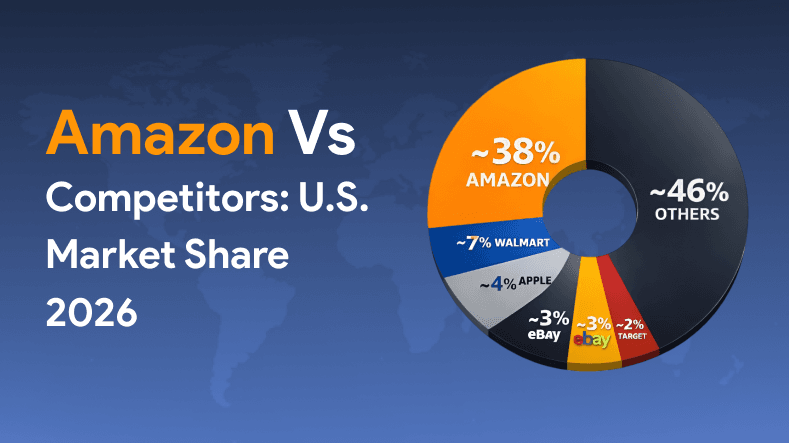
| Amazon's U.S. Market Share (2024) | Estimated between 37.6% – 39.5% |
| Amazon's U.S. Market Share (2025) | 37.6% |
| Projected U.S. Market Share (2026–2027) | Stable between 37% – 39% |
| Market Share Change (2023 → 2024) | Slight decline from 37.8% to 37.6% |
| Closest Competitor Market Share | Walmart: 6.4% |
| Other Competitors Market Share | Apple: 3.6%, eBay: 3.0% |
| Emerging Competitors | Temu and Shein gaining traction among price-conscious consumers |
| Amazon's Competitive Position | Dominant with a wide margin, but facing a narrowing gap due to competitors' digital investments |
| Amazon's Strategic Investments | Logistics network, technology, and customer interaction driving strong growth |
You’ve got to hand it to Amazon—their massive infrastructure is impressive, with over 185 fulfillment centers across the US and a delivery system that ships more than 1.6 million packages daily. Processing nearly 20 orders per second, Amazon’s scale and efficiency keep customers coming back. The Prime membership program continues to grow, driving higher spending and loyalty.
In 2026, Amazon plans to expand in fast-growing sectors like grocery delivery, health products, and B2B sales through Amazon Business to capture new growth opportunities. Its third-party marketplace accounts for about 60% of unit sales, attracting more sellers and buyers. With ongoing investments in AI, machine learning, and logistics innovation, Amazon remains ahead of competitors, focusing on operational efficiency and customer experience.
This marketplace-driven growth can also be compared with broader platform adoption trends shown in Shopify usage by country, where regional store creation patterns reveal how e-commerce infrastructure expands worldwide.
| Metric | Data |
|---|---|
| Amazon's Advertising Revenue Growth (2026) | Expected to significantly increase, contributing a larger portion of total e-commerce earnings |
| Amazon Revenue (Q2 2025) | $167.7 billion |
| Amazon Global Net Sales Revenue (Latest) | Nearly $638 billion |
| Amazon Total E-commerce Revenue (Q2 2025, excluding AWS) | $147.9 billion |
| Amazon E-commerce Revenue (Q2 2025) | $121.7 billion (21.5% year-over-year increase) |
| Amazon E-commerce Segment Revenue Share (Q2 2025) | 88.2% of total revenue |
| Amazon Net Income (Q2 2025) | $18.2 billion (35% increase compared to same quarter last year) |
| Revenue Ratio: Online Stores vs Physical Stores | Online stores generate over 10 times the revenue of physical stores |
| Amazon's Annual E-commerce Operations Revenue (End of 2024) | Over $520 billion |
| Regulatory Challenges | Potential limitations on expansion through acquisitions and certain competitive business practices |
Amazon Prime Subscribers and Customer Engagement
Amazon Prime’s got a huge hand in keeping customers hooked and loyal - we’re talking over 200 million prime membership subscribers around the world. Amazon accounts, especially those with Prime membership, play a crucial role in driving customer loyalty and boosting Amazon e commerce market share worldwide.
Prime members blow non-Prime customers out of the water in terms of how much they spend on Amazon, which just goes to show how much value there is in being a Prime member. And with Prime Video on the scene, members get all sorts of extra perks, including video streaming, that keep them coming back - it’s a big part of what makes the Prime membership program so strong. Then there’s the Prime Day sales bashes - these are huge revenue makers for Amazon, and they really show just how strong Amazon’s customer base is and how good their marketing strategies are.
The fact that Prime members are super sticky - low turnover rates and a huge number of active users every month - really shows just how well the Prime program does at building long-term relationships with customers.
But Amazon doesn’t stop at just having a killer Prime program - they’ve also got a deep understanding of how consumers behave, and they do an amazing job of tailoring the online shopping experience to individual needs.
Amazon's platform serves as the foundation for its subscription services and customer engagement, supporting the seamless integration of features that keep users coming back. And with all they’re doing behind the scenes - streamlining operations, coming up with new logistics tricks, and throwing money at AI - it’s no wonder they can keep customers loyal. So in the end, Amazon Prime is at the very heart of Amazon’s business model - it’s the key to their e-commerce success.
Amazon Statistics and Sales
Amazon started life as an online bookstore and has morphed into a global retailing giant. At present roughly 60% of the units sold on Amazon are handled through its third party Marketplace, which attracts both buyers & sellers & does away with the inventory risk by offering a much wider range of products. By enabling its 3rd party sellers to sell their wares on Amazon - usually at a set price - it helps streamline sales and gives customers the benefit of consistent pricing. As things currently stand you can buy over 350 million items from its platform.
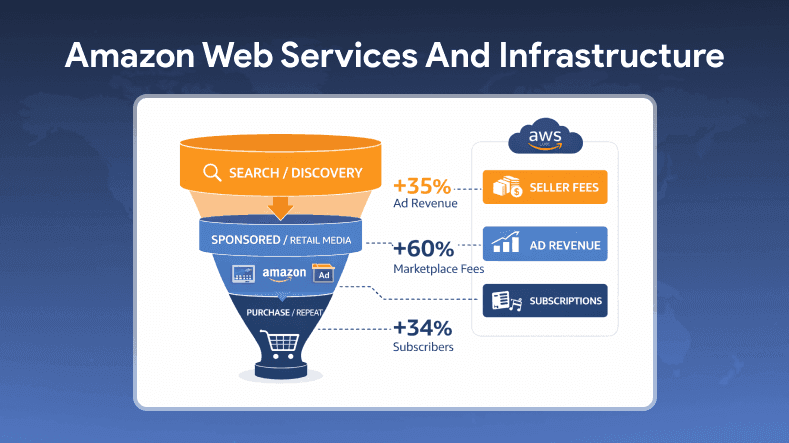
One of the major revenue streams for Amazon comes from the fees it charges third party sellers, but they're getting looked at really closely by the regulators. Amazons turnover includes sales through both its own channels & those of third parties - everything from consumer electronics to digital services like Amazon Prime Video is all part of this .
It's a pretty big deal that nearly 50% of all purchases made online in the U.S. are now taking place on Amazon. This really puts into perspective the scale of Amazons sales & the hold it has on consumers shopping habits and which products are most popular. all these developments are shaping the evolving retail landscape & we're seeing other e-commerce platforms spring up that are modelled on Amazon & social commerce too.
| Aspect | Details |
|---|---|
| Origin | Started as an online bookstore |
| Marketplace Model | ~60% of unit sales come from third-party sellers offering products, often at a fixed price |
| Revenue Sources | Seller fees, direct sales, and digital offerings (e.g., Prime Video) |
| Product Range | Extensive product selection enabled by marketplace partnerships; over 350 million items available |
| Regulatory Scrutiny | Ongoing scrutiny over seller fees and marketplace practices |
| Emerging Trends | Growth of social commerce and new competitive e-commerce platforms |
| Market Influence | Strong global e-commerce presence; nearly half of all U.S. online transactions occur on Amazon |
Amazon Advertising and Marketing

Amazons advertising revenue has become a real powerhouse for the company - a key part of its business model these days, and one that really reflects just how crucial ecommerce marketing has become in this digital age.
Over the last few years, Amazon has poured an awful lot of cash into building out an advertising platform that lets brands and all the other sellers get in front of millions of shoppers at exactly the moment they're about to make a purchase online. This focus on online advertising not only gives Amazon a big boost in terms of its own retail sales - but it's also proved a game-changer for sellers, letting them reach new customers and drive more online sales through targeted campaigns.
The company's advertising solutions are super integrated into the shopping experience on Amazon, so sellers can promote their products all over search results, product pages and even on the tv shows they offer through amazon prime video - which is pretty crazy. As a result, Amazons advertising revenue has just gone through the roof, making the company a major player in the online ad market in general. and we fully expect this growth to keep on going as more and more businesses start to see the value in advertising inside the worlds biggest online store.
Retail promotions are another major driver of online sales growth. Many brands rely on strategies such as BOGO promotions in ecommerce to attract customers and increase conversion rates during major shopping events.
But Amazon's ecommerce marketing mix is about more than just advertising - there are lots of other really powerful tools in the system, like Amazon Prime which keeps customers coming back through exclusive perks, and Amazon Marketing Services which is there to help sellers get their campaigns right and sell more.
These initiatives not only help Amazon keep its massive market share - but they also reinforce its position as the market leader in ecommerce. As the ecommerce landscape keeps evolving, you can bet Amazons ongoing commitment to innovation and its smart investments in advertising and marketing will be key to its ongoing success in retail ecommerce sales.
Technology and Innovation
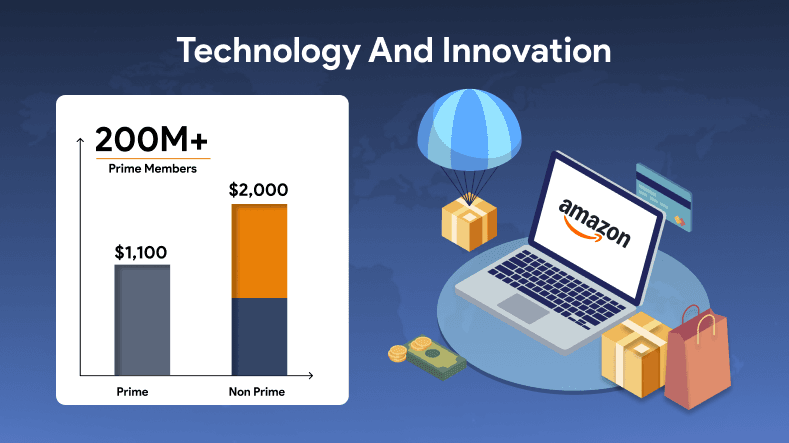
Amazon invests heavily in technology, particularly artificial intelligence and machine learning, to improve efficiency and customer experience. It optimizes inventory, personalizes recommendations, and streamlines logistics while expanding infrastructure and fulfillment centers to support growth.
Key growth areas include grocery delivery, healthcare products, and B2B sales through Amazon Business. In 2017, Amazon acquired Whole Foods Market in a $13.7 billion deal that significantly expanded its grocery and physical retail presence. This acquisition enhanced its grocery offerings and marked a major step as Amazon expanded into brick-and-mortar retail. Amazon also diversifies beyond e-commerce into cloud computing, smart devices, and physical stores.
The Amazon Marketplace allows small sellers to list products at fixed prices, expanding product variety. Amazon Web Services (AWS) provides a major revenue stream and technological foundation. Strategic innovation and long-term planning, driven by founder Jeff Bezos, position Amazon for continued leadership and adaptation to market trends.
Amazon Web Services and Infrastructure
Amazon pours a lot of money into technology - particularly artificial intelligence and machine learning - to make the whole operation run smoother and the customer experience even better. They're constantly tweaking the way they manage stock, coming up with personalized product recommendations and ironing out logistics, all while expanding their infrastructure and opening more and more fulfillment centers to keep up with the business.
Some of the key areas they're focusing on are getting grocery deliveries out to folks, selling healthcare products, and doing business-to-business sales through Amazon Business. Back in 2017, they went and bought Whole Foods Market for $13.7 billion - that seriously ramped up their grocery game and gave them a big presence in physical retail stores. This deal gave them the chance to seriously improve their grocery offerings which was a major step in getting into the physical retail game. And its not just e-commerce for Amazon. Theyre also making a play in the areas of cloud computing and smart home devices plus running physical stores.
The Amazon Marketplace lets small time sellers list their wares at fixed prices so you can get a wider range of products. Amazon Web Services (AWS) is now a huge source of revenue and also provides the foundation to build on for even more innovation. All these things combined and driven by the long-term vision of founder Jeff Bezos has put Amazon in a great position to stay on top and keep adapting to whats coming next in the market.
Customer Behavior and Trends
Understanding how people behave as customers is the key to Amazon's huge success and its position as the worlds leading e-commerce platform. With a massive 250 million plus Prime subscribers spread across the globe, it's no wonder they've got fast shipping, all sorts of products to choose from, and a shopping experience that's always super easy and seamless down to a science - all of which really locks in customers loyalty.
Their super-sized logistics network lets them get products delivered to customers in just a day, and made returns a doddle - all of which helps to keep people coming back for more and spending more cash in the process. A huge 70% of their customers use their mobile app to shop - and their marketplace business model means its always possible to find a range of products all in one place, at great prices.
Amazon uses all the latest AI tech to make customers recommendations that are right up their street - which means it really ups sales of the same products over and over again. Big sales events like Prime Day are a major pull, attracting millions of customers looking for a bargain. And by combining sales from both their own stores and third-party sellers, they can offer up a truly unbeatable choice of products at fixed prices.
On top of all that, their investment in Amazon Web Services really helps their whole platform to grow. By being super quick to respond to changes in how people shop, whether that's by getting into new areas like groceries or pharmacies, Amazon is all but guaranteed to keep its stranglehold on the market, and shape the whole e-commerce industry for years to come.
Summary
Amazon still holds the top spot in the global e-commerce landscape. At a whopping 37.6% of the market share in the U.S. alone as of 2024 - nearly 6 times that of Walmart's 6.4% - it's clear why they're such a huge force in the e-commerce game. Their focus on innovation, and getting the operations and customer experience right has been key to holding onto their leadership position.
Amazon's business moves , including their partnerships and how they run their operations, have certainly helped keep them at the top. However, this has also brought a lot of scrutiny from regulators. Despite the increasing competition and the regulatory challenges they're facing, Amazon's ability to bring together retail, cloud computing, and subscription services into a single, pretty impressive ecosystem , means they're looking pretty solid for continued growth and resilience in the e-commerce industry.
FAQs
Q1.
What is Amazon's e-commerce market share?
Q2.
Is Amazon the largest e-commerce company in the world?
Q3.
What is the biggest ecommerce market in the world?
Q4.
Who are the top three ecommerce retailers?
Q5.
What is Amazon's e-commerce market share?

WebbyCrown's Insight
No headings found in this content.